49 works in this view — arrow keys or swipe to move between them.
Dance in Art
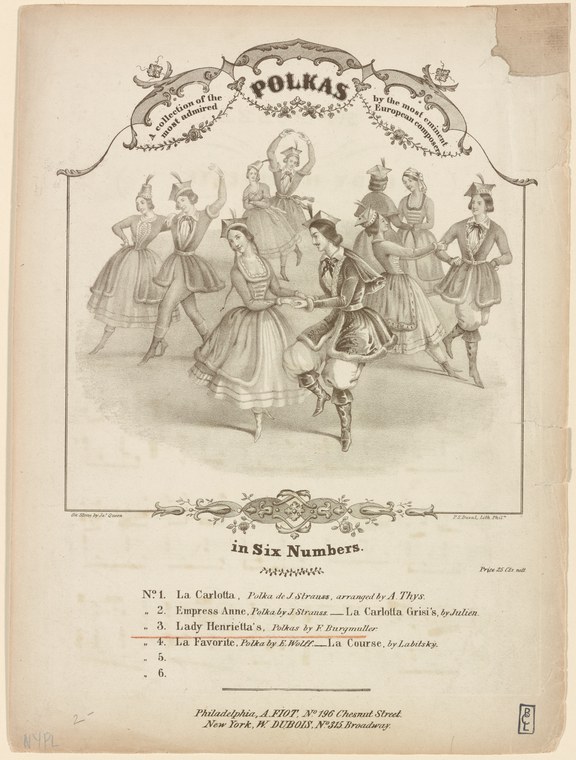
A collection of the most admired polkas by the most eminent European composers
Unknown artist
- Collection:
- Prints depicting dance
- Source:
- New York Public Library
- Rights:
- Public domain — free to use, share and adapt.
- Recorded as:
- Public Domain
The polka was a turning point in ballroom culture: a fast, fun, relatively egalitarian couple-dance that made formal ball dancing accessible to the middle classes and loosened the rigid etiquette of earlier dance forms like the quadrille. This image is one of thousands of commercial prints that circulated the polka's visual identity and helped make it a global phenomenon. For historians of dance, social history, and printmaking, it is evidence of how commercial engraving shaped public taste and how a dance form moves from exotic import to ballroom standard.
What you are looking at
This is a title page for a collection of polka music arranged for dance, printed in Philadelphia in the mid-19th century. The composition centers on a lively social dance scene with eight figures arranged in a semi-circle around a couple actively dancing. The dancers are dressed in the fashion of the 1840s–50s: the women wear full-skirted ball gowns with fitted bodices, some with small bonnets or feathered headdresses; the men are in tailcoats and trousers. The focal point is a dancing couple in the foreground center, the woman in a pale dress with her skirt caught mid-motion, the man in dark formal dress. Surrounding them are five other figures—three women and two men—who watch or await their turn, arranged as though at a ballroom gathering. The entire scene is framed by an ornate decorative border typical of mid-century commercial printing, with the title "POLKAS" in large script at the top. A smaller title below identifies this as "in Six Numbers," and a list at the bottom credits six specific polka compositions by European composers, arranged for publication by A. Fiot in New York.
The dancing
The active dancers occupy the center: the woman is caught mid-turn with her full skirt billowing, her partner in standard ballroom hold facing her. Both have an upright carriage typical of mid-Victorian formal dance. The spectating figures stand or wait in relaxed poses, most with arms at rest, facing inward toward the dancing pair. The artist has clearly understood ballroom positioning—closed hold, the partners' bodies angled toward each other, the woman's weight forward in rotation. The surrounding figures are differentiated by slight variations in posture and gaze, creating a sense of social gathering rather than a formal line.
The dance depicted
This illustrates the polka, the fashionable couple-dance that swept European and North American ballrooms in the 1840s–50s. The polka is a lively, bouncy dance in 2/4 time, performed in closed partner position, characterized by a hop-step pattern and rapid rotation. The image captures it at a moment of active turning—the woman's skirt in full swing—which is central to the dance's appeal and visual spectacle. The title page announces six published arrangements of polkas by "the most eminent European composers," indicating that the polka was being legitimized and collected as both a folk import and a composed salon piece. This was the height of the dance's popularity in urban ballrooms, and its appearance on a commercial music title page speaks to its status as essential social dancing.
How it was made
This is a wood engraving or steel engraving, a relief or intaglio print typical of mid-19th-century commercial publishing. The fine line work, the delicate modeling of fabric and figure, and the precision of the decorative border all indicate professional engraving rather than lithography. The technique allowed for high-quality reproduction suitable for sheet music covers and music-store display, suggesting this was a widely distributed commercial product, not a unique or precious object. The print was likely produced in Philadelphia by the publisher A. Fiot, whose imprint appears at the bottom alongside the New York and Broadway address.
About this work
This is a commercial music title page from mid-19th-century America, illustrating the polka at the height of its fashionable craze. The engraving depicts a ballroom scene recognizable as the social context in which polkas were danced: a couple in active rotation surrounded by smartly dressed spectators awaiting their turn. It serves simultaneously as sheet music cover, advertisement, and visual record of how the polka looked and was valued in transatlantic ballroom culture. The image is neither fine art nor documentary—it is a commercial product designed to sell music—but that status makes it historically valuable precisely because it shows what the polka meant to ordinary middle-class dancers and music consumers.
For dancers and historians, this title page documents a crucial moment in the democratization of dance. The polka was a dance that crossed class and national boundaries, and its appearance in engraved commercial form signals its acceptance into respectable urban leisure. The composition—the moment of turning, the attentive circle of onlookers—captures both the physical exuberance of the dance and the social ritual in which it was embedded.
How to look at it
Look first at the dancing couple: the woman's skirt is the visual focal point, rendered in fine parallel lines that suggest motion and lightness, while the man's rigid posture and dark coat anchor the pair. This contrast—the woman as movement, the man as frame—is typical of how dance imagery of this period aestheticizes the female body in motion. Notice the ornate border and formal typography at top: these reinforce the respectability of the dance, positioning the polka as a legitimate composition, not a vulgar novelty. Finally, observe the waiting figures: their patient, attentive poses confirm that the polka is a couple-dance with spectators, not a solo or group form.
The period
The polka arrived in western Europe from Bohemia around 1835 and reached North America by the early 1840s. By the mid-1840s it was the dominant fashionable couple-dance in ballrooms from London to New York, rivaling and eventually displacing the quadrille. Its speed, its rotation, and its relative informality (it required less preparation and drilling than a cotillion) made it an ideal subject for commercial music publishing and reproduction. Sheet music with engraved title pages showing couples dancing became a standard format for selling popular dances. This particular collection—six polkas by named European composers—reflects the period's appetite for composed dance music and the legitimization of folk and popular forms through commercial publication and European compositional authority.
Where it lives
This is a printed title page from a music collection, part of the New York Public Library's holdings of prints depicting dance. It was produced in Philadelphia (printed by A. Fiot) with New York distribution, typical of mid-19th-century music publishing in the Northeast.
Dance in this work
Questions about this work
What is a polka and why was it so popular?
The polka is a fast, bouncy couple-dance in 2/4 time that emerged from Bohemia and exploded in popularity across Europe and America in the 1840s–50s. It was faster, more fun, and less formal than the quadrille or cotillion, making ballroom dancing more accessible to the middle classes. Its rapid spinning and skirt-flaring motion made it visually exciting—a major draw for both dancers and observers.
Who danced the polka?
The polka was danced in ballrooms by middle-class and upper-middle-class people—the urban professionals, merchants, and genteel families who attended public and private balls. Unlike folk dances or court dances, the polka did not require elaborate training or aristocratic birth, which partly explains its rapid global spread.
Why are there so many people standing around?
Ballroom etiquette of the era required couples to take turns dancing while others watched and waited. The standing figures represent both courtesy (observing and appreciating others' dancing) and practicality (a long evening with limited dancing partners meant a lot of waiting).
What does the engraving tell us about how polkas were published?
Polka music was sold as sheet music with attractive engraved title pages showing the dance in action. This marketing strategy—pairing the music with a visual image of the dance—helped spread the polka globally and made it aspirational for people who might not have access to ballroom instruction.
More dance artwork





