49 works in this view — arrow keys or swipe to move between them.
Dance in Art
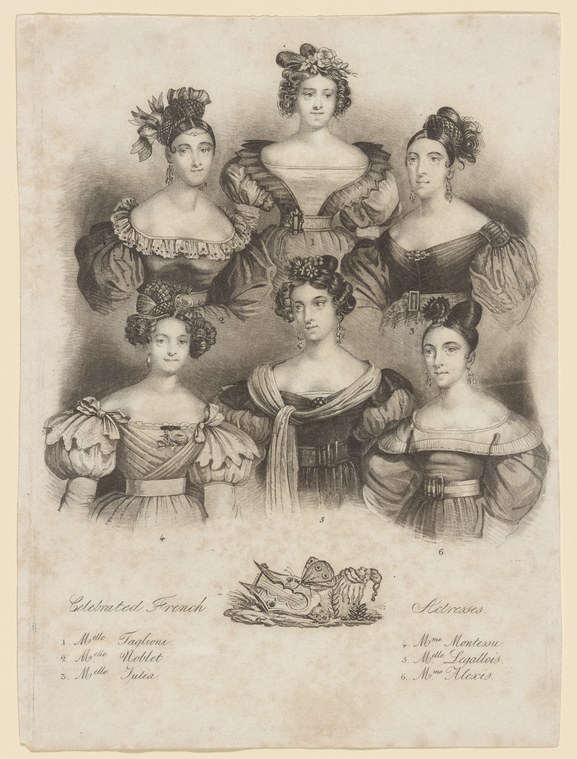
Celebrated French Actresses
Unknown artist
- Collection:
- Prints depicting dance
- Source:
- New York Public Library
- Rights:
- Public domain — free to use, share and adapt.
- Recorded as:
- Public Domain
Several of these named performers became foundational figures in Romantic ballet—notably Taglioni, who premiered La Sylphide in 1832. This print captures them before or at the threshold of their greatest fame, as theatrical celebrities in a broader sense, and reveals how theatrical and dance celebrity were marketed and consumed in early 19th-century Paris. For historians of dance and theater, the work documents the social and sartorial context in which professional ballet took shape.
What you are looking at
This is a lithographed or engraved portrait arrangement of six young women identified as celebrated French actresses of the early 19th century. They are arranged in two rows—three standing in the back, three seated or positioned lower in front—against a plain background. All wear high-waisted Empire silhouette dresses typical of the Regency and early Romantic period, with puffed sleeves, low necklines, and elaborate trimmings. Each woman wears her hair up in fashionable curls adorned with feathers, ribbons, or jeweled ornaments. Their dress and bearing suggest theatrical performers of the stage rather than ballet dancers: the costumes are those of dramatic actresses in contemporary or classical roles, not the specialized dress of professional dancers. A decorative cartouche at the bottom contains the names: Mlle. Taglioni, Mlle. Noblet, Mlle. Julia on the left; Mme. Montessu, Mlle. Dupléssis, Mme. Alexis on the right. The print technique—fine stippled shading and precise linear engraving—suggests a commercial theatrical print, possibly a souvenir or promotional image for theatergoers.
The dancing
The six figures are posed formally, frontally, and statically rather than in active movement or dance positions. They stand or sit with upright, composed carriage; arms are relaxed at the sides or held naturally across the body. There is no suggestion of elevation, turnout, or the body tension associated with trained dance technique. The arrangement is a portrait gallery of individuals rather than an ensemble in relationship—no couples in hold, no formation, no interaction between the figures. Their positioning emphasizes display of dress and face rather than bodily articulation.
The dance depicted
The identification of these figures as actresses rather than dancers is significant. The names suggest French performers of the 1820s–1830s, an era when Parisian actresses and singers commanded considerable celebrity. Several of the names listed (notably Taglioni) became famous in ballet during this period, but the print itself does not depict dance—it presents theatrical celebrities in their stage costumes and street dress. While the Romantic era saw the rise of professional ballet in Paris, this image documents the broader theatrical world of actresses and performers, some of whom may have performed danced roles but are here presented as dramatic or comedic actresses rather than as dancers in a technical sense.
How it was made
This is a hand-colored lithograph or steel engraving, executed with fine linear detail and stippled shading to model the faces and fabrics. The precision and delicate line work suggest professional commercial engraving intended for wide distribution—likely as a theatrical souvenir or print for sale to theatergoers and collectors. The technique allowed detailed rendering of costume and physiognomy while maintaining the flatness and legibility necessary for multiple impressions. The hand-coloring (visible in the dresses and ornaments) was applied after printing, a common practice for theatrical portraits of the period.
About this work
This is a celebrity portrait of six French theatrical actresses from the early Romantic period, presented in formal arranged format typical of theatrical promotional prints. The work documents the dress, styling, and celebrity culture of the Parisian stage in the 1820s–30s, when professional actresses commanded significant public attention. Though some of the named figures (such as Taglioni) later became renowned in ballet, this print presents them as stage actresses in costume, reflecting the broader theatrical culture of which dance was a part but from which it was not always clearly distinguished.
The print belongs in a dance history collection because it captures a moment when professional dance and theatrical performance occupied overlapping social and commercial space in Paris. The named performers include figures central to early Romantic ballet, and the image records how these performers dressed and were marketed to the public. It documents the theatrical world in which professional ballet emerged as a distinct practice during the 1820s–30s.
How to look at it
Observe the dress and styling: the high-waisted Empire silhouette, puffed sleeves, and elaborate hair ornaments place this firmly in the 1820s–30s. Note the formal, frontal pose and the absence of any suggestion of movement or dance technique—these are portrait poses, not action studies. Read the names in the cartouche and consider which of these performers went on to fame in ballet versus dramatic theater. The print is a record of celebrity and theatrical fashion rather than a depiction of dance itself; its value lies in what it tells us about how performers were marketed and what they wore in the theater during the early Romantic period.
The period
This print dates to the 1820s–1830s, the threshold of the Romantic ballet era in Paris. The Empire waistline and Regency silhouettes visible in the dress mark the print as early 19th-century. The Parisian theatrical world of this period was dominated by the Opéra and the boulevard theaters; actresses and singers commanded celebrity status comparable to or exceeding that of dancers. The 1820s saw the professionalization of ballet as a distinct theatrical genre, with the rise of the Romantic aesthetic (ethereal, melancholic, supernatural themes) and the emergence of the ballerina as a primary theatrical attraction. This print captures the theatrical culture in which those changes took place, showing how actresses were presented to the public in the years immediately preceding or contemporary with the triumph of Romantic ballet.
Where it lives
The work is held in the New York Public Library's collection of prints depicting dance. It is a commercial theatrical print, likely sold to theatergoers as a souvenir or collected as a theatrical celebrity portrait. The hand-coloring and fine engraving suggest it was a relatively high-quality and probably moderately priced print for the period.
Questions about this work
Are these dancers?
The print identifies them as actresses (the French titles Mlle. and Mme. designate unmarried and married women). However, during the early 19th century, the boundaries between dramatic actresses, singers, and dancers overlapped considerably in the Parisian theater world. Some of these performers may have performed danced roles, but this print presents them as theatrical celebrities in costume rather than as dancers in a technical sense.
Who was Taglioni?
Marie Taglioni (1804–1884) became the most celebrated ballerina of the Romantic era, best known for her role as the Sylph in La Sylphide (1832). This print likely dates to around the time of that triumph or slightly before, capturing her when she was known as a theatrical performer but before she became the supreme icon of Romantic ballet.
What era is this?
The dress, hairstyling, and typography place this in the 1820s–1830s, the threshold of the Romantic era in European culture. This was a moment of transition in ballet: the Regency aesthetic was giving way to Romantic themes of the supernatural and melancholic, and professional ballet was consolidating as a distinct theatrical form.
Why is this in a dance collection if they are not dancing?
This print documents the theatrical and social context in which professional ballet emerged in Paris. It shows how theatrical performers were marketed to the public, what they wore, and how they were styled—essential context for understanding the rise of Romantic ballet. Several of the named performers became central to ballet history.
More dance artwork





