49 works in this view — arrow keys or swipe to move between them.
Dance in Art
La dansomanie
Unknown artist
- Collection:
- Prints depicting dance
- Source:
- New York Public Library
- Rights:
- Public domain — free to use, share and adapt.
- Recorded as:
- Public Domain
The image documents not just a dance technique but a historical moment when ballroom dancing became a mass social practice and cultural preoccupation across Europe. For historians of dance, it provides rare visual evidence of how the Romantic-era waltz was actually executed—the body positions, the role of the partner, the context of display within formal society—and for social historians, it captures the gendered performance of refinement and the anxieties surrounding women's movement in public space.
What you are looking at
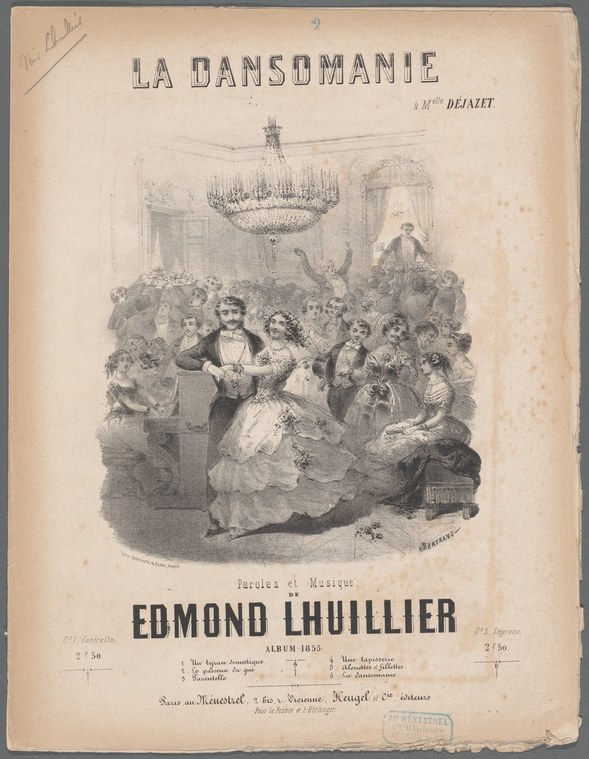
A grand ballroom scene crowded with fashionably dressed figures in what appears to be mid-19th-century formal attire. The composition centers on a woman in a white ball gown executing a dramatic turn or spin, her skirt billowing outward in a wide arc. She is partnered with a man in dark evening dress. Around them, dozens of onlookers in black tailcoats and formal gowns fill the space, creating a dense social scene lit by an enormous crystal chandelier suspended from the ceiling. The engraver has captured the moment of maximum extension in the woman's movement, with her body leaning back and her arms positioned to balance the rotational motion. The setting is clearly an elite ballroom with classical architectural details—paneled walls and formal drapery visible in the background.
The dancing
The central couple are in a closed ballroom hold typical of 19th-century social dance, with the man's right hand at the woman's waist and their outside hands clasped. The woman's body is deeply curved backward in a dramatic turn, her left leg extended, creating a pronounced contra-body movement. Her free arm is raised for balance. The surrounding figures are static or in conversation, their upright postures and formal dress marking them as spectators rather than active participants. The engraver emphasizes the virtuosity of the central woman's movement through the contrast between her dynamic extension and the stillness of the crowd.
The dance depicted
This depicts a fashionable social waltz or similar turning dance of the Romantic era, likely from the 1830s-1850s. The title 'La dansomanie' (dance mania) suggests both the social obsession with ballroom dancing during this period and perhaps a particular composition or musical work associated with the craze. The image captures the moment of maximum spin in what appears to be a waltz or galop—the kind of turning dance that generated both enthusiasm and moral anxiety among contemporaries. The dramatic backward lean and extended leg position are characteristic of the ballroom style of this era, where technical display and partner connection were essential.
How it was made
This is a steel engraving, a technique that allowed for fine detail and wide circulation as prints. The medium's capacity for precise line-work is evident in the rendering of fabric texture, the chandelier's geometry, and the definition of individual figures within the crowded composition. Steel-faced copper plates enabled thousands of impressions, making such images affordable and accessible to a middle-class audience interested in fashion and social dance. The technique suggests this was a popular print, likely published as sheet music cover art or as a standalone social commentary on the ballroom dancing phenomenon.
About this work
This is a social document and artistic record of the European ballroom dancing craze of the early-to-mid 19th century. The print captures both the technical virtuosity demanded of dancers and the social spectacle of formal ballroom culture—a world in which dancing skill was a marker of refinement and participation in fashionable society was itself a form of performance. The 'dansomanie' referenced in the title points to the era's intense enthusiasm for ballroom dancing, which occupied a prominent place in social life and generated considerable cultural commentary.
How to look at it
Attend to the precise moment the engraver chose: the woman at the apex of her turn, her body fully extended and leaning back, captured mid-rotation. This is not the beginning or end of the movement but the moment of maximum display—when the dancer's technical control is most evident and most beautiful. Notice how the crowd's stillness frames the central couple's motion, and how the woman's dramatic backward lean, which would have appeared both elegant and slightly transgressive to contemporary viewers, is presented as the natural outcome of virtuosic turning. The chandelier's geometric precision contrasts with the organic curves of the moving body.
The artist
The print is attributed to 'Mme Delayet' and credits text indicates paroles (lyrics) and music by Edmond Lhuillier, with an album date of 1835. This was likely a popular musical publication accompanying a quadrille, waltz, or other fashionable dance tune of the period. The print may have served as cover art or illustration for the musical score, combining the commercial interests of music publishers with the visual appeal of fashionable ballroom imagery.
The period
The 1830s-1840s were the height of the Romantic era's obsession with ballroom dancing. The waltz, which had shocked conservative society a generation earlier, was now established as the centerpiece of elite social life. Dance manuals proliferated, dance masters were celebrities, and ballroom scenes became a standard subject in both fine and commercial art. This image belongs to the broader cultural moment when dancing was both a site of genuine social anxiety (particularly about women's freedom of movement and male-female physical contact) and an object of intense enthusiasm and commercial exploitation.
Where it lives
This print is held in the New York Public Library's collection of prints depicting dance. It appears to be a commercial music-related engraving, likely published as part of a musical score or dance album from the 1830s.
Dance in this work
Questions about this work
Is this a waltz?
The composition and the dramatic turning motion suggest a waltz or similar turning dance of the Romantic era (waltz, galop, or polka). The deep backward lean and the partner hold are consistent with Romantic-era waltz technique, though without music or a fuller score it is not possible to be completely certain of the specific dance type.
What does 'dansomanie' mean?
'Dansomanie' combines the French words for dance (danse) and mania, reflecting the 19th-century phenomenon of intense, sometimes anxiety-producing enthusiasm for ballroom dancing. It is both a playful nod to the social fashion and a commentary on the seeming obsession with dancing that gripped European society during this period.
Was it normal for women to dance this dramatically?
By the 1830s, yes—at least among the fashionable elite. The Romantic waltz celebrated technical virtuosity and dramatic movement, and skilled women dancers were admired for their ability to execute turns, spins, and extensions. However, the woman's deep backward lean would have been considered bold and transgressive by some conservative observers, as it emphasized the body's extension and required significant physical contact with her male partner.
Who was Edmond Lhuillier?
Lhuillier was a composer and musician of the 1830s-1840s associated with popular dance music and quadrilles. The credit lines suggest he wrote both the music and lyrics for this composition, which was likely marketed as a fashionable dance tune for ballrooms and amateur musicians.
More dance artwork





