49 works in this view — arrow keys or swipe to move between them.
Dance in Art
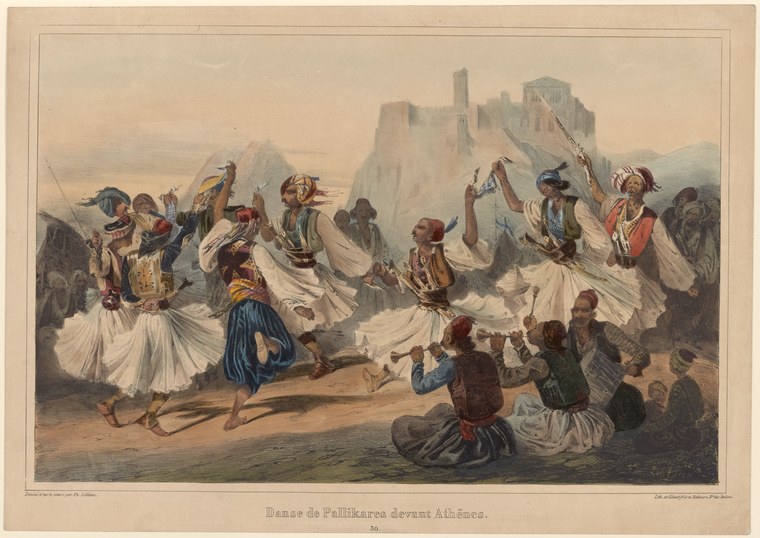
Danse de Pallikares devant Athènes.: Dessine d'après nature par Th. Leblanc
Unknown artist
- Collection:
- Prints depicting dance
- Source:
- New York Public Library
- Rights:
- Public domain — free to use, share and adapt.
- Recorded as:
- Public Domain
This is one of the few surviving visual documents of how Greek Pallikares dances were understood and performed in the 19th century, before modern standardization and stage adaptation. It shows a moment when European artists and their audiences were beginning to record and aestheticize the dances of newly independent or increasingly visible peoples, and Greek dance in particular became entangled with nationalism and romantic nostalgia. For historians of Greek dance and of ethnographic representation, this print reveals both authentic detail and the idealizing lens through which non-Western dance was often seen.
What you are looking at
A group of Greek dancers—Pallikares, or Greek warriors—perform in spirited formation before the Acropolis in Athens. The scene is set in an open landscape with the classical citadel rising dramatically in the background, its columns and fortifications rendered in pale stone against a hazy sky. In the foreground, standing and kneeling figures watch the performance. The dancers themselves occupy the center and right of the composition, arranged in loose formation rather than strict line. They wear white skirts or fustanellas (the pleated garment of Greek folk dress), red or patterned vests or tunics, and head coverings or caps; several hold arms aloft in energetic gesture. The movement is vigorous and upright, with bodies in various attitudes of animation—some with arms raised, others in mid-step. The artist has captured a moment of evident exuberance, the dancers' bodies leaning and turning within the landscape. The hand-colored print technique allows warm ochres and flesh tones to animate the scene, while the white garments stand out brilliantly against the darker earth and sky.
The dancing
The dancers stand mostly upright with extended arm positions, many raising both arms overhead or to the sides in celebratory gesture. Several figures show the kind of vertical spine and lifted carriage typical of Greek folk dance. The group moves without apparent close physical contact or formal ballroom hold; instead, they occupy individual or loosely grouped space, some moving forward, others turning. The weight appears to shift from foot to foot in a walking or processional rhythm rather than a closed partnered pattern. At least eight to ten dancers are visible in active movement, with several more seated or standing at rest in the foreground, suggesting this is a performance or gathering rather than social couple-dancing.
The dance depicted
This depicts Greek folk dance, specifically the Pallikariko or a related warrior dance tradition of Greece. The Pallikares were celebrated guerrilla fighters of the Greek War of Independence (1821–1829), and their martial dances became iconic symbols of Greek national identity in the 19th century. The image shows the kind of spirited, upright movement and raised-arm gestures associated with these warrior dances—performed not in couples but as group or individual display. The fustanella, the white pleated skirt, is the distinctive dress of Greek Pallikares and remains central to Greek folk costume. The setting before the Acropolis is symbolically significant, anchoring the dance to Greek national patrimony and suggesting this image was made as part of 19th-century European fascination with Greek independence and romantic nationalism.
How it was made
This is a hand-colored engraving or lithographic print, established from the fine linear work, the delicate modeling of tone, and the evidence of hand application of color wash in the clothing and landscape. The technique of hand-coloring over a printed base allowed for the warm ochres, flesh tones, and bright whites of the skirts while maintaining fine detail in faces and costumes. The process was labor-intensive and relatively expensive, indicating this was made for a cultivated audience—likely Europeans interested in exotic or newly liberated Mediterranean cultures. The notation 'Dessine d'après nature par Th. Leblanc' (drawn from nature by Th. Leblanc) suggests the composition was based on direct observation or a preparatory sketch, a claim that legitimated the work as documentary rather than pure imagination.
About this work
This hand-colored print documents a scene of Greek Pallikariko or related warrior dance performed before the Acropolis, attributed to observation by the artist Th. Leblanc. It belongs to a substantial 19th-century tradition of European prints and paintings depicting the dances and folkways of newly liberated or newly visible Mediterranean and Near Eastern peoples, made for audiences hungry for images of exotic and romantic nationalism. The work sits at the intersection of ethnographic documentation, Romantic-era orientalism, and nationalist commemoration—the Pallikares being particularly celebrated in post-Independence Greece as symbols of heroic resistance.
For dancers and historians, the image offers a rare visual record of 19th-century Greek folk practice, showing costume, formation, arm and body carriage, and social context. The setting before the Acropolis, while possibly idealized or retrospective, stakes the dance's claim on national identity and historical significance, a claim that would shape how Greek dance was performed and understood throughout the century that followed.
How to look at it
Attend first to the formation and spacing: the dancers do not move in closed couples or lines, but in a more dispersed, individualized arrangement, each body animated but not synchronized. Notice the arm positions—raised, extended, celebratory rather than formally placed—and the upright carriage of the torso, which conveys the energy and pride of warrior dance rather than the flowing passivity sometimes associated with Orientalist representations of 'Eastern' dance. The setting is crucial: the Acropolis in the background is not merely backdrop but statement, anchoring these dancers to a specific national heritage and sacred landscape. Finally, observe the moment the artist chose: not a still pose but a moment of movement, with bodies at different points in their gesture, suggesting the liveliness and spontaneity that made these dances markers of living national culture rather than museum pieces.
The artist
Th. Leblanc is identified in the inscription as the artist who drew this scene 'from nature' (d'après nature), a claim to observational authenticity. Beyond this attribution, little is known of Leblanc's biography or broader practice from the catalogue record. The phrase suggests he may have traveled to Greece or worked from sketches made there, or may have been working from reports and descriptions circulating in European artistic and literary circles. Artists of this period who depicted Greek and Near Eastern scenes often worked without direct travel, assembling images from secondhand sources, literary description, and pictorial convention, so the claim to nature drawing should be read with appropriate caution.
The period
This print was made in the aftermath of Greek independence (1829) and during the height of European Philhellenism and Romantic enthusiasm for Greek culture and landscape. In the 1830s–1850s, European artists and publishers produced a flood of images—prints, paintings, lithographs—depicting Greek life, costume, and custom, feeding appetite among bourgeois collectors for picturesque scenes from the Mediterranean. Simultaneously, modern Greek dance was undergoing transformation as it became a subject of nationalist pride and European aesthetic interest; traditional warrior dances and folk forms were being rediscovered, documented, and sometimes staged for European audiences. The hand-colored print was a primary medium for this visual ethnography, circulating widely in albums, periodicals, and collections. In Greek artistic and cultural life, the Pallikares had become iconic—their dances and costumes signifying heroic resistance and newly recovered national identity—making them a natural subject for artists catering to European fascination with the 'Orient' and its liberation.
Where it lives
The work is held in the New York Public Library's collection of prints depicting dance, part of its broader holdings of 19th-century European prints and engravings. It appears to be a standalone sheet or part of a larger album of prints on Greek or Mediterranean subjects, a common format for circulating such imagery among educated audiences.
Dance in this work
Questions about this work
What were the Pallikares and why did their dances matter?
The Pallikares were Greek guerrilla fighters celebrated in the War of Independence (1821–1829) against Ottoman rule. Their dances became iconic symbols of Greek national identity and martial virtue in the 19th century. European artists and audiences were fascinated by them as embodiments of heroic resistance and romantic nationalism, making them frequent subjects in prints and paintings of the period.
Is this image accurate documentation or romantic fantasy?
Likely both. The inscription claims the drawing was made 'from nature,' suggesting the artist may have observed actual performances or had access to eyewitness accounts. However, 19th-century European depictions of non-Western dance often mixed observational detail with idealization, flattering angle, and symbolic emphasis. The choice to place the dancers before the Acropolis is almost certainly an artistic choice, not a documentary statement of where they danced.
What is the fustanella?
The fustanella is a pleated skirt, traditionally worn by Greek men, particularly Pallikares and other highland warriors. The white version shown here became emblematic of Greek national dress and is still worn in formal and ceremonial contexts. It signals both warrior masculinity and specifically Greek identity.
What technique was used to make this print?
This is a hand-colored engraving or lithograph—a printed base image colored by hand with watercolor or gouache. This technique was labor-intensive and relatively expensive, making such prints luxury items for educated European collectors. It allowed fine detail in the printed line while allowing warm, naturalistic color in the figures and landscape.
More dance artwork





