49 works in this view — arrow keys or swipe to move between them.
Dance in Art
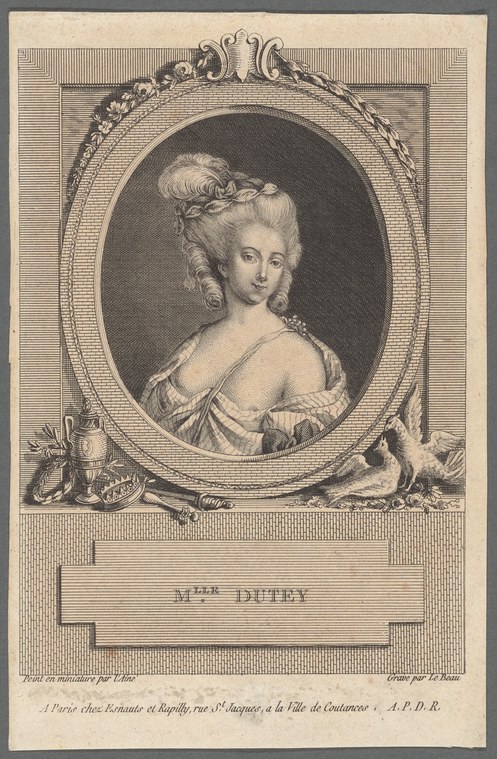
Mlle. Dutey
Unknown artist
- Collection:
- Prints depicting dance
- Source:
- New York Public Library
- Rights:
- Public domain — free to use, share and adapt.
- Recorded as:
- Public Domain
Portraits of individual dancers from this period are rare and valuable evidence of who danced professionally, how they were dressed and presented to the public, and what status they held in society. Dutey's name is not widely documented in surviving theatrical records, making this engraved portrait one of the primary records of her existence and career.
What you are looking at
A half-length portrait of a woman in an oval frame, rendered as an engraving in fine parallel lines characteristic of 18th-century reproductive prints. The sitter is shown from the shoulders up, turned three-quarters to the right, with her head tilted slightly back and her gaze directed outward. Her hair is dressed high and ornately, gathered up with what appears to be a decorative ribbon or ornament. She wears a low-cut corseted gown with off-shoulder sleeves gathered at the upper arm, the fabric falling away to expose her shoulders and upper chest in the manner of fashionable court dress. The background is a dark, featureless field that throws the figure into relief. The oval frame is surrounded by an elaborate rococo border of scrollwork and ribbons, and at the base sits a cartouche bearing the name "Mlle. DUTEY" in capitals. Below the frame, small text in French reads "à Paris chez Bormante et Dalphin, rue S[t]. Jaq[ues], à la Ville de Coulommiers, à P.D.R.", indicating this is a commercial print from Paris.
The dancing
The figure is a single woman, stationary in a posed portrait attitude rather than in the act of dancing. Her body is relaxed and frontal, with no weight shift or balletic frame. Her arms are not visible, being cut off by the oval frame. The pose is one of fashionable self-presentation rather than movement—the slight tilt of the head and the turn of the shoulders are conventions of portraiture. There is no indication of dance technique or training in the body's carriage.
The dance depicted
This is not a depiction of dance in progress, but a portrait of a woman identified as 'Mlle. Dutey'. The inscription and the commercial print format suggest this was a celebrated performer of the period—the name may refer to a dancer or actress of late 18th-century Paris. Without additional documentation, the specific nature of her performances cannot be determined from the image alone. The fashionable court dress and the quality of the engraving suggest she was a figure of some prominence, but the portrait itself shows her in formal dress rather than in costume or performance.
How it was made
This is a copper-plate engraving, identifiable by the fine parallel hatching lines that create tone and shadow, the crisp outlines, and the formal compositional structure typical of reproductive prints. The engraving technique allowed for precise detail and easy reproduction, making it ideal for commercial distribution to a literate and affluent audience. The rococo ornamental frame and the commercial publication information ('chez Bormante et Dalphin') indicate this was a professional print shop production, likely one of a series of celebrity portraits circulated in late 18th-century Paris. Such prints were collectible items and served as a form of celebrity image-making.
About this work
This is a commercial portrait engraving of a woman identified as Mlle. Dutey, executed in the refined reproductive print tradition of late 18th-century Paris. The work belongs in a dance collection not because it depicts dance itself, but because Dutey was evidently a dancer or performer of sufficient prominence to warrant a published portrait. The fashionable dress, elegant presentation, and formal print medium indicate that she occupied a visible place in Parisian cultural life. Such portraits are valuable documents of how performers were marketed and how dance professionals presented themselves to the public during the ancien régime and revolutionary period.
How to look at it
Attend to the dress and presentation: the fashionable cut and exposure of the shoulders, the elaborate hairstyling, and the refined engraving technique all signal that this was a woman of some social standing and visibility. The three-quarter pose and the upward gaze are conventions of flattering portraiture designed to convey elegance and dignity. The ornate frame elevates the image beyond a simple portrait, marking it as a commodity—a collected item with cultural prestige. The tiny publication information at the base is easy to overlook but crucial: it tells us this was a commercial product, not a private portrait, and that her image was valuable enough to market and sell.
The artist
The engraver is not recorded in the catalogue. The print is signed in small script at the lower left (partially legible in the image). The publication information indicates it was issued by the Paris print shop Bormante et Dalphin, which was active in the late 18th century and specialized in reproductive portrait engravings of notable figures—actors, dancers, musicians, and aristocrats. Such shops maintained teams of skilled engravers who worked from drawings or paintings to produce commercial prints for sale.
The period
This engraving dates to the late 18th century, a period of considerable expansion in dance as a professional and public art form. Paris was the capital of European dance culture, and the theatrical world was highly visible and widely documented through prints, librettos, and periodical literature. Women dancers had achieved new prominence and celebrity status, and commercial portrait prints served to market performers to audiences and to the aristocratic patrons who supported the theaters. The rococo style of the frame and the fashionable dress visible in the portrait place this work in the 1770s–1790s, a moment when the aesthetics of Enlightenment portraiture were giving way to neoclassical formality.
Where it lives
This engraving is held in the New York Public Library's collection of prints depicting dance. It is a commercial reproductive print, one of many similar celebrity portraits produced and distributed by Parisian print shops in the late 18th century. Such prints were sold individually or assembled into portrait albums and collected by theaters, salons, and private enthusiasts.
Questions about this work
Was Mlle. Dutey a famous dancer?
She was prominent enough to merit a published commercial portrait, which suggests a successful career on the Paris stage. However, detailed information about her performances and roles is scarce in surviving records. This print may be one of the primary documents of her existence.
What can we learn about dance from a portrait that shows no dancing?
Celebrity portraits reveal how dancers were dressed, presented, and marketed to the public; what status they held in society; and what aesthetic ideals surrounded the profession. They are also crucial documents for identifying performers whose names might otherwise be lost.
Why is the frame so elaborate?
The ornate rococo border was a marker of quality and prestige, signaling that this was not a cheap broadsheet but a refined print intended for collection and display. It elevated the subject and made the print more desirable as a luxury item.
What do the French words at the bottom mean?
They identify the print shop in Paris where it was published and sold: 'At Paris, at Bormante and Dalphin's, rue Saint-Jacques, at the sign of the City of Coulommiers.' This was the publisher's mark, allowing customers to know where to buy more prints.
More dance artwork





