49 works in this view — arrow keys or swipe to move between them.
Dance in Art
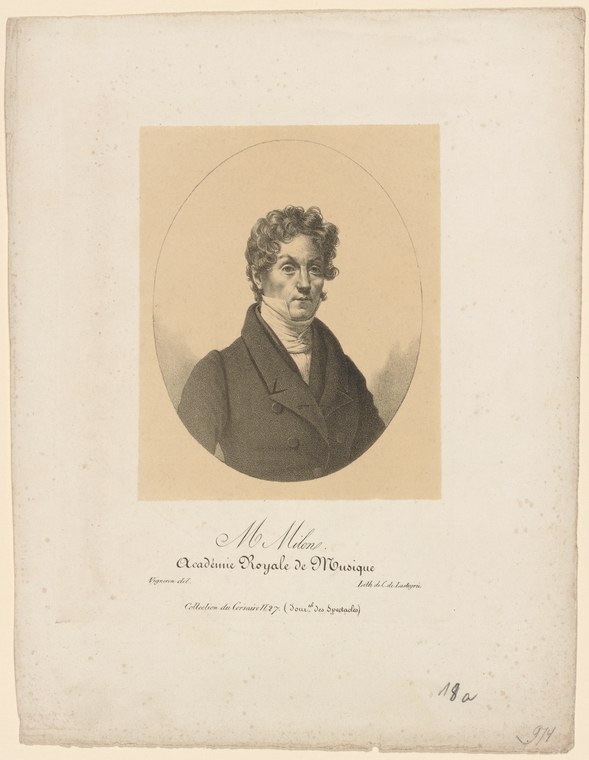
M. Milon. Académie Royale de Musique
Unknown artist
- Collection:
- Prints depicting dance
- Source:
- New York Public Library
- Rights:
- Public domain — free to use, share and adapt.
- Recorded as:
- Public Domain
Milon was responsible for commissioning, creating, and staging some of the most significant Romantic ballets performed at the Paris Opera, including works that defined the era's aesthetic. Understanding the institutional side of dance history—who decided what got made and how—is as important as understanding the choreography itself, and this portrait marks that institutional memory. For historians, this image is evidence of how dance figures were commemorated and valued by their own institutions.
What you are looking at
A portrait bust of a man in early 19th-century dress, rendered in a classical oval frame. The sitter wears a dark coat with a white collar, his hair arranged in the Romantic style of the period—curled and swept back from his forehead. The engraving is executed with fine linear work that creates volume through careful cross-hatching, giving the face three-dimensionality against the plain background. The inscriptions below identify him as "M. Milon" and state his role as "Académie Royale de Musique" (Royal Academy of Music), with an additional note indicating the collection date of 1847 and his role as "Secrétaire" (Secretary). This is a commemorative print, one of a series documenting notable figures associated with French dance and music institutions.
The dancing
A single head-and-shoulders portrait; the subject faces forward with a thoughtful, neutral expression. The pose is formal and stationary—this is not a dancer in motion but a dignified institutional figure. The sitter's gaze is direct and contemplative. There is no bodily gesture, no indication of choreographic knowledge through posture or arm position.
The dance depicted
This is not a depiction of dance itself, but a portrait of Jean-Louis Milon (1795–1871), a major choreographer and administrator of the Paris Opera Ballet during the Romantic era. Milon was a creator of full-length ballets and a shaping force in how ballet was organized and taught in France. The inscription confirms his role in the institutional structure of French dance rather than capturing him in performance. The image documents the person, not the art form.
How it was made
This is an engraving, executed with fine linear hatching to model form. The technique is reproductive rather than original—designed to be printed and circulated in sets documenting institutional figures. The oval format and the careful finish indicate a formal, official purpose: likely part of a published series of notables associated with the Académie Royale de Musique. The print's clarity and careful execution suggest a skilled engraver working from a drawing or painting, distributed to patrons and members of the institution.
About this work
This is a commemorative engraving of Jean-Louis Milon, a central figure in 19th-century French ballet as both choreographer and institutional leader. It documents him not as a performer but as an administrator—recording his role in shaping the structure and repertoire of ballet in France during the Romantic period. The work belongs in a gallery of dance not because it depicts choreography, but because it records a figure whose decisions about what ballets were created, how dancers were trained, and how institutions were run fundamentally shaped the dance of his era.
The print is one of a series documenting notable figures associated with French dance and music institutions, likely issued in 1847 or shortly after. It serves as both historical document and institutional commemoration—a marker of Milon's status and influence at a moment when dance administration was becoming a recognized, recorded role.
How to look at it
This is not a dynamic image; there is no frozen moment of movement to analyze. Instead, attend to what the conventions of the portrait tell you: the subject's calm authority, the quality of finish, the formal dress indicating social status, and the institutional inscriptions that define him by his role rather than his body. The oval format and refined technique mark this as an official record—a commemorative object meant to confer recognition and preserve institutional memory. The portrait's stillness is itself the point: it documents a figure of lasting importance.
The artist
The engraver is not recorded in the catalogue. The print is part of a larger institutional documentation project, likely produced by the Académie Royale de Musique or a publishing house working on its behalf. The style and execution suggest a professional reproductive engraver of mid-19th-century France, working within conventions of formal portraiture and institutional record-keeping.
The period
This engraving dates to 1847, well into the Romantic period in ballet. By this date, Jean-Louis Milon had already created major works for the Paris Opera and was serving in an administrative capacity. The Romantic era (1830s–1840s) saw ballet shift toward narrative, emotion, and ethereal femininity—the age of *La Sylphide*, *Giselle*, and *La Bayadère*. Milon's role was to commission, shape, and stage these works, making him a crucial figure in the institutional apparatus of Romanticism. The engraving's formal, dignified style reflects how important cultural figures were recorded in this period—through official portraiture intended for circulation among educated patrons and institutional members.
Where it lives
The work comes from the New York Public Library's collection of prints depicting dance. It is part of a series of engravings documenting notable figures associated with the Académie Royale de Musique, likely issued as a bound or loose-leaf set for circulation among members and patrons of the institution.
Questions about this work
Was Jean-Louis Milon a performer?
Milon began as a dancer and choreographer, but by the time this portrait was made (1847), he was primarily known as a major creative force and administrator at the Paris Opera. He choreographed full-length ballets and oversaw the company's artistic direction. The inscription identifies him by his institutional role, not as a performer.
Why would a dance collection include a portrait that doesn't show anyone dancing?
Dance history is not only about choreography and performance; it includes the people who shaped institutions, commissioned works, trained dancers, and decided what ballets would be created and performed. Milon was one of the most influential figures in Romantic-era ballet, so his portrait documents that influence and the institutional history of French dance.
What does the date 1847 tell us?
By 1847, Milon was near the end of a long career. The print likely commemorated his long service or retirement. It was made during the mature Romantic period, when ballets like *Giselle* (1841) and *La Bayadère* (1830) were already established works in the Paris Opera repertoire—many of them either created by or staged under Milon's direction.
More dance artwork





