49 works in this view — arrow keys or swipe to move between them.
Dance in Art
Polka du Diable à quatre
Unknown artist
- Collection:
- Prints depicting dance
- Source:
- New York Public Library
- Rights:
- Public domain — free to use, share and adapt.
- Recorded as:
- Public Domain
The polka was a genuinely revolutionary social dance: democratic, fast, and accessible to the middle classes, it displaced the waltz in popularity and represented a significant shift in what European society danced. This image shows how the dance was marketed and understood—not as courtly refinement but as theatrical energy and popular entertainment. Lithographed music covers are primary sources for understanding which dances mattered to ordinary musicians and dancers, and which composers and choreographers achieved commercial success.
What you are looking at
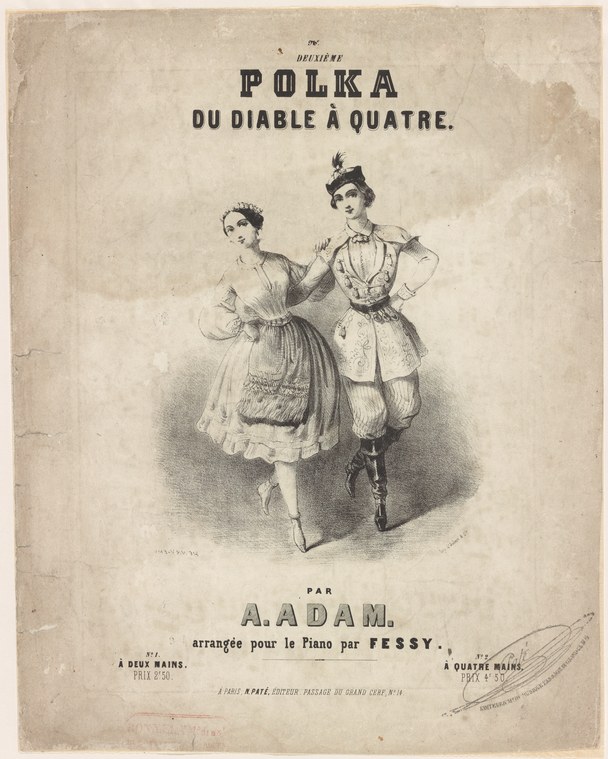
This is a lithographed title page for a polka composed by A. Adam and arranged for piano by Fessy. Two dancers are depicted in mid-performance against a plain background. The woman on the left wears a white dress with a gathered skirt and fitted bodice; she is barefoot and captured in a dynamic pose with one leg raised. The man on the right wears a military-style white tunic with epaulettes and fitted trousers with boots, and a decorative hat with a plume. His posture is energetic and forward-leaning. The composition captures a moment of vigorous movement characteristic of the popular dance of the period. The lithographic technique creates soft shading and modulation in the figures' forms, and the image carries the formal layout of a music cover with title text prominently displayed above and publication information below.
The dancing
Both dancers are shown in an open, traveling position rather than closed ballroom hold. The woman's barefoot raised leg and torso tilt suggest a quick, springing movement. The man leans forward with an energetic stride, his body angled to accompany her motion. Their positioning and the trajectory of their bodies convey rapid, bouncing steps rather than the smooth glide of a waltz. The asymmetry of their dress—her light, unadorned costume against his military uniform—suggests a playful, theatrical interpretation of the dance.
The dance depicted
This is a polka, as stated in the title *Polka du Diable à quatre* (Polka of the Devil to Four). The polka was one of the most fashionable social dances of the mid-to-late nineteenth century, characterized by quick tempo, a hopping step, and an air of exuberance. The print is a cover for a musical composition, suggesting this was a specific polka tune popular enough to warrant both an orchestral version and a piano reduction. The lithograph captures the spirit of the polka's energetic character and its popularity in ballrooms and theaters across Europe.
How it was made
This is a lithograph, a stone-printing process that allowed for easy mass production and distribution of images. The soft tonal qualities visible in the shading of the figures and clothing are characteristic of lithographic technique, which could render gradations of tone unavailable in simple engraving or woodcut. As a music cover, this object was intended for wide circulation—anyone purchasing or performing the composition would receive it. The technique and format indicate this was a commercial product aimed at amateur musicians and the dancing public, not a unique or precious work.
About this work
This lithographed music cover documents the polka as it was experienced and promoted in the nineteenth century: a social dance energetic enough to require military-styled vigor and theatrical presentation. The image is not a record of an actual performance or ballet—there is no stage setting, no ensemble, no narrative—but rather a stylized marketing image meant to convey the character and appeal of the dance to potential buyers. It belongs in a dance history collection as evidence of how a popular social dance was visualized and sold to the public during its era of greatest popularity. The pairing of the military figure with the barefoot woman may also suggest the social transgression or playfulness the polka represented—a rapid, democratic dance that broke from older courtly conventions.
How to look at it
Attend to the barefoot woman and the military man: their costumes tell two stories at once. The woman's simple white dress and bare feet suggest folk or peasant origins (consistent with the polka's Bohemian roots), while the man's uniform suggests military swagger or theatrical costume. The raised leg and forward lean of both figures capture the characteristic bouncing, springing action of the polka step. The open, traveling position—not a closed ballroom embrace—shows how the dance could accommodate rapid movement and style variation. This cover presents the polka not as a stately social dance but as spirited, almost transgressive entertainment.
The artist
The composer A. Adam is not identified beyond the signature on the cover. The arranger Fessy is likewise unattributed in available records. Both names suggest French or Continental European musicians of the mid-nineteenth century. The lithographer's name is not legible in this reproduction. The work was published by Brandus & Co. (or similar—the publisher mark is partially visible), indicating professional music publishing infrastructure in a major European city, most likely Paris.
The period
The polka erupted as a fashionable dance in the 1840s and dominated European and North American ballrooms through the 1860s and beyond. It arrived from Bohemia (modern Czech territory) and spread with remarkable speed, spawning countless compositions and sparking moral panic among conservative critics who saw it as vulgar and sexually suggestive. The same period saw the rise of lithographic music publishing, which made sheet music affordable and distributable to amateur pianists—the polka's primary domestic market. Theatrically, the polka was incorporated into ballet and opera, often as a comic or folk element, as suggested here by the theatrical costumes and staging of the cover image.
Where it lives
This is a lithographed music cover held by the New York Public Library in its collection of prints depicting dance. It is a commercial object—a cover for a published musical composition—and represents the material culture of nineteenth-century music-making and dance.
Dance in this work
Questions about this work
What is a polka?
The polka is a lively couple dance in duple meter (2/4 time) with a characteristic hopping or bouncing step. It originated in Bohemia in the 1830s and became wildly fashionable across Europe and the Americas in the 1840s–1860s. It was danced in ballrooms by social dancers and also incorporated into theatrical ballets and operas, often as a comedic or folk element.
Why is the woman barefoot?
Barefoot dancers often represented peasant, folk, or pastoral characters in nineteenth-century theatrical dance. The contrast between her simple dress and bare feet and the man's ornate military uniform may suggest a folk or comedic interpretation of the polka, emphasizing its Bohemian (rural) origins even as it became fashionable in cities.
What does 'du Diable à quatre' mean?
The phrase translates as 'of the Devil to Four' or 'of the Devil's Four.' It likely refers to a specific tune or version of the polka, possibly with theatrical or comedic associations. Many popular dances of the period were given whimsical or fantastical titles to attract buyers.
Who was A. Adam?
The composer is identified only as 'A. Adam' on this cover. A prominent composer of the period bearing this name was Adolphe Adam (1803–1856), a French composer famous for ballets including *Giselle*. However, without additional documentation, we cannot confirm the composer's identity from the print alone.
More dance artwork





