49 works in this view — arrow keys or swipe to move between them.
Dance in Art
Ribbon dance
Unknown artist
- Collection:
- Prints depicting dance
- Source:
- New York Public Library
- Rights:
- Public domain — free to use, share and adapt.
- Recorded as:
- Public Domain
This is documentary evidence of a named 18th-century female performer and the specific dance form in which she was famous. Ribbon dances are poorly documented in written sources, making visual records like this essential to understanding what theatrical solo dances actually looked like, how they were executed, and how central female performers were to public entertainment in this period.
What you are looking at
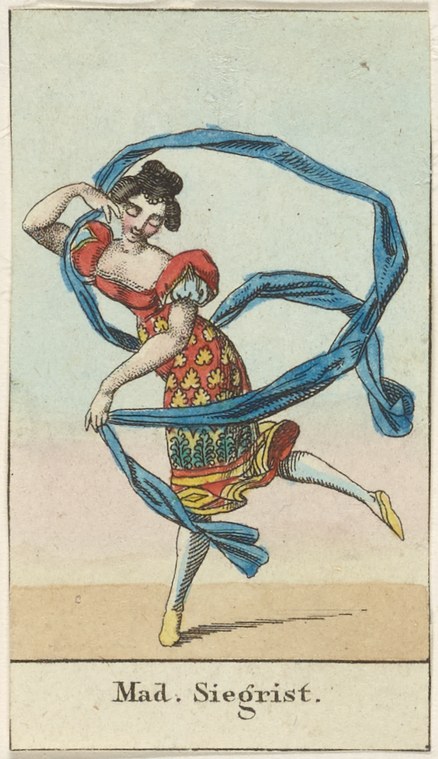
A single female dancer in theatrical dress dominates the composition, captured mid-movement against a plain background. She wears a short red bodice with yellow decorative patterning and a full skirt in yellow with green embellishment at the hem, paired with flesh-colored tights and yellow shoes with heels. Her dark hair is styled up in period fashion. The most striking feature is a long blue ribbon or sash that curves around her body in a flowing arc, suggesting rapid rotation or movement. Her body is tilted and one leg is raised; she appears to be in a spiraling or turning motion, with her arms positioned to hold or manipulate the ribbon. The pose conveys momentum and lightness, with the dancer's weight appearing to rest on one leg while the other is lifted. The colored engraving technique preserves fine detail in the costume and the delicate rendering of fabric and flesh.
The dancing
A single dancer stands in a dynamic spiral or pirouette, her weight shifted to one supporting leg while the other lifts behind. Her arms are positioned to frame and control a long blue ribbon that wraps around her torso and extends outward, suggesting active manipulation of the prop rather than incidental decoration. The body angle—tilted forward from the vertical—and the lifted leg indicate momentum and rotation. Her posture is upright and graceful, with the head held high, and there is no suggestion of strain or effort despite the complexity of the position.
The dance depicted
This is a ribbon dance, as the title states. The work depicts a solo female performer engaged with a long flowing ribbon as the primary element of the choreography. Ribbon dances were a feature of 18th-century European theatrical and ballroom entertainment, appearing in court spectacles, pantomimes, and as entertainment pieces for mixed social gatherings. The costume—short skirt, fitted bodice, heeled shoes—and the refined execution suggest this is a theatrical or court dance rather than a folk tradition. The image documents the fundamental principle of ribbon dance: the ribbon becomes an extension of the dancer's body, traced through space by the performer's movement and creating visual patterns that emphasize rotation and fluidity.
How it was made
This is a hand-colored engraving, identifiable by the fine black line work that defines forms and the separately applied watercolor or gouache tints layered over the print. The engraving technique allowed for precise rendering of delicate details—the folds of the skirt, the features of the face, the curve of the ribbon—and the colored finish made the image suitable for framing or binding into an album. The technique implies circulation among educated or affluent audiences; such prints were collected as records of theatrical fashions and dance practice and were significantly cheaper than original paintings while remaining precious objects.
About this work
This hand-colored engraving documents a ribbon dance, a theatrical entertainment form popular in 18th-century Europe. The inscription 'Mad. Siegrist' (Madame Siegrist) at the bottom indicates this is a portrait of a named performer, capturing her in the characteristic pose of the dance: a spiraling turn in which the long blue ribbon becomes the visual focus. Ribbon dances combined elements of ballet vocabulary—turned-out positions, lifted legs, precise footwork—with the novelty of the prop, creating a spectacle that emphasized the dancer's control over both her own body and the external object. The work belongs to a tradition of theatrical prints documenting celebrity performers and fashionable dances of the period, serving both as a record of performance practice and as a marketing image for the dancer herself.
How to look at it
The artist has frozen the dancer at the moment of maximum spiral, when the ribbon traces the longest arc around her body and the lift of her leg is most apparent. The pose is physically demanding but appears effortless, which was the ideal of 18th-century theatrical dancing. Notice how the ribbon does not lie flat but curves away from the body in a graceful sweep, implying speed and the centrifugal force of rotation. The dancer's gaze is averted, adding a quality of concentration or detachment characteristic of the period's theatrical convention.
The artist
The artist is unknown; the work is catalogued only as a colored engraving from a collection of dance prints. The inscription 'Mad. Siegrist' names the dancer, not the engraver, suggesting this was a commercial theater print produced to capitalize on the performer's celebrity. The quality of the engraving and coloring suggests a professional workshop rather than an amateur hand, consistent with the market for theatrical portraiture of the period.
The period
Ribbon dances flourished in Europe during the 18th century as part of a broader expansion of theatrical and ballroom entertainment for urban elites. The period saw the professionalization of dance, the rise of named celebrity performers (particularly women), and the emergence of choreographed solo pieces that showcased individual technical skill and the dancer's ability to handle props. The theatrical costume shown here—short skirt, heeled shoes, fitted bodice—reflects the European fashion and silhouette of the mid-to-late 18th century. At this same moment, early ballet was developing its vocabulary of turned-out positions and lifted movements, and ribbon dances may have drawn on or influenced these emerging techniques.
Where it lives
This work is held in the New York Public Library's Prints collection, part of a larger assemblage of dance prints catalogued together. Such collections document the circulation of theatrical images and the audience for entertainment culture in the 18th and 19th centuries.
Dance in this work
Questions about this work
Who was Madame Siegrist?
The inscription identifies her as a performer known for ribbon dances, but no other information is recorded in the catalogue. She was evidently celebrated enough to warrant a commercial print, suggesting a successful career in theatrical or court entertainment in 18th-century Europe. Without further research, nothing more can be established from the image itself.
Is this ballet?
Ribbon dances shared some vocabulary with early ballet—turned-out positions, lifted legs, precise footwork—but they were a distinct entertainment form, performed as solo pieces outside the ballet theater proper. This particular dance shows theatrical training but cannot be definitively classified as ballet proper.
How was the ribbon controlled?
The dancer held one or both ends of the ribbon in her hand(s), using her arm and body movement to create shapes and patterns. The ribbon could be thrown, spiraled, held aloft, or allowed to trail, depending on the choreography. The skill lay in making these movements appear effortless and visually compelling while maintaining the dancer's own technical execution.
Why are ribbon dances not performed now?
Ribbon dances fell out of fashion as entertainment forms changed and as ballet became the dominant form of virtuosic female dance in the 19th century. They survive in folk traditions and have been revived in some contemporary circus and flow-arts contexts, but they are not part of the standard theatrical or ballroom repertoire.
More dance artwork





