49 works in this view — arrow keys or swipe to move between them.
Dance in Art
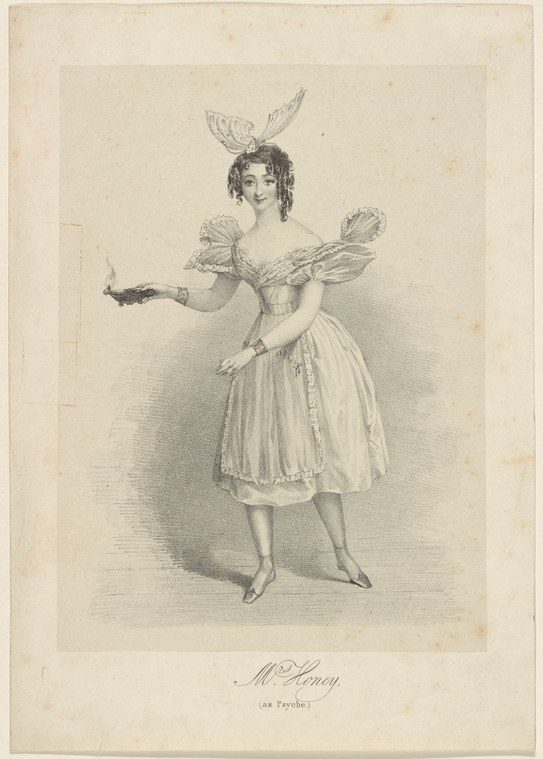
Mrs. Honey, (as Psyche)
Unknown artist
- Collection:
- Prints depicting dance
- Source:
- New York Public Library
- Rights:
- Public domain — free to use, share and adapt.
- Recorded as:
- Public Domain
This image documents the visual culture of nineteenth-century theatrical performance and the commercial circulation of images of dancers and performers. It shows how roles and performers were marketed and memorialized through engraved portraits, revealing the professional status of performers like Mrs. Honey and the audience's appetite for images of theatrical spectacle. Understanding how dancers and theatrical performers were presented and promoted—through costume, pose, and printmaking technology—is essential to understanding the history of dance as a public, commercial, and artistic practice.
What you are looking at
A woman in theatrical costume stands in a three-quarter pose against a plain background, her body angled to display the full silhouette of her dress. She wears a short, full skirt of gauze or similar diaphanous fabric, gathered high at the waist, with puffed sleeves and what appears to be a corsetted bodice. On her head sits an ornamental headdress with wing-like or petal-like projections extending upward. Her left arm is extended outward at shoulder height, while her right arm hangs at her side, one hand appearing to hold a small object—possibly a fan or prop. Her posture is upright and dignified, with her weight evenly distributed on both legs, her head turned slightly toward the viewer. The print is executed in fine line work with careful shading, creating volume in the fabric and definition in the figure. The overall composition emphasizes the costume and the controlled, posed quality of theatrical presentation.
The dancing
A single female figure occupies the frame, standing in a static, presentational pose rather than in mid-movement. The arms are positioned for display rather than active dance—the extended left arm is held in an open, decorative position at approximately shoulder height, while the right remains relaxed. The body shows no weight shift, turn, or dynamic momentum; instead, the stance is frontal and balanced. The posture is upright with shoulders back, typical of formal theatrical presentation. There is no evidence of the rapid footwork, pointed feet, or sustained turnout that would characterize ballet technique, nor of the partnered interaction that would mark ballroom or social dance.
The dance depicted
This appears to be a theatrical costume study or character portrait rather than a depiction of dance in motion. The figure's pose and presentation suggest a performer in a mythological or fantastical role—the winged headdress and diaphanous drapery point toward representation of a supernatural being, likely an attendant spirit or allegorical figure. The engraving commemorates Mrs. Honey in the role of Psyche, the mythological figure from Apuleius's *Metamorphoses*. As a theatrical representation from the nineteenth century, this documents costume and character rather than a specific dance technique or style; it is a portrait of a performer in role rather than a study of choreography. The static pose and frontal presentation are typical of theatrical costume documentation and promotional imagery of the period.
How it was made
This is a finely executed engraving, likely steel or copper engraving on paper, employing fine parallel lines (hatching and cross-hatching) to create volume, texture, and tonal variation in the figure and drapery. The technique allows precise rendering of fabric weight and ornament, evident in the careful gradation of the gauze skirt and the detailed articulation of the headdress. Engravings of this type—theatrical costume studies with a performer's name inscribed below—were commercially produced and distributed to audiences, functioning as both commemorative objects and promotional materials for theatrical productions. The circulation as a print made the image available to a broad public beyond those who attended the performance, creating a visual record of the role and the performer's interpretation of it.
About this work
This is a nineteenth-century engraved theatrical costume study documenting Mrs. Honey in the role of Psyche, likely from a musical or spectacular theatrical production. It records the appearance and costume of a performer in character, preserving the visual elements of a theatrical role rather than choreographic movement. The work belongs in a gallery of dance in art because theatrical performance and costume were central to nineteenth-century dance and theatrical presentation, and because such images document the performers, roles, and aesthetic conventions of theatrical dance during a formative period in its history.
The engraving serves as historical documentation of theatrical practice, costume design, and the visual presentation of performer identity. Mrs. Honey's role as Psyche—a figure from classical mythology often represented in allegorical and spectacular forms on stage—would have involved movement and gesture as part of the dramatic action, even if this particular image captures her in a static, presentational pose. The print preserves how she was marketed to and remembered by audiences of her time.
How to look at it
Attend to the costume as a complete visual statement: the proportions of the skirt, the construction of the headdress, the ornamental detail, and the silhouette created by the fabric and cut. Note that the artist has chosen a static, formal pose for display rather than capturing a moment of movement—this was the convention for theatrical costume documentation of the period. Observe how the engraving technique creates texture and volume in the different fabrics (the sheer skirt, the fitted bodice, the ornamental headdress), emphasizing the theatrical richness of the costume. The inscribed name below anchors this as a portrait of a specific performer in a specific role, making the image a historical record of a performance that has otherwise left no trace.
The period
The nineteenth century saw the expansion of theatrical spectacle and the rise of the professional performer as a public figure. Engraved theatrical prints were a major form of popular visual culture, circulating widely and making performers visible to audiences beyond those who attended live performances. This was the era in which ballet was becoming professionalized and codified, Romantic ballet dominated European stages, and theatrical dance was establishing itself as a distinct art form. Mythological and allegorical subjects—including Psyche—remained popular in theatrical spectacle and dance, though often in highly fantastical, visually elaborate forms that prioritized costume and scenic effect. The careful documentation of costume and the formal presentation of the performer in prints like this one reflects the importance of visual spectacle and the performer's image to theatrical success and commercial appeal.
Where it lives
The print is held by the New York Public Library in the Prints collection depicting dance. It is a nineteenth-century engraved theatrical costume study, one of many such prints that documented performers and roles for circulation to audiences and collectors.
Questions about this work
What is Psyche, and why would a performer be cast in this role?
Psyche is a figure from classical mythology, most famously from Apuleius's *Metamorphoses*. She was the subject of numerous theatrical, operatic, and ballet productions during the eighteenth and nineteenth centuries, usually represented as a young woman subjected to trials by Venus, eventually united with Cupid, and transformed into a divine being. The role offered opportunities for spectacular costume, allegorical representation, and the display of supernatural or fantastical elements—precisely what the winged headdress and diaphanous drapery in this image convey.
Does this image show Mrs. Honey dancing, or just posing?
The image is a posed costume study, not a depiction of dance in motion. It was created as a commemorative and promotional portrait, showing how the performer appeared in the role rather than capturing a moment of choreography. However, as a professional performer playing a dramatic role in a theatrical production, Mrs. Honey would have danced, moved expressively, and used gesture as part of her performance; this print simply preserves her visual appearance in the costume and character rather than the movement itself.
Why was this printed as an engraving?
Engravings were the primary method of producing and distributing images of theatrical performers during the nineteenth century. The process was relatively economical and allowed multiple impressions to be printed and sold to audiences, making the performer and role visible to a wide public. Theatrical prints were collected and displayed in homes, contributing to the performer's fame and commercial value. The fine engraving technique also conveyed prestige and quality, appropriate to the elevated, mythological subject matter.
More dance artwork





