49 works in this view — arrow keys or swipe to move between them.
Dance in Art
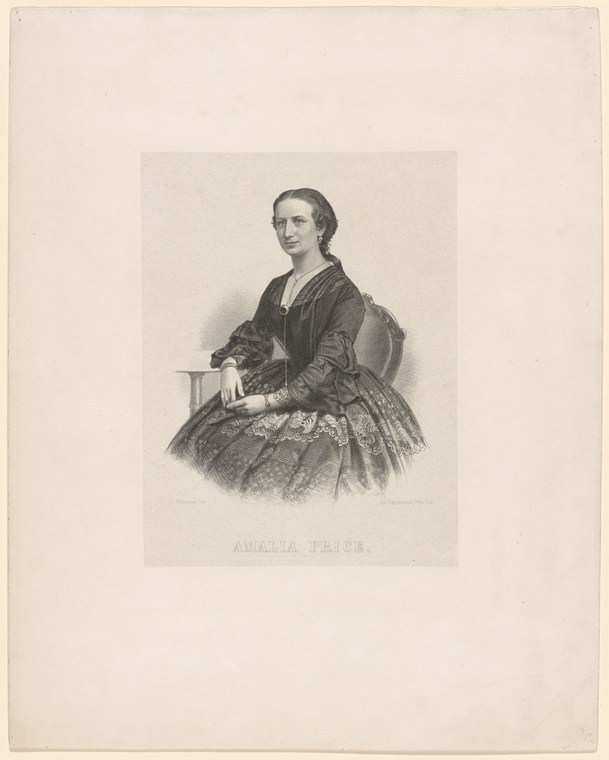
Amalia Price: portrait
Unknown artist
- Collection:
- Prints depicting dance
- Source:
- New York Public Library
- Rights:
- Public domain — free to use, share and adapt.
- Recorded as:
- Public Domain
This work is important primarily as a historical document of 19th-century portraiture and printing technique, and potentially as evidence of who Amalia Price was and how she was publicly presented. For a dance collection, it serves as a cautionary example: not every portrait of a performer is a representation of dance, and the distinction matters for accurate cataloguing and interpretation.
What you are looking at
A three-quarter-length portrait of a woman seated in a chair, her body angled toward the viewer's left. She wears a dark jacket or corsage over a voluminous skirt with heavy pleating or gathering, rendered in fine detail to show the weight and fall of the fabric. The dress is typical of mid-19th-century fashion. Her hair is parted in the center and pulled back smoothly. Her left arm rests on the arm of the chair; her right arm hangs naturally. The background is plain and neutral, emphasizing the figure. The work is executed as an engraving or steel engraving in black and white, with careful attention to tonal modeling, particularly in the folds of the skirt and the texture of the jacket. The name "AMALIA PRICE" appears in small capitals at the bottom of the image.
The dancing
A solitary seated figure in a formal pose, not in active dance movement. The body is composed and stationary, with the weight settled into the chair. There is no visible indication of an active hold, frame, or the dynamic positioning characteristic of dance photography or illustration. This is a portrait study, not a representation of movement.
The dance depicted
The image does not depict dance. While the sitter is identified as Amalia Price—a name that may have been associated with the theatre or dance world in the 19th century—this is a formal portrait in which she is seated and still. No dance posture, gesture, footwork, or movement is visible. Without additional context about Amalia Price's profession or role, we cannot determine whether she was a dancer, and the image itself offers no evidence of dance activity.
How it was made
This is an engraving, likely a steel engraving, printed from an intaglio plate. The technique allows for fine linear detail and careful tonal gradation, particularly visible in the rendering of fabric texture and the modeling of the face and hands. The clean, uniform paper and the signature engraved inscription suggest this was a commercial portrait print, produced for circulation and display—probably as part of a series of theatrical or celebrity portraits. The quality and finish indicate mid-19th-century printing standards.
About this work
This is a formal portrait engraving of a woman identified as Amalia Price, rendered in the mid-19th century. The work is a seated figure study, not a dance representation, and should be catalogued accordingly. While the sitter may have been a performer or public figure, the image itself is a static portrait in fashionable dress of the period. Its presence in a collection of "Prints depicting dance" may reflect confusion about the subject's profession or an archival error in cataloguing.
How to look at it
Approach this as a historical portrait rather than a dance image. Note the skill with which the engraver has rendered fabric texture and the subtle modeling of the face and hands through line and tone alone. Observe how the composition emphasizes stillness and formal dignity—the chair, the settled posture, the neutral background all work against any sense of movement or performance. This is a study in how the visual language of respectability was constructed in the 19th century.
The artist
The artist is not recorded. The style and technique are consistent with mid-19th-century commercial engraving practice, suggesting the work was produced by a professional print shop or skilled engraver whose name has been lost or was not considered significant enough to record. The quality suggests competent professional work rather than amateur effort.
The period
The dress, hairstyle, and printing technique all place this work in the mid-19th century, a period of flourishing commercial portraiture and celebrity culture. Theatrical and musical performers were frequently subjects of portrait engravings, which were collected and sold as a form of popular entertainment and fan culture. The formal seated pose and fashionable dress reflect contemporary conventions for presenting women of status or accomplishment.
Where it lives
The work is held in the New York Public Library's collection of prints depicting dance. It was likely acquired as part of a broader historical or theatrical collection, or misfiled under the dance category due to assumptions about the sitter's profession.
Questions about this work
Was Amalia Price a dancer?
The catalogue record does not specify her profession. The name suggests she may have been a theatrical performer of some kind, but this portrait alone provides no evidence. Further research into mid-19th-century theatre records would be needed to establish her role and career.
Why is this in a dance collection?
That is unclear. It may have been catalogued as a dance image in error, or Amalia Price may have been known as a dancer or performer and included on that assumption. The portrait itself depicts no dance activity.
How was this print made?
It is an engraving, most likely a steel engraving, produced by incising an image into a metal plate and printing it through an intaglio press. This technique allowed fine detail and multiple impressions from a single plate, making it ideal for commercial portrait reproduction in the 19th century.
More dance artwork





