49 works in this view — arrow keys or swipe to move between them.
Dance in Art
Pastoral scene
Unknown artist
- Collection:
- Prints depicting dance
- Source:
- New York Public Library
- Rights:
- Public domain — free to use, share and adapt.
- Recorded as:
- Public Domain
The handkerchief and the semi-open position are precise indicators of folk-dance tradition, making this a valuable record of how courtship dances were actually performed in the 19th century. The inclusion of spectators and the rural setting document dance as social practice embedded in community life, not as staged performance—a perspective rare in dance imagery of the period.
What you are looking at
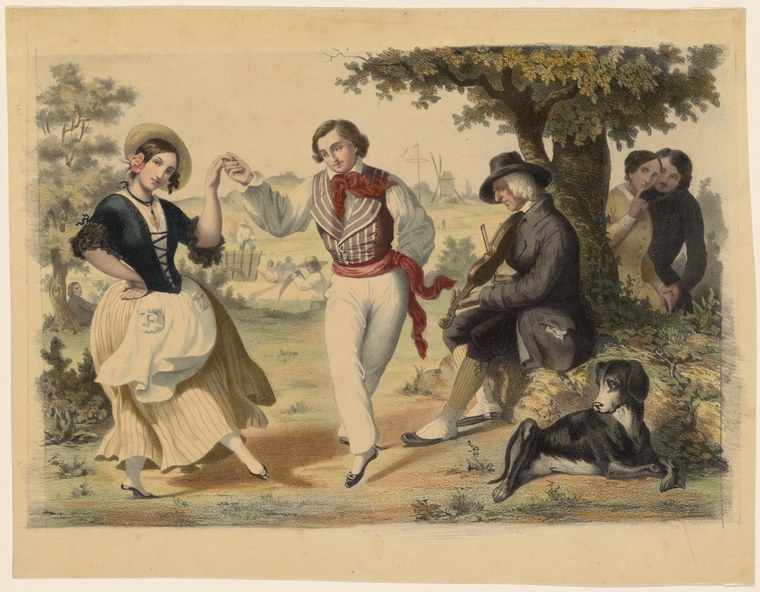
A young couple dances in a pastoral landscape while three figures watch from beneath a large tree. The woman wears a black bodice with a white gathered skirt decorated with a blue emblem or pattern; she holds a handkerchief in one hand and her partner's hand in the other. The man, dressed in pale breeches, a red-patterned waistcoat, and a white shirt, leads with one arm extended. His posture is upright and animated, weight forward on the balls of his feet. The three onlookers—an older man in dark coat and hat, a woman in a bonnet, and another figure—stand conversing and gesturing. A small dog sits in the foreground. The background shows a rural village with a church steeple and scattered trees under a warm, golden light characteristic of hand-colored prints of the 19th century.
The dancing
The dancing couple are in a loose, semi-open position typical of social dancing: the man's right arm holds the woman's left hand at approximately waist height, while his left arm curves outward. The woman's right arm extends to hold a handkerchief, a gesture that suggests both coquetry and the use of a prop common in folk and social dances. Both figures are upright with weight distributed to the balls of the feet, suggesting active stepping rather than gliding. The man's posture shows forward momentum and confidence; the woman's body leans slightly back in response, her skirt caught in a moment of movement or lift.
The dance depicted
This depicts a courtship dance, most likely a 19th-century European folk or country dance from the Gilded Age period. The handkerchief in the woman's hand is a strong indicator of folk traditions, particularly common in English, German, or Scandinavian rural dances where such props featured in courtship rituals. The semi-open position, the vertical posture, and the emphasis on individual step patterns rather than close partnership suggest this is a folk or country dance rather than a formal ballroom dance. The presence of an audience and the informal outdoor setting indicate this is social dancing among rural or village communities, captured at a moment of courtship display.
How it was made
This is a hand-colored lithographic or engraved print, evidenced by the soft tonal gradations, the delicate shading in the foliage and sky, and the characteristic line-work visible in the figures' outlines. The warm ochre tones of the paper and the careful hand-coloring in watercolor or tinted medium indicate mid-19th-century commercial production, likely made for popular consumption. The technique allowed for wide circulation and affordable distribution to a broad audience, suggesting this image of rural courtship and dance held appeal beyond specialist or elite viewers.
About this work
This hand-colored print captures a moment of courtship through dance in a 19th-century rural setting. A young couple execute what appears to be a folk or country dance—identifiable by the woman's handkerchief, the semi-open position, and the upright, energetic carriage of both figures—while village onlookers and a dog observe beneath an ancient tree. The work belongs to a large body of popular prints depicting rural life and customs that circulated widely in the 19th century, functioning both as entertainment and as documentary evidence of folk practice. It records not only the steps and hold of the dance but also its social function: a public display of courtship watched and approved by the community.
How to look at it
Notice first the handkerchief: it is not decorative but functional, a choreographic prop that signals this as folk or country dance rather than ballroom waltz or quadrille. Watch the couple's hands and posture—the weight is forward and the hold is loose, allowing each dancer independence of movement rather than the synchronized closure of formal ballroom technique. The onlookers are not incidental; their presence and attentive stance tell you this dance is a community affair, a ritual of courtship performed for an audience. The artist has caught not a virtuosic moment but the everyday social dance, which is why it matters to historians.
The period
This print dates to the mid-19th century, when popular lithography was at its height as a medium for domestic decoration and entertainment. Romantic-era interest in rural life, folk customs, and the 'picturesque' made such scenes highly marketable. Dance imagery of this period often emphasized courtship, flirtation, and the display of youth and attractiveness within socially sanctioned contexts. The rural setting and the formal observation of custom reflect both genuine folk practice and urban Romantic nostalgia for an idealized countryside.
Where it lives
The work is held in the New York Public Library's Prints collection, a repository established to preserve popular visual culture including commercial prints, engravings, and lithographs. Such prints were affordable and widely distributed, suggesting this image was made for a general audience rather than a specialist or aristocratic market.
Dance in this work
Questions about this work
How can you tell this is a folk dance and not a ballroom dance?
The handkerchief in the woman's hand is the strongest clue: it is a prop specific to many European folk traditions and rarely appears in formal ballroom dances of the period. The semi-open position, where the couple hold hands but maintain separate upper bodies and allow independent arm movement, is also typical of folk and country dancing. Ballroom dances of the Gilded Age required a much closer, more integrated hold.
What does the dog tell us about this scene?
The dog is a detail that anchors the scene in everyday rural life rather than formal performance. Its inclusion suggests this is an illustration of actual village custom and social practice—a community gathering where dance was part of daily culture—rather than a staged or theatrical moment.
Why are people watching the dancers?
In 19th-century folk tradition, courtship dances were public rituals. The presence of onlookers, particularly the older figures who appear to be approving or commenting, indicates that this dance served a social function beyond personal enjoyment. It was a formal display of eligibility, character, and community standing, performed under the eyes and judgment of the village.
More dance artwork





