49 works in this view — arrow keys or swipe to move between them.
Dance in Art
Le fandango
Unknown artist
- Collection:
- Prints depicting dance
- Source:
- New York Public Library
- Rights:
- Public domain — free to use, share and adapt.
- Recorded as:
- Public Domain
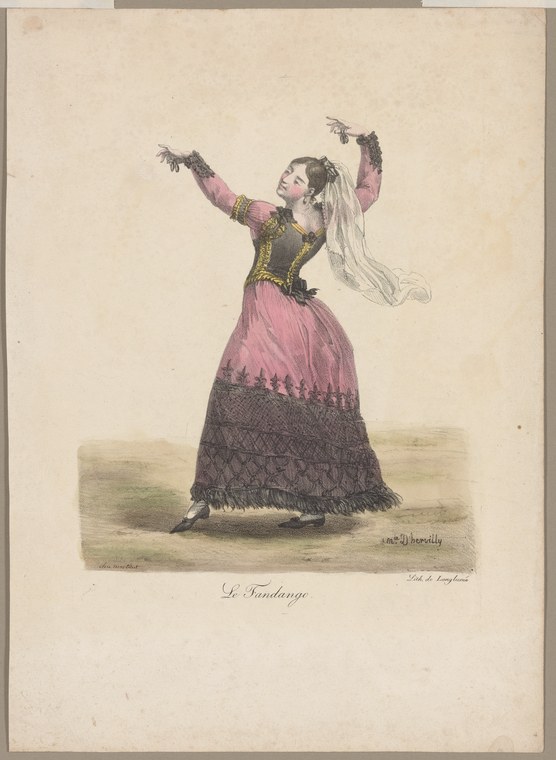
This print preserves both the visual style and the costume of the fandango as it was understood and marketed in European popular culture during the 19th century. For historians of dance, tourism, and cultural imagery, it documents how European audiences encountered and consumed representations of Spanish dance before photography. The work shows that dance was not only a lived practice but also a profitable subject for the print industry.
What you are looking at
A single female dancer is depicted in a dynamic pose against a plain, neutral background with subtle earth-tone wash. She wears a striking two-tone dress: a dark corset or bodice in what appears to be olive or brown tones, paired with a voluminous pink skirt that extends to the ankles and is trimmed at the hem with darker (likely black) lace or decorative edging. Her arms are raised high and to the sides in an expressive gesture, her head tilted back, and her long blonde hair flows loosely down her back. She wears dark gloves or sleeves extending to the forearm. The pose suggests a moment of spirited, upward-reaching movement—characteristic of Spanish social dance. This is a hand-colored print, likely from the 19th century, rendered in the style of fashion or theatrical costume documentation.
The dancing
The dancer stands in a single upright figure with legs in a natural stance, weight evenly distributed. Her arms are raised to approximately shoulder height or slightly above, with elbows bent and hands held at the wrists in a relaxed but deliberate gesture. This arm position is characteristic of Spanish social dances where the dancer frames the upper body while keeping the lower body relatively controlled. The expression in the face and the backward tilt of the head convey joy and abandon. There is no partner; this is a solo or demonstration figure.
The dance depicted
This is almost certainly a depiction of the fandango, as the title indicates. The fandango was a Spanish social dance of the 18th and 19th centuries, typically danced by couples or individuals in a lively, flirtatious manner, often accompanied by castanets and guitars. The arm position—raised but not in the high, strict frame of classical ballet—and the relaxed yet expressive gesture align with fandango style. The costume, with its fitted bodice and full skirt, is consistent with Spanish folk dress of the 19th century. The pose captures a moment of spirited elevation rather than a specific footwork figure, which is typical of how European prints documented such dances for audiences unfamiliar with them.
How it was made
This is a hand-colored engraving or lithograph, likely from the early 19th century, based on the printing technique and coloring method visible in the image. The outline appears to be printed in black ink, with colors applied by hand in watercolor or gouache—a common and economical technique for producing fashion and theatrical prints in quantity. The signature or mark visible at the lower right suggests this was a published commercial print, probably sold to a middle-class audience interested in continental fashion and theater. The technique allowed wide circulation of images of foreign dances among European audiences.
About this work
This is a commercial print documenting the fandango, one of the most famous Spanish dances of the 18th and 19th centuries. It captures not the footwork but the emotional and gestural character of the dance—the raised arms, the backward-tilted head, the spirited joy. The work belongs in a gallery of dance art because it is a primary document of how Europeans understood and consumed images of dances from other cultures; it circulated among audiences who would never see a live fandango, shaping their imagination of Spain and Spanish femininity. The figure is idealized and fashionable rather than documentary, reflecting the conventions of printed dance imagery for the middle-class market.
How to look at it
Notice the artist's choice to show the dancer with arms raised and head back—a gesture of joy and abandon rather than a technical footwork moment. This choice emphasizes the emotional character and the exoticism of the dance rather than its technical content, which reflects both the conventions of European dance prints and the perceived nature of Spanish dance as passionate and improvisational rather than formally codified. The costume is equally important: the fitted bodice and full skirt are rendered in fashionable colors and materials available to European audiences, making the foreign dance legible and desirable as a visual spectacle.
The artist
The artist is not recorded in the available catalogue information. The style and production method suggest a commercial print house or fashion illustrator working in the early 19th century, likely based in a major European publishing center such as Paris, London, or Vienna. The signature or attribution mark visible in the lower right may help identify the artist, but without additional archival research, the maker remains unknown.
The period
The fandango was already legendary in Europe by the 19th century, thanks to descriptions in travel literature and exotic opera. This print dates from the era when printed images of foreign dances had become a commercial commodity. The early 19th century saw a boom in hand-colored prints depicting fashionable dress, theatrical scenes, and social customs from across Europe and beyond. At the same time, the fandango was being absorbed into European theatrical culture, appearing in ballets and operas that repackaged Spanish dance for concert audiences. This print sits at the intersection of tourist interest, theatrical fashion, and the emerging consumer culture of printed images.
Where it lives
This work is held in the Prints Depicting Dance collection at the New York Public Library, part of the institution's broad holdings of commercial and theatrical prints. It is part of the historical record of how printed images circulated representations of dance.
Dance in this work
Questions about this work
What is the fandango?
The fandango is a Spanish social dance, typically in triple meter, that was performed by couples or individuals in the 18th and 19th centuries. It was often accompanied by castanets, guitar, and singing. By the 19th century, it had become a symbol of Spanish culture in the European imagination and appeared frequently in theater and opera. This print documents how it was understood and visually represented for European audiences.
Is this a photograph or a painting?
This is neither. It is a hand-colored print—most likely an engraving or lithograph—produced for commercial circulation. The outline was printed in black, and colors were added by hand. This technique was fast and economical, allowing publishers to produce many copies for a mass market interested in fashion and theatrical subjects.
Who was the artist?
The artist is unknown from the available catalogue information. The print bears what may be a signature or publisher's mark, but without further research, the maker cannot be identified. Such commercial prints were often produced by print houses rather than individual artists and sometimes went uncredited.
When was this made?
The style, costume, and printing technique suggest the early 19th century, but the exact date is not recorded. The fashion and the quality of hand-coloring are consistent with commercial prints produced between approximately 1810 and 1840.
More dance artwork





