49 works in this view — arrow keys or swipe to move between them.
Dance in Art
Propos de coulisses [selections]
Unknown artist
- Collection:
- Prints depicting dance
- Source:
- New York Public Library
- Rights:
- Public domain — free to use, share and adapt.
- Recorded as:
- Public Domain
For historians of dance, this work is valuable not as documentation of technique but as evidence of the social and sartorial world in which ballroom dance took place. It reminds us that the history of dance is not only a history of movement but of the costume, setting, and courtship rituals that gave dance its meaning.
What you are looking at
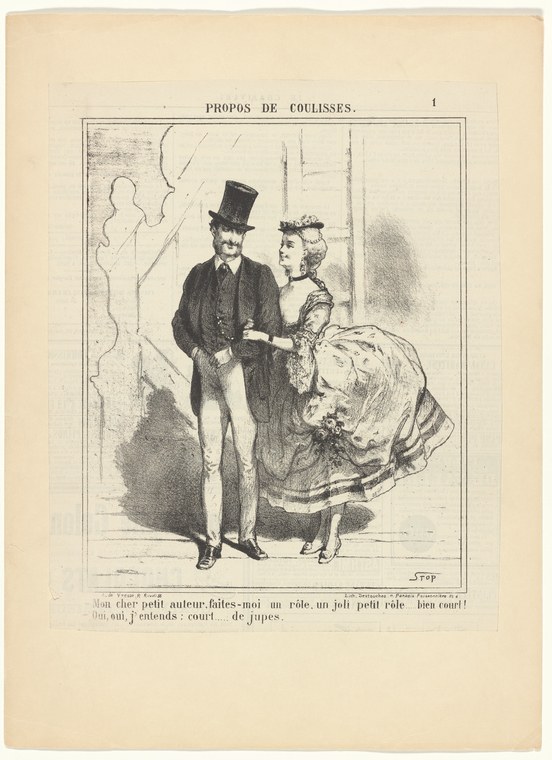
A gentleman in formal evening dress—top hat, tailcoat, and trousers—stands in conversation with a woman in an elaborate ball gown. Her dress is voluminous, with a fitted bodice and a full skirt decorated with ruffles and ribbons, characteristic of mid-19th-century fashion. The woman wears a small floral headdress and holds her skirt with one hand. The setting appears to be indoors, suggested by vertical paneling on the walls behind them. The figures are rendered in a sketch-like manner with careful attention to fabric texture and drapery. The artist has used fine cross-hatching and line work to create volume and shadow, particularly in the woman's elaborate costume.
The dancing
The man stands at ease, his body angled slightly toward the woman in a posture of attentive conversation. The woman's posture is graceful but static—she is not actively dancing but rather pausing mid-conversation or mid-social interaction. Her free hand rests against her body, and her weight appears evenly distributed. No closed hold or dance frame is evident; this is a social encounter rather than an active dance partnership.
The dance depicted
This print depicts a moment of social interaction in the ballroom, not an active dance. The title *Propos de coulisses* (Backstage Chat or Green Room Chat) suggests these are theater or ball figures caught in conversation. While the woman is dressed for formal dancing and the setting is clearly a ballroom or theatrical social space, the figures are stationary and engaged in dialogue. The image captures the social dimension of ballroom culture—the flirtation, conversation, and courtship that occurred alongside or between dances—rather than choreography itself.
How it was made
This is a lithographic print or engraving rendered in black ink on cream paper. The technique employs fine linear hatching and cross-hatching to create tonal depth, particularly visible in the modeling of the woman's elaborate skirt and the gentleman's silhouette. The detail and precision suggest a commercial print medium suited to reproduction and mass circulation—likely a page from a serialized publication or print portfolio. The signature visible in the lower right corner indicates this is by a named artist.
About this work
This work belongs to a rich tradition of 19th-century social satire and observation, in which the customs and fashions of ballroom culture were recorded with wit and attention to sartorial detail. Rather than depicting the choreography of dance itself, the print captures the coded social rituals surrounding ballroom attendance: the display of dress, the performance of courtesy, the moments of flirtation and conversation. It is a document of how people *prepared for* dance, how they *presented themselves*, and how they *socialized* within the ballroom world.
As part of a series titled *Propos de coulisses*, this work sits within a recognizable genre of 19th-century Parisian satirical prints, which often mocked or gently observed the pretensions and follies of fashionable society. The ballroom was not only a place where couples danced; it was a theater of manners, where every movement, every word, and every fold of fabric conveyed social meaning. This print captures that theater.
How to look at it
Notice the woman's costume in precise detail: the style and volume of her skirt, the placement of the ruffles, the delicate headdress, and the way she holds her fabric tell you everything about the period and social moment. The gentleman's top hat and tailcoat are equally deliberate—they speak to the formality and the gender codes of ballroom society. The print captures not a moment of movement but a moment of *pause*: the social interaction that structured the ballroom experience. Look at the body language and the spatial relationship between the figures to see how social distance and courtesy were performed.
The artist
The print bears a signature (partially legible as 'Stop' or similar), suggesting it is by a professional lithographer or caricaturist working in mid-19th-century Paris. The style is consistent with Parisian satirical illustration of the period, when artists like Honoré Daumier, Paul Gavarni, and others produced witty social commentary in print form for publication in journals and as individual sheets for the emerging popular market.
The period
This print dates to the period when the waltz and quadrille dominated ballroom culture across Europe, roughly 1830s–1860s. The woman's costume—the silhouette, the style of decoration, and the headdress—suggests the mid-19th century. At this time, Parisian society was increasingly recorded and satirized in prints and in new media like the illustrated newspaper. The ballroom had become a central institution of bourgeois and aristocratic social life, and its customs and fashions were endlessly documented and mocked in popular culture.
Where it lives
This work is held in the New York Public Library's collection of prints depicting dance. It appears to be a single sheet from a series of satirical prints, likely published in Paris in the mid-19th century.
Dance in this work
Questions about this work
Is this a dance?
Not in the sense of choreography or movement. The figures are stationary and in conversation. However, the print is deeply concerned with ballroom culture: the clothing, the social rituals, and the performance of courtship that surrounded dance. It is a document of the ballroom world.
What is 'Propos de coulisses'?
The title translates roughly as 'Backstage Chat' or 'Green Room Chatter.' In theater and ballroom contexts, 'coulisses' refers to the space behind the scenes or on the margins where informal conversation and flirtation took place. The series likely observes these moments of social interaction.
What is the woman wearing?
A formal ball gown of mid-19th-century style: a fitted bodice, a full skirt decorated with ruffles and ribbons, and a small floral headdress. The elaborate costume signals her status and her readiness to participate in fashionable society. The gentleman wears a tailcoat, top hat, and formal trousers.
Who was this for?
Satirical prints like this were produced for mass circulation in Paris—sold as individual sheets, published in illustrated journals, or collected in portfolios. They were consumed by the middle and upper classes as commentary on fashionable society, often with gentle mockery.
More dance artwork





