49 works in this view — arrow keys or swipe to move between them.
Dance in Art
Propos de coulisses [selections]
Unknown artist
- Collection:
- Prints depicting dance
- Source:
- New York Public Library
- Rights:
- Public domain — free to use, share and adapt.
- Recorded as:
- Public Domain
This work opens the backstage world of 19th-century theatrical dance to historical scrutiny. It reveals the gendered power dynamics of theatre and the celebrity culture surrounding dancers, showing that dancers' labour included managing social attention and flattery. The satirical tone reminds us that contemporary audiences understood these dynamics perfectly well—the exaggeration is not unconscious but deliberately critical.
What you are looking at
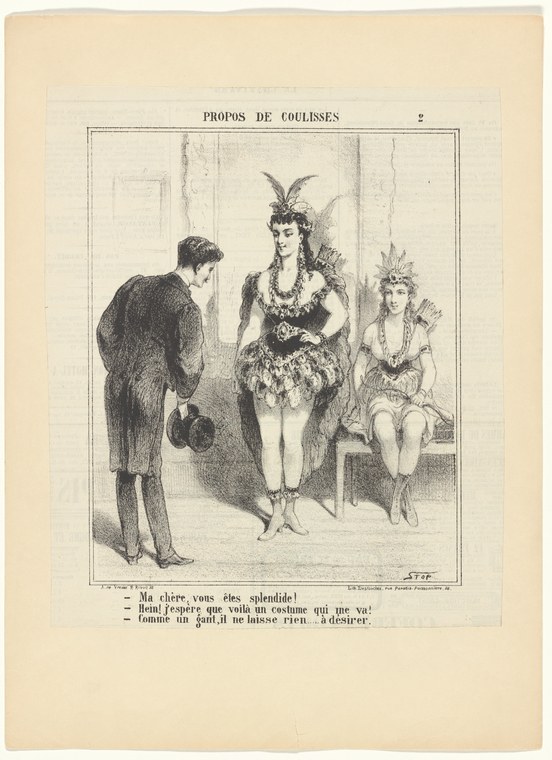
A man in dark formal dress stands in profile, bowing deeply toward two women in theatrical costume. The woman nearer to him wears a short skirt adorned with feathers or leaves, a fitted bodice with ornamental detail, and an elaborate headdress with tall feathered plumes; she stands in a relaxed pose with one leg slightly forward. A second woman sits to the right, similarly costumed in a shorter skirt with feathered trim and an ornate tiara-like crown. The setting is a shallow interior space with drapery visible behind them, rendered in a light wash that suggests backstage or a dressing room. The composition captures a moment of theatrical gallantry—the man's deep bow and the women's composed, almost indifferent bearing suggest the social rituals of 19th-century theatre.
The dancing
The man's body is folded in an exaggerated, courtly bow—spine curved, head dropped, arms held formally at his sides in the manner of deliberate deference. The standing woman holds her weight evenly, her frame open and frontal, with a slight turn of the head that suggests she is acknowledging rather than reciprocating the attention. The seated woman maintains an upright, dignified posture. The bodies are not in contact; the relationship is one of formal address rather than dance partnership.
The dance depicted
This is not a depiction of dance itself, but of the theatrical and social conventions that surrounded dancers of the 19th century. The image captures the backstage world of French theatrical dance, specifically the moment of courtship or flattery between a male admirer and female performers in their dressing room. The women's costumes—short skirts, feathered ornaments, and decorative crowns—are consistent with the exotica and fantasy roles that dominated French theatrical spectacle in the mid-to-late 1800s, particularly in ballet and pantomime. The title *Propos de coulisses* ('Backstage Talk') places this squarely in the genre of satirical social commentary about the theatre world.
How it was made
This is a steel engraving or lithograph, rendered in fine black line with selective hatching and wash to suggest form and shadow. The technique allows for precise delineation of costume detail and facial expression while maintaining the light, almost gossip-sheet quality appropriate to its satirical purpose. The even tone and fine line suggest reproduction for periodical publication, likely as an illustration in a Parisian journal of the 1860s–1880s. Engravings of this type reached a broad urban readership and served as vehicles for social satire alongside caricature.
About this work
This is a satirical engraving documenting the social theatre of 19th-century Parisian dance culture—not the dance itself, but the world surrounding it. The image captures a backstage encounter between a male suitor and two female performers in theatrical costume, rendered with the sharpness of social observation typical of French graphic satire. The work belongs in a dance gallery not because it depicts movement, but because it is evidence of who dancers were, how they were perceived, and what economies of attention and desire surrounded their labour. The women's costumes and poses establish them as performers in a specific theatrical tradition, and the man's exaggerated deference is simultaneously flattering and mocking—the image shows us how dancers were courted, celebrated, and satirized by the society that consumed their performances.
How to look at it
Attend first to the costume detail: the feathered skirts and ornamental headdresses are specific to theatrical fantasy roles, not social dance. Notice the man's posture—the depth of the bow is exaggerated enough to signal courtliness performed, perhaps even mockery. The women's faces are calm and knowing; they are not surprised or flattered but experienced in receiving such attentions. The spatial arrangement—the man outside their intimate group, addressing them across a gap—emphasizes the separation between the admirer and the admired. This is not a moment of connection but of performance within performance.
The artist
The work is unsigned in the visible image and the artist is not recorded in the catalogue. The style and subject matter are consistent with the mid-to-late 19th-century French tradition of theatrical satire practised by illustrators for publications like *Le Charivari*, *Le Figaro*, and similar journals. Works of this type were often produced anonymously or under house names, making individual attribution difficult.
The period
This engraving dates from the era of Romantic ballet's twilight and the rise of theatrical spectacle in the form of pantomime and musical theatre. By the 1860s–1880s, Paris was the capital of theatrical entertainment, and dancers—particularly women—had become objects of intense public fascination and moral anxiety. The growth of illustrated journalism created a new market for images of theatrical life that were simultaneously celebratory and satirical. This work sits in the tradition of *coulisses* imagery, which had become a minor but persistent genre documenting the social and sexual economies of the theatre.
Where it lives
This work is held in the New York Public Library's collection of prints depicting dance, catalogued as part of their broad holdings on theatrical and social history. It is representative of the illustrated journalism and graphic satire tradition of 19th-century Paris.
Questions about this work
Is this actually a dance scene?
No—it is a backstage scene documenting the social rituals around dancers rather than dance itself. The value of the image lies in what it tells us about who dancers were, how they dressed, and how they were perceived and approached in theatrical society.
What do the women's costumes tell us?
The short skirts, feathered ornaments, and decorative crowns are consistent with the roles available to dancers in 19th-century theatrical fantasy—the exotica, the supernatural, the exotic dancer. These were the performances that made dancers visible and celebrity, but also fixed them in particular kinds of roles and social positions.
What is 'Propos de coulisses'?
'Coulisses' refers to the wings and backstage area of a theatre, and by extension to theatrical society itself. 'Propos de coulisses' means 'backstage talk' or 'theatre gossip'—a title that signals this as satire of theatrical manners and morals.
Why is the man bowing so deeply?
The exaggeration is intentional and satirical. The bow is courtly and flattering in form but performed in a way that suggests either mockery or absurdity—the image is commenting on the conventions of male courtship and female celebrity within theatrical society.
More dance artwork





