49 works in this view — arrow keys or swipe to move between them.
Dance in Art
Propos de coulisses [selections]
Unknown artist
- Collection:
- Prints depicting dance
- Source:
- New York Public Library
- Rights:
- Public domain — free to use, share and adapt.
- Recorded as:
- Public Domain
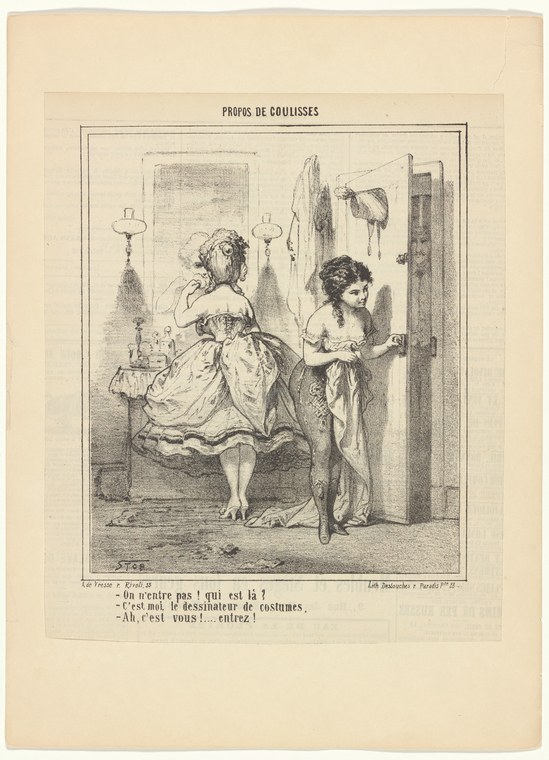
The image offers insight into the private world of 18th-century actresses and dancers—their dress, their furnishings, their attendants—at a moment when the theatre was becoming a central site of urban entertainment and moral anxiety. It is one of a series depicting 'backstage remarks,' a genre that blurs the line between documentary and fantasy, showing the viewer what was hidden.
What you are looking at
A young woman in an elaborate pale silk gown sits at a dressing table or vanity, her back to the viewer, adjusting her hair or headdress in a mirror. A second, younger female figure—possibly a lady's maid or attendant—stands to the right in darker dress, gesturing toward or opening a tall door or wardrobe. The setting is a boudoir or dressing room, indicated by hanging garments visible on the wall to the left, wall sconces with dangling tassels, and furnishings typical of 18th-century domestic interiors. The room is rendered in fine cross-hatching and stippling characteristic of engraving technique. A small dog sits in the foreground. The composition is angled to show both figures and the intimate domestic space they occupy.
The dancing
The seated woman is posed in three-quarter view, her body angled toward the mirror, one arm raised to her hair or head. The standing attendant leans forward slightly, one arm extended toward the open door or wardrobe in a gesture of presentation or suggestion. Neither figure is in motion suggestive of dance; both are static and posed. The spatial relationship is hierarchical: the seated woman commands the foreground and the composition, while the attendant is secondary.
The dance depicted
This image does not depict dance. The figures are engaged in the private ritual of dressing and toilette, a common subject in 18th-century genre prints. The title 'Propos de coulisses'—literally 'backstage remarks' or 'green-room gossip'—suggests this may be related to theatre or the demi-monde, but the scene itself shows no movement, no partnering, no characteristic dance frame or footwork. It is a moment of preparation or consultation, not performance.
How it was made
The work is an engraving, identifiable from the fine parallel line-work, cross-hatching, and stippled modeling of form characteristic of 18th-century reproductive engraving. The precision of the line and the tonal subtlety suggest a skilled hand; the technique allows for fine detail in fabric texture and interior furnishings, and would have enabled multiple impressions for circulation among a cultivated middle-class audience. The title cartouche and signature mark visible in the lower left indicate this was a commercial print.
About this work
This is a genre scene engraving from the 18th century, likely French, depicting two women in a boudoir or dressing room—one seated at a mirror, one standing with an open door or wardrobe. The title 'Propos de coulisses' suggests a connection to theatre or the world of actresses and performers, but the image itself is a study of costume, interior space, and social hierarchy rather than of dance itself. It belongs in a dance collection because it documents the material culture of 18th-century theatre—the dress, the rituals of preparation, the spaces offstage where dancers and performers existed—and because the 'coulisses' (wings) of a theatre were the domain of dancers and performers between scenes.
How to look at it
Look first at the composition: the geometry of the seated figure at the mirror, the angle at which the attendant approaches the open door, the play of light on silk and furnishings. The engraver has frozen a moment of transition—the woman about to leave her dressing room, or being invited to do so. Notice the title cartouche at the top, which frames the scene and invites the viewer to read it as a moment of 'backstage remarks'—a privileged glimpse into a world usually hidden. The inscribed dialogue below (in French) indicates this is a narrative scene, a specific moment in a social exchange, not merely a display of dress.
The artist
The signature or initials are not legible in this reproduction, and the catalogue record provides no artist name. The print is part of a series titled 'Propos de coulisses,' likely a commercial suite of engravings sold to a popular audience in 18th-century France or the Low Countries. The subject matter and style suggest a connection to the tradition of theatre and opera prints that flourished in the mid-18th century.
The period
This engraving dates to the 18th century, a period when theatre and dance were rapidly expanding as commercial public entertainments. The dressing room or boudoir was a frequent subject in prints of this era, often serving as a vehicle for the display of luxury goods, fashionable dress, and the female body in an informal domestic setting. The title 'Propos de coulisses' (literally 'backstage gossip') was a popular genre in French theatre of the period, often used in comedies and farces to satirize the manners of actresses and other performers.
Where it lives
The work is held in the New York Public Library's collection of prints depicting dance. It is catalogued as part of the 'Propos de coulisses' series, a group of 18th-century engravings documenting theatre and performer culture. The exact date and artist remain unknown.
Questions about this work
Is this a dance scene?
No. It shows two women in a dressing room—one at a mirror, one at a door—preparing for an outing or engaged in the private rituals of dress and grooming. There is no movement, no partnering, no footwork. It belongs in a dance collection because of its subject matter: the world of 18th-century theatres, where dancers and performers lived and worked.
What does 'Propos de coulisses' mean?
'Coulisses' refers to the wings (side scenery) of a stage, or more broadly to backstage areas. 'Propos' means remarks or gossip. The title suggests these are scenes of 'backstage remarks'—snatches of conversation or moments from the private lives of theatre people. It was a popular genre in 18th-century French comedy and satire.
Why is this in a gallery about dance?
It documents the material culture of the 18th-century theatre and the world of performers—their dress, their attendants, their private spaces. For historians of dance and theatre, such images are invaluable for understanding how performers lived, dressed, and moved through non-performance spaces.
More dance artwork





