49 works in this view — arrow keys or swipe to move between them.
Dance in Art
Stage scene
Unknown artist
- Collection:
- Prints depicting dance
- Source:
- New York Public Library
- Rights:
- Public domain — free to use, share and adapt.
- Recorded as:
- Public Domain
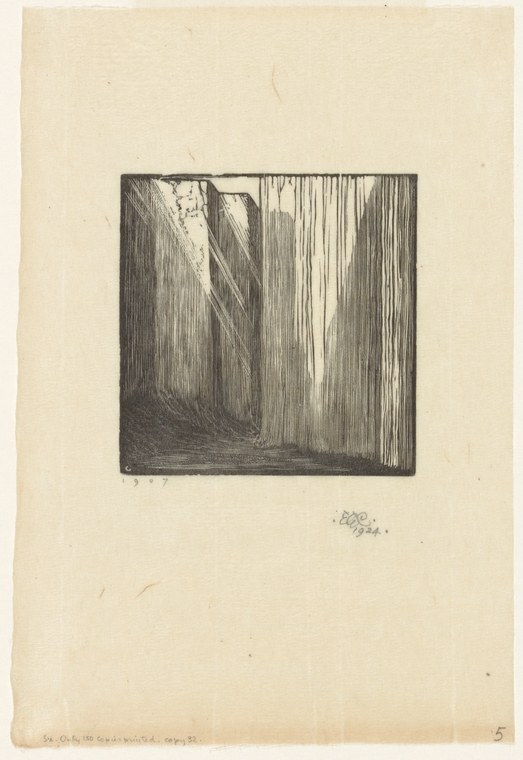
The work is a rare example of theatrical imagery focused on architecture rather than bodies. For dance historians, it documents the physical infrastructure of performance and suggests how artists thought about stage space as an independent formal subject.
What you are looking at
A narrow, deep stage interior rendered in bold parallel lines that create intense atmospheric perspective. The space recedes sharply from foreground to background, with vertical striations suggesting either heavy curtains or the interior walls of the stage itself. The composition is architectural and austere—no figures are visible, and the scene contains no dancers or human forms. The stage appears empty or abandoned, with light entering from the right side, creating a stark division between illuminated and shadowed areas. The overall effect is one of theatrical anticipation or aftermath: a space prepared for performance but momentarily vacant.
The dancing
No figures or dancers are present in this image. The work depicts an interior architectural space rather than human movement or bodily gesture.
The dance depicted
This is not a dance scene. The image shows a stage interior devoid of performers. While the title "Stage scene" and the theatrical context suggest a work created in relation to dance or theatre, the actual subject is the empty space itself—the built environment rather than the human activity it might contain.
How it was made
This is an engraving or etching, identifiable by the fine parallel line work (hatching and cross-hatching) that creates tonal gradation and the characteristic crisp black lines on a light ground. The technique allows the artist to build atmosphere through accumulated marks; the dense vertical striations suggest either a fine-tipped burin or needle work. This small-scale printmaking was intended for circulation among collectors and prints collectors rather than as a public theatrical document.
About this work
This print presents a stage interior as pure architecture—a receding void of curtains or walls rendered through systematic linear perspective. Created without figures, it functions as a study of theatrical space itself: the empty stage as a space of potential rather than realized performance. Its inclusion in a collection of dance-related prints suggests it may document an actual theatre interior or evoke a particular venue, or it may represent the artistic interest in theatrical mise-en-scène that extended beyond the performance itself to the spaces that framed it.
How to look at it
Attend to the systematic buildup of parallel lines that create the illusion of deep space receding toward a vanishing point. Notice how the vertical striations dominate, emphasizing the height and narrowness of the stage, and how the asymmetrical lighting (concentrated on the right) creates a sense of anticipation or drama in an inanimate space. The artist has chosen to render the stage empty—not as a failure of representation but as a formal and philosophical choice.
The period
This print belongs to a tradition of theatrical documentation and fine printmaking that flourished in the late 19th and early 20th centuries. During this period, artists increasingly documented not only performers but also the physical and lighting conditions of theatrical spaces. The interest in atmospheric perspective and the sublime qualities of interior space reflects broader movements in printmaking toward expressive technique rather than narrative illustration.
Where it lives
This work is held in the New York Public Library's collection of prints depicting dance, catalogued with minimal descriptive information. It is part of a broader print collection rather than a specialized theatrical archive, suggesting its relevance to dance documentation was recognized at the time of acquisition.
Questions about this work
Why is there no one dancing in a work titled 'Stage scene' in a dance collection?
The empty stage is itself the subject. Theatrical space—its architecture, lighting, and atmosphere—shaped how dance was performed and understood. This print documents the physical environment that enabled performance, a perspective that appeals to historians studying not just the movement itself but the conditions surrounding it.
What is the printing technique used here?
This is an engraving or etching, made by incising lines into a metal plate (or in the case of etching, using acid to bite lines into the plate). The dense parallel lines visible throughout the print are characteristic of this technique, built up to create tone and atmosphere.
Could this depict an actual theatre?
Possibly. The specificity of the architectural rendering—the proportions, the lighting condition, the stage depth—suggests it may document a real space rather than an imagined one, though without artist attribution or title information, the venue cannot be identified.
More dance artwork





