49 works in this view — arrow keys or swipe to move between them.
Dance in Art
Dance prints from L'Illustration
Unknown artist
- Collection:
- Prints depicting dance
- Source:
- New York Public Library
- Rights:
- Public domain — free to use, share and adapt.
- Recorded as:
- Public Domain
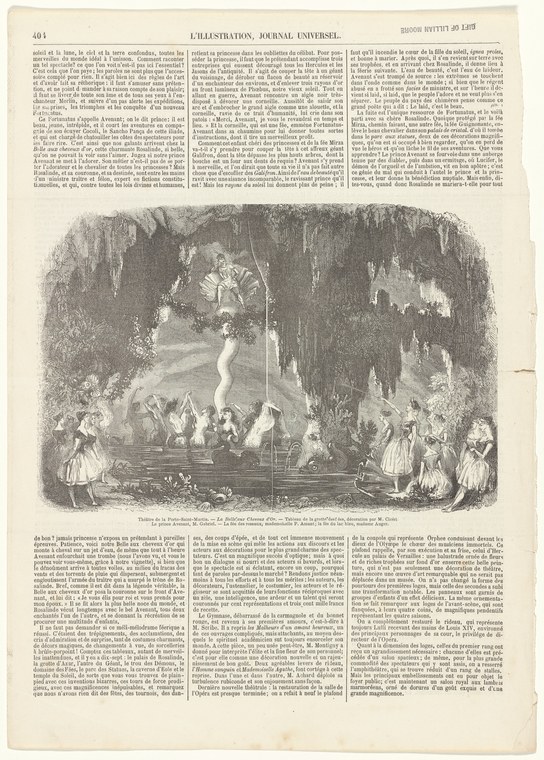
This image documents the emergence of outdoor, mixed-sex social dancing as a leisure activity in the 19th century, a shift from the formal ballroom conventions of earlier periods. It also illustrates how commercial illustration shaped and disseminated images of dance and society, making *L'Illustration* a primary source for understanding how dancing was understood, performed, and consumed in this period.
What you are looking at
A wood engraving depicting an outdoor garden or park setting with a substantial stone bridge or causeway crossing water. The scene is crowded with figures in mid-19th-century dress: women in long skirts and bonnets, men in formal coats and top hats. The composition is dense and theatrical, with figures arranged at multiple levels—some on the bridge structure, others in the water or on the banks below. The lighting creates strong contrasts typical of wood-engraved illustration, with deep shadows in the foliage and bright passages on the figures and water. The overall effect is of a fashionable outdoor gathering or promenade, rendered with the journalistic immediacy characteristic of *L'Illustration*, the French periodical that popularized such scenes for a mass audience.
The dancing
The dancers (if this depicts dance rather than social promenade) are rendered at various scales and in varied postures, suggesting movement and spatial depth. Several figures appear to be in motion—some with arms raised, others in bent or twisting positions. The women's long skirts dominate visually; the weight and drape of the fabric would have made rapid or acrobatic movement difficult. The figures lack the formal alignment of a structured dance formation; instead they appear scattered and naturalistic, as though captured mid-movement in an uncontrolled social setting. The engraving technique cannot resolve fine details of footwork or hold.
The dance depicted
This may depict a fashionable outdoor dance or entertainment, but the image is ambiguous. The crowd, the outdoor setting, the informal scatter of figures, and the absence of visible musicians or musical instruments all suggest social promenade or public entertainment rather than a formal dance performance. If dancing is intended, it appears to be courtship display or carnival amusement—the kind of impromptu, heterosocial mingling that characterized 19th-century leisure gatherings. The style and scale of dress suggests the 1830s–1850s, making this consistent with Romantic-era outdoor entertainment.
How it was made
This is a wood engraving, a relief printing technique that uses the end-grain of a hardwood block and a burrin to create fine, precise lines. The technique allowed *L'Illustration* (founded 1843) to produce detailed, intricate images at high volume and low cost, making such scenes accessible to middle-class readers. Wood engraving was the dominant medium for newspaper and magazine illustration in the mid-19th century; its reproductive efficiency and the crisp, linear aesthetic it produced made it ideal for journalistic and documentary purposes. The image shows sophisticated use of parallel line work to create tone and texture, particularly in the foliage, water, and fabric.
About this work
This wood engraving from *L'Illustration*, the influential French illustrated journal, depicts a fashionable outdoor gathering—possibly a dance or public entertainment—in a romantic garden or park setting. The scene captures the social and visual culture of mid-19th-century leisure, when public promenades, outdoor concerts, and casual mixed-sex entertainments became popular among the urban middle classes. The work exemplifies the role of illustrated periodicals in documenting and shaping perceptions of contemporary social life. *L'Illustration* built its reputation by translating current events and fashionable scenes into detailed wood engravings for a mass audience; such images were both documentary and aspirational, showing readers how leisure was—or ought to be—enjoyed.
How to look at it
Attend to the composition and its narrative of sociability. The artist has chosen a moment of mingling and movement rather than a formal dance step or structured figure. Notice how the engraving technique renders the fabric of the women's dresses—the parallel lines follow the folds and movement of cloth, suggesting weight and motion. The bridge and water create spatial depth and a sense of leisure-time pleasure in a cultivated setting. The scatter of figures and the absence of visible musical accompaniment suggest that this is social rather than formal theatrical dance.
The period
The mid-19th century saw a dramatic transformation in how dance was represented and consumed. Romantic ballet—with its emphasis on ethereal female dancers, exotic settings, and emotional narrative—dominated theatrical dance, but outside the theatre, outdoor entertainments, public gardens, and promenades became sites where ordinary people could dance and be seen. *L'Illustration*, founded in 1843, pioneered the use of wood engraving to deliver timely, detailed images of contemporary life to a mass readership. The journal documented fashionable society, urban leisure, and current events, treating dance and social gathering as subjects of general interest. This democratization of illustrated reportage meant that dance moved from the preserve of court chronicles and artistic allegory into the realm of journalism and social documentation.
Where it lives
This is a wood engraving from *L'Illustration*, the French illustrated periodical that was the leading journal of its kind in the 19th century. The work is held by the New York Public Library as part of its collection of prints depicting dance.
Dance in this work
Questions about this work
Is this a real event or an imagined scene?
*L'Illustration* combined documentation with artistic interpretation. While such outdoor gatherings and entertainments were common in mid-19th-century Paris and provincial towns, the specific scene may be a composite or idealized version of fashionable leisure. The journal aimed to capture the spirit and style of contemporary life rather than to provide literal reportage.
What kind of dance is this?
The image is too ambiguous to identify a specific dance form. It appears to depict social mingling and promenade rather than a structured dance with recognizable steps or formation. If dancing is occurring, it is likely courtship display or informal social dancing rather than a named dance style.
How was this image made and distributed?
A wood-engraved block was cut by hand and then printed using a printing press, allowing thousands of impressions to be made. *L'Illustration* published such images weekly, making them affordable and accessible to middle-class readers who could not attend live performances or exhibitions.
More dance artwork





