49 works in this view — arrow keys or swipe to move between them.
Dance in Art
Dance cartoons
Unknown artist
- Collection:
- Prints depicting dance
- Source:
- New York Public Library
- Rights:
- Public domain — free to use, share and adapt.
- Recorded as:
- Public Domain
This work documents the cultural saturation of theatrical and ballroom vocabulary into mid-century bourgeois life. For historians of social dance, it shows how the refined, turned-out postures and exaggerated gestures of the ballroom had become so naturalized in upper-middle-class female deportment that they were ripe for mockery. The cartoon reveals that dance training shaped not only formal performance but the everyday bodily culture of fashionable society.
What you are looking at
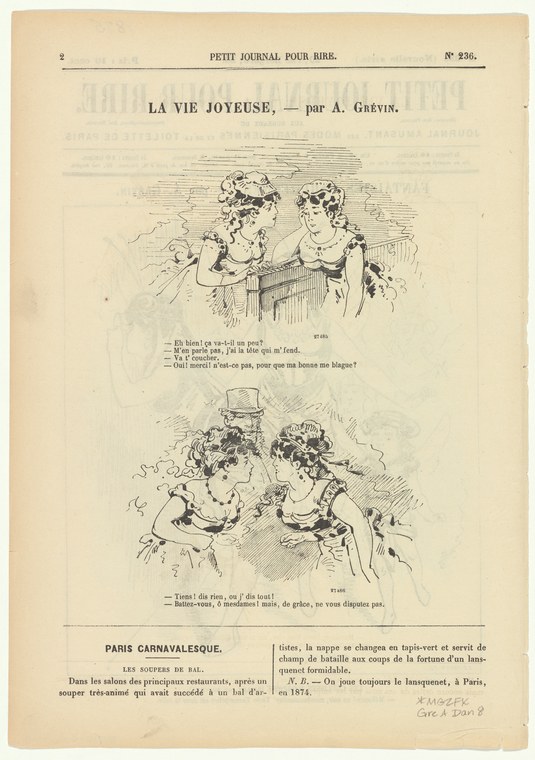
This is a French satirical cartoon from the Petit Journal pour Rire, presented in two stacked panels. The upper panel shows two young women in elaborate mid-19th-century dress—full skirts, fitted bodices, and ornate hairstyles—in close conversation or intimacy, their heads nearly touching. A small figure of a man in formal dress with a top hat appears in the background, reduced in scale and rendered faintly. The lower panel depicts the same two women in a more animated pose, now facing each other with exaggerated expressions and gestures, their bodies tilted toward each other in what reads as mock-dramatic or coquettish engagement. The cartoon's hand-drawn line work is loose and expressive, typical of period satirical illustration. The French captions suggest social commentary on courtship, flirtation, or female friendship—the kind of gentle mockery of contemporary manners that was the journal's stock-in-trade.
The dancing
The two female figures dominate both compositions. In the upper panel they stand close, their postures bent slightly inward, heads inclined toward each other in a posture of confidence or shared gossip. In the lower panel they face directly toward each other with more pronounced bodily engagement—their arms gesture expressively, and their silhouettes suggest turned-out positions or a theatrical exaggeration of social interaction. There is no formal dance hold; instead the artist captures the body language of flirtation and intimate conversation. The proportions and stiffness of the line suggest the figures are rendered with satirical intent rather than anatomical precision.
The dance depicted
This is not a depiction of dance in the formal sense but rather a satirical commentary on social movement and courtship ritual among young women of the Second Empire period. The exaggerated postures and gestures function as a parody of the refined, affected mannerisms expected in fashionable society. While the figures' turned-out positions and theatrical framing evoke the vocabulary of theatrical gesture and ballroom deportment, the work satirizes social performance rather than documenting an actual dance style. The content is social satire, not dance documentation.
How it was made
This is a wood engraving or pen-and-ink illustration, printed as a page in the Petit Journal pour Rire, a popular French satirical weekly. The loose, gestural line work and the capacity to render fine tonal gradations and expressive facial features are characteristic of engraved or etched work for periodical reproduction. The two-panel format and the caption boxes below each panel follow the conventions of narrative cartoon sequences. The technique allowed for rapid production and wide circulation to a middle-class readership, making satire of contemporary manners and dress a form of mass entertainment.
About this work
This is a satirical cartoon from a mid-19th-century French humor magazine, capturing not a dance but the theatrical body language of fashionable courtship and female friendship among the urban bourgeoisie. The artist A. Grévin, credited in the title, uses exaggerated posture and gesture to mock the affected mannerisms of his contemporaries. The work belongs in a dance gallery not because it documents a choreographed form but because it reveals how dance vocabulary—turned-out positions, theatrical framing, expressive gesture—was absorbed into everyday social performance and became a target for visual satire. The refined gestures of ballroom culture and theatrical deportment are so embedded in the figures' bodies that satire of fashionable society necessarily becomes satire of how bodies move.
How to look at it
Notice how both panels use the turned-out positions and inclined torsos associated with ballroom deportment, but exaggerate them into absurdity. The upper panel's intimacy and the lower panel's theatrical intensity parody the refined, affected mannerisms of the period. Pay attention to the scale and faintness of the male figure in the background of the upper panel—he is literally marginalized while female intimacy dominates. The cartoon works by taking the normal vocabulary of fashionable posture and stretching it into ridicule.
The artist
A. Grévin was a prolific cartoonist and illustrator for the Petit Journal pour Rire in the 1860s, known for social satire targeting contemporary fashion, courtship, and bourgeois manners. His light, expressive line and gift for capturing bodily gesture made him well-suited to the rapid-production demands of weekly periodicals. He later became known for his wax museum (the Musée Grévin), but his early reputation rested on his skill as a satirist of Parisian society.
The period
The Second Empire (1852–1870) saw an explosion of illustrated periodicals and satirical magazines aimed at a growing literate bourgeoisie. The Petit Journal pour Rire, founded in 1848, was among the most successful, offering gentle mockery of contemporary fashion, courtship, and social aspiration. The period was also the height of the Romantic era in ballet, but theatrical dance was being absorbed and adapted into ballroom culture—the waltz, polka, and quadrille were the social dances of the period. Cartoon satire of fashionable society necessarily captured this fusion of theatrical and social movement.
Where it lives
This page is from the Petit Journal pour Rire, a weekly French satirical magazine held in the New York Public Library's prints collection. The journal published from 1848 and was a major vehicle for social and political satire aimed at a middle-class urban audience. Individual pages survive as prints and are catalogued as part of the library's dance-related graphics collection.
Questions about this work
Is this actually a dance?
No—it is a satirical cartoon of social behavior and courtship. But it matters for dance history because it shows how ballroom and theatrical vocabulary (turned-out positions, theatrical gesture, refined deportment) had become so embedded in everyday fashionable behavior that they were ripe for satire. The bodies move like dancers even when they are not dancing.
Who is A. Grévin?
A prolific cartoonist and illustrator for the Petit Journal pour Rire in the 1860s, known for satire of Parisian fashion and manners. He later founded the Musée Grévin, a wax museum in Paris that still exists.
Why was this in a humor magazine?
The exaggerated postures, the coded social interactions between the women, and the absurdly marginalized male figure in the background are all sources of humor. The cartoon mocks the affectation and self-consciousness of refined society—the way fashionable women performed versions of themselves.
More dance artwork





