49 works in this view — arrow keys or swipe to move between them.
Dance in Art
Dance prints from L'Illustration
Unknown artist
- Collection:
- Prints depicting dance
- Source:
- New York Public Library
- Rights:
- Public domain — free to use, share and adapt.
- Recorded as:
- Public Domain
These engravings show the ballroom as a subject of mass-circulation visual media in the nineteenth century—how dance became part of the illustrated news and entertainment culture that shaped middle-class life. They also reveal the gap between what an engraver could convey about dance through the conventions of the medium: spectacle, crowd, setting, and fashion are legible, but the actual dance technique is not.
What you are looking at
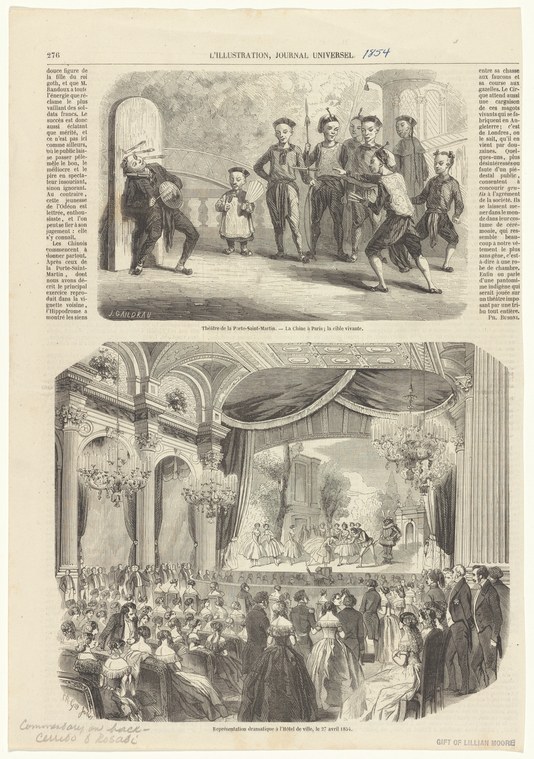
Two prints from L'Illustration occupy this page. The upper print depicts a theatrical scene in which a young boy in light clothing stands center-stage, surrounded by five men in dark formal dress (coats, trousers, hats) who gesture toward him with canes and pointing fingers. The setting appears to be an interior room with classical archways visible in the background. The composition is animated: the men lean forward with exaggerated postures suggesting mockery, accusation, or interrogation, while the boy's stance is uncertain. The lower print shows the interior of a grand ballroom or salon during an evening reception. The space is vast, with soaring arched ceilings, ornate swags of fabric, and glittering chandeliers casting light over hundreds of figures in formal evening dress. Couples and clusters of guests populate the floor; in the center distance, a raised stage or dais is visible where musicians perform or formal activities occur. The crowd is dense but organized, and the overall impression is one of fashionable society at leisure. Both are engravings rendered in the detailed, theatrical style characteristic of mid-nineteenth-century French journalism and illustration.
The dancing
In the upper print, five men display exaggerated gestural language—raised canes, extended arms, leaning torsos—that suggests theatrical rather than ballroom dance convention. The boy at center does not assume a dance position; his posture is reactive and defensive. In the lower print, while figures are dressed formally and the setting implies ballroom activity, the perspective and crowding make it impossible to discern specific dance steps, holds, or positions. Couples appear to be mingling and possibly waltzing, but the engraver prioritizes the spectacle of the assembled crowd over legible depiction of the dance itself.
The dance depicted
The lower print clearly depicts a formal ball or reception at which ballroom dancing would occur. The fashionable dress, the grand interior architecture, and the formal assembly all place this in the world of nineteenth-century European social dance—waltz, cotillion, quadrille. However, the engraving does not isolate or clearly depict any single dance style. The upper print is theatrical rather than social; it may depict a scene from a play or operetta involving dance or choreographed movement, but it is not documentation of actual ballroom practice. Neither print offers sufficient detail of footwork, hold, or frame to specify a particular dance style with confidence.
How it was made
Both works are engravings (wood or steel engraving on the evidence of the line work and tonal hatching). This medium allowed rapid production and mass circulation through L'Illustration, a weekly illustrated journal that reached middle-class readers across France and Europe from 1843 onward. The technique's requirement for clear line and high contrast suited the pictorial language of journalism and entertainment journalism in particular: bold gesture, sharp silhouettes, readable composition from distance. The engravings would have been printed alongside text (visible in the margins), making them work as press illustration rather than as fine art prints.
About this work
These are two pages from L'Illustration, the pioneering French illustrated weekly, showing ballroom and theatrical scenes. The lower print documents the aesthetic and social world of the formal ball—the architecture, the crowd, the gathering itself—in a style that prioritizes spectacle over technical ballroom documentation. The upper print, possibly from a theatrical narrative, shows exaggerated gesture in a way that suggests performance rather than social dance. Together they represent how mid-nineteenth-century French visual journalism depicted dance as a subject: not primarily interested in the mechanics of movement, but in dance as a marker of class, fashion, social ritual, and theatrical entertainment. The engravings are valuable not as technical dance records but as evidence of how dance was understood and consumed as a public spectacle by readers of a commercial illustrated press.
How to look at it
Focus first on the lower print's architecture and crowd: the engraver has chosen to emphasize the grand setting and the assembled society rather than individual dancers in motion. Look at how figures relate to one another in the ballroom—some appear paired, some in conversation, most part of an undifferentiated crowd. In the upper print, attend to the contrast between the men's aggressive, gestural postures and the boy's passive stance; this is theatrical or narrative choreography, not ballroom. Notice in both the formal dress codes and rigid social arrangement that distinguish these spaces—dance here is inseparable from fashion, hierarchy, and ritual.
The artist
These engravings are attributed to L'Illustration's staff, not to an identified artist. L'Illustration employed teams of wood engravers and artists who worked from sketches and designs; individual attribution was rare. The journal's visual style was collaborative and standardized, designed for rapid, weekly production.
The period
The ballroom was at its height as a site of urban social ritual in the mid-nineteenth century. The waltz had established itself across Europe despite clerical and conservative resistance; the quadrille and cotillion remained central to formal dance. L'Illustration's readers—merchants, professionals, educated urban middle class—defined themselves partly through attendance at such gatherings. The journal's regular coverage of balls, receptions, and theatrical events reflected and reinforced the importance of these occasions as markers of respectability, taste, and social position. Simultaneously, dance was becoming a subject of journalism and popular visual culture in a new way; the ball had moved from private record to public spectacle.
Where it lives
These works are from the NYPL's collection of prints from L'Illustration. The journal ran from 1843 to 1944 (with interruptions); the style and printing technique of these engravings places them in the mid-nineteenth century, most likely 1840s–1860s. They are part of the journal's archive, one of the most complete visual records of European urban life in this period.
Dance in this work
Questions about this work
Can you tell what dances are being performed?
Not with certainty. The lower print shows a formal ball at which waltz, quadrille, and cotillion would all have been danced, but the engraver has prioritized the spectacle of the crowd and setting over legible depiction of individual dancers or steps. The upper print appears theatrical and does not document ballroom dance at all. Neither engraving provides the close, unobstructed view of a couple or group that would allow identification of a specific dance style.
Who were these images made for?
These are pages from L'Illustration, a weekly illustrated journal for educated, urban, middle-class readers. The journal covered fashion, society, theater, and current events. Readers would have recognized the ballroom as a site of social aspiration and ritual; the engravings reinforced the idea that attendance at such events was a marker of respectability and taste. The images functioned as both documentation and entertainment—a way for readers to see (or imagine seeing) themselves in fashionable society.
Why is so much of the lower image taken up by the crowd and space?
The engraver has chosen to depict the ball as a total social and architectural experience, not as a demonstration of dance technique. The grandeur of the setting, the density of the crowd, the glitter of the chandeliers—these are the point. This reflects how the nineteenth-century urban middle class experienced the ball: as a prestigious gathering, a display of fashion and status, and a public ritual. Individual dancers and the movements they made were less important to document than the fact and feeling of the event itself.
More dance artwork





