49 works in this view — arrow keys or swipe to move between them.
Dance in Art
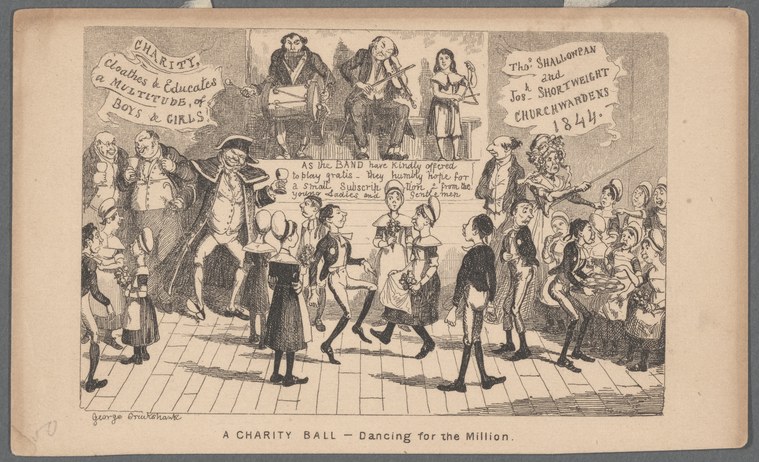
A charity ball, dancing for the million
Unknown artist
- Collection:
- Prints depicting dance
- Source:
- New York Public Library
- Rights:
- Public domain — free to use, share and adapt.
- Recorded as:
- Public Domain
This image documents how ballroom dancing functioned as social performance and aspiration in the 19th century, while also showing how contemporaries used visual satire to critique class mobility and social ambition. For dance historians, it reveals anxieties about who had the right to dance and what counted as proper technique—concerns that structured Gilded Age society.
What you are looking at
A satirical engraving depicting a crowded indoor charity ball, rendered in the comic style typical of 19th-century social satire. The composition is densely packed with figures of varying sizes and proportions, many distorted for comedic effect. The setting appears to be a ballroom with a checkered floor; figures crowd the entire space from foreground to background. At the top of the composition, three figures in formal dress—two men and a woman—are positioned above the crowd, possibly indicating the event's patrons or organizers. The women wear long gowns and bonnets; the men are in tailcoats and top hats. The dancing figures below are arranged in loose groupings across the floor, some paired, others isolated or in small clusters. The overall effect is one of chaotic festivity, with bodies at odd angles and various states of movement. The title "A Charity Ball—Dancing for the Million" appears at the bottom, suggesting this is social commentary on the commercialization or spectacle of charity events.
The dancing
The figures are rendered in a deliberately exaggerated, cartoonish style with distorted proportions and energetic, ungainly postures. Dancers are shown in various orientations—some appearing to waltz in loose pairs, others in more awkward or contorted positions, suggesting either inexperience or the artist's comic intent. The bodies lack the refined carriage expected of ballroom dancers; arms are held at varied and often irregular angles, and the overall impression is one of ungraceful or undisciplined movement rather than trained technique. The clustering and overlapping of figures makes it difficult to discern precise holds or frames, but no formal ballroom positioning is clearly evident.
The dance depicted
This is most likely depicting social ballroom dancing of the Gilded Age—the period when ballroom dancing was a central feature of upper- and middle-class social life. The title references a charity event "for the million," suggesting the artist is satirizing the democratization or commercialization of what had traditionally been an exclusive social practice. The style of dress and the formal ballroom setting point to waltzes and quadrilles, the dominant ballroom dances of the era, though the exaggerated, comic rendering makes it impossible to identify the specific dance with confidence. The image seems designed to mock the pretensions or awkwardness of amateur dancers rather than to document actual technique.
How it was made
This is a wood engraving or etching, rendered in black line with fine hatching and cross-hatching to suggest depth and shadow. The technique allows for detailed, precise linework and was the standard medium for mass-produced satirical prints of the 19th century. The fine detail visible in the figures' dress and facial expressions, combined with the satirical exaggeration, is typical of hand-engraved satirical commentary intended for periodical publication. The medium's accessibility and reproducibility made it ideal for social satire aimed at a broad, literate public.
About this work
This is a satirical print from the Gilded Age, likely appearing in a comic periodical or broadside, that uses distorted figures and chaotic composition to mock the social spectacle of a charity ball. The work belongs to a tradition of 19th-century social satire in which dance—as a marker of refinement, class aspiration, and social participation—becomes the target of humorous critique. The "dancing for the million" of the title suggests the artist is commenting on the broadening of access to previously elite social rituals, a phenomenon that fascinated and alarmed social commentators of the period. The exaggerated, almost grotesque rendering of the dancers serves both comic and critical ends, inviting the viewer to laugh at the pretensions and awkwardness of those attempting to participate in genteel society.
How to look at it
The viewer should attend to the distortion and chaos: note how the artist has deliberately rendered the dancers as ungainly, with awkward postures and disproportionate limbs, in contrast to the refined carriage that ballroom dancing was supposed to exemplify. Observe the density of the composition and the overlapping of figures, which suggests confusion and loss of control rather than the orderly grace of a well-managed ballroom. The exaggerated facial expressions and body angles are the satire's vehicle—the artist is not documenting actual dancers but commenting on the pretensions and failures of those trying to perform refinement. The positioning of the three figures at the top, separate from the crowd, may indicate the social hierarchy being satirized.
The period
The Gilded Age (roughly 1870s–1900) saw the explosive growth of public ballroom dancing and the emergence of new venues—dance halls, public ballrooms, and charity balls—that made ballroom dancing accessible beyond the aristocratic salon. Simultaneously, this democratization provoked satirical commentary from artists and journalists concerned with class boundaries and authentic gentility. Waltzes and quadrilles, which had dominated 19th-century ballroom culture since the early 1800s, remained the standard forms, though their meaning was shifting as they became increasingly commercialized and public. Wood engravings and etchings for comic periodicals were a major vehicle for this kind of social satire, reaching a mass audience and shaping public discourse about manners, fashion, and social aspiration.
Where it lives
This work is held in the New York Public Library's collection of prints depicting dance, a collection focused on visual representations of dance practice and performance across periods and cultures. Such satirical prints were typically produced for periodical publication and were widely distributed; their presence in institutional collections reflects both their historical significance as documents of social attitudes and their value as artistic and social commentary.
Dance in this work
Questions about this work
Is this depicting a real ballroom dance?
No—this is satire. The distorted figures and chaotic composition are intentional exaggeration designed to mock the dancers or the event itself. The artist is using comic distortion to comment on social pretension or the awkwardness of people attempting to participate in genteel society, not documenting how ballroom dancing actually looked.
What dance is being shown?
The formal dress, ballroom setting, and period suggest waltzes or quadrilles, the dominant ballroom dances of the Gilded Age. However, the satirical rendering makes precise identification impossible. The title's emphasis on 'the million'—suggesting ordinary people, not trained dancers—reinforces that technique is not the point; social aspiration is.
Why would someone make a satirical print about a charity ball?
Charity balls were a major social institution of the Gilded Age, serving both charitable aims and social prestige. Satirists seized on them as sites of class anxiety and social climbing—the perfect target for commentary on who belonged in genteel society and who did not. The print likely appeared in a comic periodical as social commentary.
What does the title 'Dancing for the Million' mean?
'For the million' suggests dancing by or for ordinary people, a stark contrast to the exclusive, aristocratic contexts in which ballroom dancing had traditionally taken place. The phrase likely carries irony: the artist may be mocking either the organizers' pretense of charity or the audacity of ordinary people claiming access to elite social rituals.
More dance artwork





