49 works in this view — arrow keys or swipe to move between them.
Dance in Art
Theatrical portraits
Unknown artist
- Collection:
- Prints depicting dance
- Source:
- New York Public Library
- Rights:
- Public domain — free to use, share and adapt.
- Recorded as:
- Public Domain
This work captures the aesthetics of early 20th-century theatrical femininity and the training in bodily control that underpinned performance in that era. It shows how dance and theater training shaped the bearing and posture of performers across genres, and how theatrical prints distributed idealized images of women's movement and dress to a wide audience.
What you are looking at
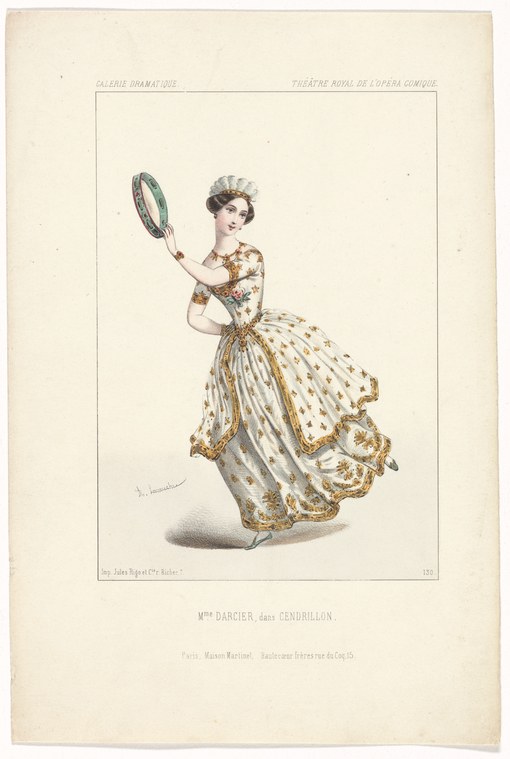
A single female figure in a white Edwardian dress with gold embroidered detail occupies the center of the composition. She stands in a posed attitude with her weight shifted onto one leg, holding a tennis racket at shoulder height with her right arm raised and slightly bent. The dress is fashionable for the period—a high-waisted silhouette with puffed sleeves, the skirt flaring dramatically from the hip and sweeping into elaborate folds and pleats at the hem. The bodice is fitted and decorated with small floral or geometric patterns in gold. Her hair is styled up in the fashion of the Edwardian era, topped with a small cap or ornament. The background is plain and neutral, letting the figure and her elaborate costume dominate the frame. The pose is elegant and balanced, suggesting a moment of leisure or athletic grace rather than active motion.
The dancing
The dancer's posture is upright and poised, weight centered over the supporting leg while the other leg is relaxed and slightly bent. Her raised right arm holds the racket in a gesture that suggests readiness or a moment caught between actions—neither mid-swing nor at rest. The arm line is graceful and controlled. The figure stands alone, and the entire composition emphasizes the silhouette and the interplay between the fitted bodice and the full, decorative skirt.
The dance depicted
This is not a depiction of concert dance but rather a theatrical or comedic study of a woman engaged in tennis, a fashionable upper-class leisure activity of the Edwardian era. The work sits at the boundary between dance and sport, capturing a moment of physical elegance and postural control that echoes theatrical movement training. The pose has theatrical sophistication—it is a held, composed attitude rather than a snapshot of athletic exertion. This appears to be a theatrical portrait type, possibly from a revue, operetta, or society entertainment where the line between sport, movement, and theatrical display was fluid.
How it was made
This is a color engraving or chromolithograph, evidenced by the delicate hand-coloring in watercolor or gouache overlaid on a printed line work. The technique allows fine detail in the costume's decoration and the precise rendering of the figure's silhouette. The print was likely produced for circulation among a theater-going audience, distributed as a theatrical souvenir, or published in a contemporary periodical celebrating fashionable entertainments. The quality of production and artistic finish suggest a commercial print intended for a middle to upper-class market.
About this work
This is a theatrical portrait from the early 20th century, most likely French, depicting a performer or fashionable figure in an Edwardian tennis outfit—a costume that blurs the line between sport and theatrical display. The work belongs to a tradition of theatrical prints that documented the dress and posture of performers and fashionable society figures, capturing idealized images of elegance and physical grace. In the context of dance and movement studies, it documents a historical moment when theatrical training and fashionable deportment were inseparable, and when even everyday leisure activities like tennis were performed with theatrical polish and attention to line.
How to look at it
Attend to the balance and control in the posture: the figure is not caught mid-exertion but held in a moment of composed elegance, with weight centered and lines clean. The artist emphasizes the silhouette and the interplay between the fitted bodice and the sweeping skirt, showing how a woman's movement was constrained and shaped by her costume. The raised arm and the tilt of the head create a sense of readiness and attention, suggesting the figure is aware of being looked at—a theatrical presence rather than an absorbed athlete.
The artist
The artist is not recorded. The print bears the mark of a professional theatrical print house, likely French, working in the chromolithographic tradition. The style is consistent with early 20th-century Parisian theatrical portraiture.
The period
This work dates to the Belle Époque or early Edwardian period, when theatrical entertainment was a major social institution and theatrical prints were widely collected. Tennis had recently become fashionable among upper-class women, and sporting dress was increasingly visible in theatrical and social contexts. The intersection of athletic and theatrical movement was a rich subject in the visual culture of the period. Theatrical prints like this one served as both documentation and propaganda for fashionable entertainments and the idealized femininity they promoted.
Where it lives
This work is held in the New York Public Library's collection of theatrical prints and dance imagery. It was likely published as a commercial theater print or appeared in a contemporary entertainment periodical. The catalogue record attributes it to an unknown artist and dates it to the early 20th century.
Questions about this work
Is this a dance print or a sports print?
It sits between the two. The pose and presentation are theatrical, not documentary—the figure is staged and idealized rather than captured mid-motion. The costume is a fashionable sporting outfit of the Edwardian era, but the way it is displayed and the control of the posture owe more to theatrical training and presentation. This reflects a historical moment when theatrical movement training shaped the deportment of upper-class women and entertainers across many contexts.
Who was this performer?
The print is identified only as a theatrical portrait of a woman in tennis costume, and the catalog does not name her. She may have been a well-known music hall or theater performer of the period, or a fashionable society figure whose image was commercially printed for sale to the theatrical public. Without additional inscription or provenance information, we cannot identify her.
What does this tell us about early 20th-century dance?
It shows that theatrical movement training shaped how women carried themselves in everyday activities and leisure contexts. The upright posture, the control of weight, the awareness of the line of the body, and the graceful deployment of the arms—these reflect the training in bodily discipline that was central to theatrical performance. Tennis was fashionable, but it was performed and documented with theatrical polish and attention to visual effect.
More dance artwork





