49 works in this view — arrow keys or swipe to move between them.
Dance in Art
James Figg: Master of ye Noble Science of Defence
Unknown artist
- Collection:
- Prints depicting dance
- Source:
- New York Public Library
- Rights:
- Public domain — free to use, share and adapt.
- Recorded as:
- Public Domain
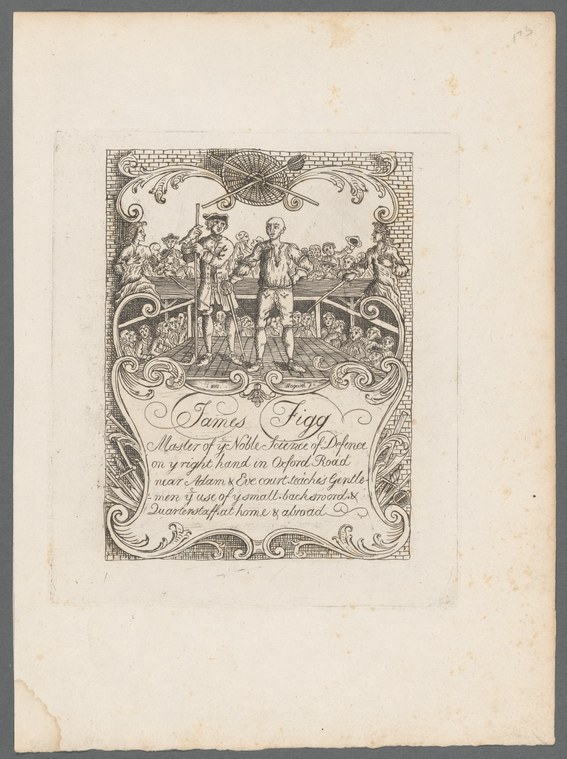
James Figg's status as the first modern boxing champion and master of the sword makes this one of the earliest promotional images of an athletic instructor in Britain. For dance historians, it documents the permeable boundary between dance training and combat training in the Georgian period—both were taught to the same audience, in the same studios, by instructors who often crossed between disciplines. The image is a rare window into how martial and dance expertise were understood as related accomplishments of the gentlemanly body.
What you are looking at
A man in early eighteenth-century dress stands centre-stage in a theatrical or demonstration setting, his body in profile facing right. He wears a coat, breeches, and stockings; his posture is commanding and instructional rather than recreational. To either side stand smaller figures in similar period dress, positioned as if watching or waiting instruction. The background suggests an interior space with a crowd of onlookers arranged informally. The entire composition is enclosed in an ornate baroque cartouche of scrollwork and architectural detail, with brick patterning above. Below the image runs a long inscription in flowing script, identifying the subject and describing his accomplishments. The engraving has the crisp, high-contrast quality typical of early eighteenth-century reproductive prints.
The dancing
The central figure stands with weight evenly distributed, one arm extended in a demonstrative gesture while the other hangs at his side—a posture of authority and instruction rather than dance. His stance is upright and formal, the legs in a stride position rather than in any balletic closed or open frame. The attendant figures are smaller, clustered, and deferential in their positioning. The entire composition reads as a teaching moment or performance demonstration rather than social dance between equals.
The dance depicted
This is not a depiction of dance as performance or social ritual, but rather a record of expertise in combat and the martial arts. James Figg was a famous fencing master and boxing instructor whose 'Noble Science of Defence' encompassed swordplay, cudgel work, and unarmed combat—all presented in eighteenth-century London as athletic and gentlemanly accomplishments. The image captures him as a master demonstrating technique to pupils or an audience. While combat systems of this era are related to the formal, geometric body language of baroque courtly dance, and both employ similar principles of stance and carriage, the subject here is martial instruction, not dance.
How it was made
This is an engraving, identifiable by the uniform line work, the parallel hatching used to create tone, and the sharp definition of fine detail. The technique allows for wide reproduction and circulation at modest cost, making it ideal for publicity and advertisement of Figg's school and reputation. The decorative cartouche suggests this was printed as a standalone portrait-advertisement, possibly distributed as a trade card or collected separately. The level of finish and the inclusion of a lengthy biographical inscription indicate this was a formal, commissioned work intended to document and promote a celebrated figure.
About this work
This is a documentary engraving from the early eighteenth century depicting James Figg, the celebrated London fencing master and boxing instructor who elevated hand-to-hand combat to a fashionable gentlemanly pursuit. Though combat is distinct from dance, the image belongs in a dance history collection because the formal carriage, geometric body positioning, and rules of engagement in fencing and boxing of this period share deep formal and philosophical roots with baroque dance. Both were taught to gentlemen as markers of status and courtly bearing, both used symmetry and line as organizing principles, and both were recorded in the same visual and rhetorical idiom. Figg's codification of combat technique influenced the development of theatrical movement vocabularies and contributed to the broader visual culture of the body in motion.
How to look at it
Look at the precision of Figg's stance and the controlled positioning of his limbs—nothing is slack or accidental. The smaller figures frame him as the authoritative center, positioning the viewer as student or spectator rather than participant. The long inscription below is as important as the image itself: read it to understand what accomplishments and victories Figg claimed, and how combat expertise was marketed to the Georgian public. Notice the ornamental cartouche, which elevates Figg to the status usually reserved for nobility or royalty in prints of this era—evidence of how celebrity was constructed in the early print age.
The artist
The artist is not recorded in the catalogue. The engraving's style and finish suggest it was produced by a London print workshop in the 1720s-1730s, during the height of Figg's fame. The decorative cartouche and biographical inscription follow conventions used for celebrated performers and instructors of the period, indicating this was a formal commission. The quality of execution and the care lavished on detail suggest the engraver was competent and the print was expensive—evidence of Figg's prominence and his ability to commission work.
The period
James Figg taught boxing and fencing in London from the 1710s until his death in 1734, at a moment when both disciplines were being systematized and elevated into gentlemanly arts. The 1720s saw the rise of the ampitheatre at Figg's School near Lincoln's Inn Fields, where London's gentry and nobility came to witness demonstrations and take instruction. This coincided with the codification of baroque dance technique and the publication of the first systematic dance notation systems—a parallel drive to discipline the body and make its movements legible and teachable. Figg's image exemplifies the fascination of the period with mastering formal, geometric uses of the body.
Where it lives
Held in the New York Public Library's collection of prints depicting dance. The work is catalogued as a dance-related print, likely because of the formal body positioning and the relevance of fencing and combat training to the history of theatrical movement.
Questions about this work
Is this actually a dance?
James Figg taught fencing and boxing, not dance in the modern sense. However, both were taught to the same Georgian gentry, often in the same spaces, and both valued formal carriage and controlled geometric movement. The boundary between martial and dance training in this period was fluid. This engraving belongs in dance history because it documents a related system of body discipline and training.
Who was James Figg?
Figg (1695–1734) was a boxer and fencing master based in London who became famous for his public demonstrations and instruction. He is often called the father of modern boxing. His amphitheatre near Lincoln's Inn Fields was a fashionable destination where gentlemen learned combat skills and watched exhibitions. He published accounts of his victories and maintained a school until his death.
What is this engraving used for?
This is a publicity print—a form of advertisement and celebrity documentation. It would have been sold separately, used as a trade card, or distributed to promote Figg's school and reputation. The long biographical inscription serves the same function as a modern biography or press release, asserting his achievements and status.
Why is the cartouche so ornate?
The elaborate baroque scrollwork elevates Figg to a level of importance usually reserved for nobility or royalty in eighteenth-century prints. It is a visual claim that he is a figure worthy of commemoration and study—part of the marketing of his celebrity and the legitimization of combat training as a gentlemanly art.
More dance artwork





