49 works in this view — arrow keys or swipe to move between them.
Dance in Art
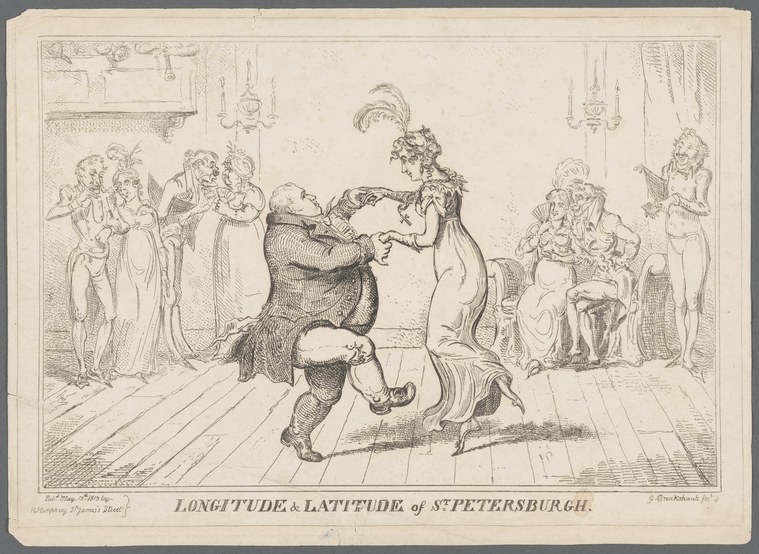
Longitude & latitude of St. Petersburgh
Unknown artist
- Collection:
- Prints depicting dance
- Source:
- New York Public Library
- Rights:
- Public domain — free to use, share and adapt.
- Recorded as:
- Public Domain
This print documents the contempt with which acrobatic display was regarded in elite circles of the late 18th century, when the refinement of ballroom dancing depended on upright posture, control, and the suppression of the body's capacity for inversion and extremity. It is evidence of a rigid aesthetic hierarchy in which theatrical gymnastics and social dancing occupied opposite poles. The work also reveals how 18th-century satirists used the dancing body—pushed into undignified positions—as a vehicle for social criticism.
What you are looking at
A satirical engraving depicting a grotesque dancing scene in an aristocratic interior. A portly figure in dark clothing executes an exaggerated backward somersault or headstand in the center of a polished wooden floor, his legs splayed in the air. He is surrounded by elegantly dressed onlookers in the classical dress of the late 18th century—women in high-waisted gowns with feathered headdresses, men in tailcoats—who observe from both sides of the room. The setting is a grand interior with classical architectural details: a fireplace and overmantel on the left, hanging chandeliers, and tall draperies. The artist has captured the moment of maximum absurdity, with the central figure's body inverted and his posture entirely divorced from the refined deportment expected of his peers. The contrast between the elegant stasis of the onlookers and the violent physicality of the performer creates the satirical force.
The dancing
The central male dancer is captured mid-inversion, his torso bent backward and legs vertical, suggesting either a deliberate acrobatic display or an undignified collapse. His arms are extended, one reaching toward the floor. The surrounding figures stand upright in conventional postures, some gesturing with hands raised in apparent surprise or amusement. No couple holds; all attention is directed toward the solo performer. The body language of the onlookers—particularly the raised hands and turned heads—suggests comic astonishment rather than participation.
The dance depicted
This appears to be satirical social commentary on fashionable dancing rather than documentation of an actual dance form. The acrobatic inversion—a backward somersault or headstand—is grotesque rather than skillful, suggesting mockery of either a specific fad or a particular dancer's pretensions. The title references St. Petersburg (then the Russian capital and a center of elite culture), implying this may ridicule either Russian court fashion or the pretensions of those imitating it. The image belongs to a genre of 18th-century satirical prints that lampooned fashionable behavior and dancing masters. No recognizable historic dance style is depicted; instead, the work uses an impossible, undignified posture to unmask the absurdity of contemporary fashion.
How it was made
This is an engraving, likely hand-colored, executed in fine lines with careful cross-hatching to create tonal depth. The technique allows precise detail in the architectural setting and the delineation of costume—the feathered headdresses, the cut of the coats, the folds of the gowns. Engraving was the medium of choice for satirical social commentary in the 18th century, allowing wide circulation and reproduction. The inscription at the bottom—'Longitude & Latitude of St Petersburgh'—appears in a hand-lettered caption typical of popular prints sold as loose sheets.
About this work
This is an 18th-century satirical engraving depicting an aristocratic gathering in which a central male figure performs an exaggerated acrobatic inversion—a backward somersault or headstand—while fashionably dressed onlookers respond with apparent shock or amusement. The work mocks fashionable dancing, pretentious dancers, or the fads of elite society, using the impossible and undignified posture of the central figure to create comic effect. The title's reference to St. Petersburg suggests the target is Russian court culture or its imitators. As satire rather than documentation, it reveals attitudes toward dance and bodily display in late-18th-century polite society: acrobatic display and loss of composure were ridiculous, worthy of public mockery.
How to look at it
Observe the precise moment the artist chose: the peak of inversion, when the figure's dignity is most thoroughly compromised. Notice how the engraver has emphasized the contrast between the central figure's violent, undignified posture and the upright, controlled stance of every onlooker—a visual argument about what constitutes proper bodily comportment. The architectural precision of the setting makes the human figure's loss of control all the more striking. Read the inscription and the title together: they are part of the satire, and their exact meaning may contain historical reference now lost.
The artist
The engraver is not recorded. The style and subject matter are consistent with the anonymous or pseudonymous satirical print tradition of late-18th-century England and continental Europe. Many such works were produced as popular broadsheets and sold cheaply, circulating widely among educated audiences. The execution is competent rather than brilliant, suggesting a commercial workshop rather than a major artist.
The period
This engraving dates to the era of the quadrille, cotillion, and minuet—dances defined by geometric precision, symmetry, and the suppression of the body's capacity for acrobatic display. The late 18th century saw fierce competition between competing styles of deportment and dancing pedagogy, and satirical prints frequently lampooned new fads, foreign affectation, and dancing masters' pretensions. The apparent mockery of Russian taste or St. Petersburg fashion suggests this may respond to specific cultural tensions or to the widespread European suspicion of Russian court culture as excessive and barbaric. Acrobatic feats were associated with street performance, circus, and the lower orders, making them natural targets for satire aimed at élites.
Where it lives
This is a print from the New York Public Library's collection of prints depicting dance. The work is a loose sheet, typical of the mode of circulation for satirical and topical prints in the 18th and early 19th centuries.
Questions about this work
Is this a real dance, or a made-up joke?
This is satire. The acrobatic posture—an inversion—is not a recognized dance step. The artist has exaggerated a figure into an absurd and undignified position to mock fashionable dancing or a specific dancer or fad. The title may contain a specific reference to Russian court culture that is now lost.
Why would people find an inverted body funny?
In the context of refined 18th-century society, the loss of upright posture signaled a loss of control and dignity. An aristocratic figure reduced to a headstand would have been both shocking and ridiculous—a visible collapse of the very bodily discipline that distinguished the elite from the lower orders. The satire works by showing what ought never be seen in polite society.
What is the title referring to?
The title 'Longitude & Latitude of St. Petersburgh' is likely a satirical reference to Russian court culture or fashion. It may play on the idea of mapping or measuring St. Petersburg as a source of exotic or aberrant behavior. Without additional context, the precise target of the satire is unclear, but it suggests the work mocks a specific fad or foreign affectation.
When was this made?
The style and costume suggest the late 18th century, but the catalogue record does not provide a date. The hand-lettered inscription, the engraving technique, and the fashions visible in the dress are all consistent with the 1780s–1790s, but this is an inference from the image alone.
More dance artwork





