49 works in this view — arrow keys or swipe to move between them.
Dance in Art
Theatrical portraits
Unknown artist
- Collection:
- Prints depicting dance
- Source:
- New York Public Library
- Rights:
- Public domain — free to use, share and adapt.
- Recorded as:
- Public Domain
Theatrical portrait prints like this one are primary documents of 19th-century stage culture, showing how performers were costumed, posed, and marketed to audiences. They reveal conventions of feminine display, character type, and performance that shaped theatrical dance and pantomime, even when no active movement is shown. The image preserves a moment of theatrical communication now lost—the direct relationship between performer, costume, and fan.
What you are looking at
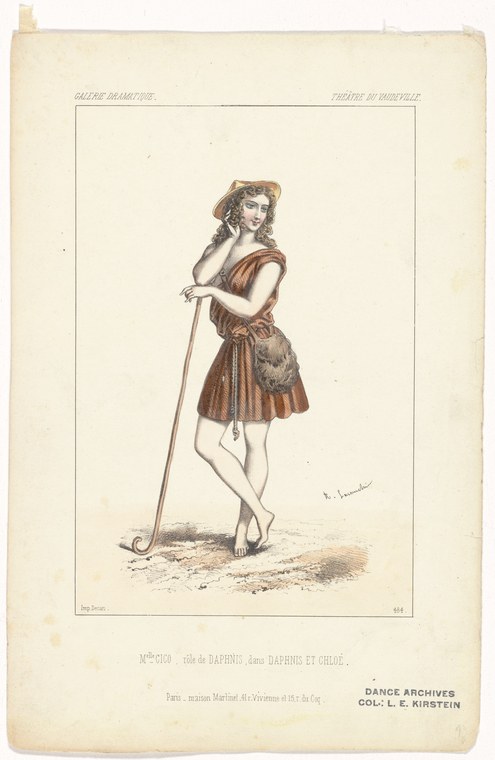
A young woman in mid-19th-century dress stands in a theatrical pose against a plain background, holding a long staff or shepherd's crook in her right hand. She wears a rust-brown skirt with horizontal pleating or fluting, a lighter upper garment with short sleeves, and a small bonnet or cap. Her posture is relaxed but graceful, with her left hand raised near her face in a gesture of pensiveness or coquetry. Her right leg is extended slightly forward, the weight distributed naturally rather than in a balletic position. The figure is rendered in hand-colored engraving with fine cross-hatching for shadow and texture. The composition isolates her against white space, a common format for theatrical portraiture that emphasizes her costume and bearing rather than narrative action.
The dancing
A single figure, a woman viewed at three-quarter length. Her weight is evenly distributed, with one leg slightly forward in a casual stance that suggests repose between movements or a moment of charming distraction. The raised left hand and tilted head convey a fleeting emotional state—neither balletic formality nor classical contrapposto. Her right arm holds the staff vertically, not planted firmly but held as a prop to be displayed. The posture is that of a character awaiting action rather than executing a demanding technical feat.
The dance depicted
This is a theatrical portrait of a female performer, likely from a mid-19th-century play, operetta, or pastoral pantomime. The costume—the bonnet, the rustic skirt, and especially the shepherd's crook—suggests a shepherdess or country character role. No active dance is depicted; instead, the image captures a moment of characterization and display, the kind of portrait that would have been sold as a souvenir to theatre-goers. The staff marks the character type rather than indicating a specific dance style.
How it was made
Hand-colored steel or copper engraving, a commercial reproductive process that allowed mass production of theatrical portraits. The fine hatching and delicate line work are characteristic of mid-19th-century theatrical print technology. Hand coloring was applied afterward, giving each print slight variations in tone. This technique was used to create affordable mementos of celebrated performers and roles, circulated to fans and collected in scrapbooks and albums. The quality and care of the engraving suggest this was issued by an established publisher.
About this work
A theatrical portrait print of a female performer in pastoral costume, from the period when such images were popular souvenirs of stage performance. The work belongs to a genre of ephemeral theatrical portraiture that documented the costumes, bearing, and character types of the 19th-century stage. It records not a moment of dance but a moment of theatrical presence—the performer's display of character and costume to an imagined audience beyond the frame. For dance historians, such prints are valuable documents of how movement and character were understood and presented in theatrical contexts before photography.
How to look at it
Note the stillness of the pose: this is not a moment of movement but of pause and presentation. The slight forward shift of weight and the raised hand convey a fleeting emotion or awareness of the viewer's gaze, a convention of theatrical portraiture that asks the spectator to read character in stance and expression. The costume details—the bonnet, the pleated skirt, the staff—are displayed clearly and frontally so that they register as identifying markers of the role. The engraver has used fine line and subtle shading to model the face and body, giving the figure presence and individuality despite its small scale.
The artist
The engraver's name is not recorded. The signature on the print (if legible, appears to read "E. Renaud" or similar) may indicate the engraver rather than the performer or original artist. Such theatrical portrait prints were produced by commercial printing workshops in Paris and London, often based on sketches or paintings of celebrated performers. The unsigned or barely credited engraver was typical of mass-market theatrical ephemera.
The period
The 1850s–1870s saw a boom in theatrical portraiture as chromolithography and hand-colored engraving made such images affordable and collectible. Performers' likenesses were sold at the theatre and by print dealers, feeding a appetite for celebrity imagery that preceded photography's dominance of portraiture. Pastoral and rustic character roles were popular in operetta and vaudeville, offering comedic contrast to urban settings and allowing performers to display a different register of femininity—rosy-cheeked innocence rather than tragic dignity.
Where it lives
The print is part of the New York Public Library's collection of theatrical and dance-related prints. The note at the base of the print cites a Paris publisher (Maison Martinet de l'Hôtel de Drouot, or similar), indicating commercial distribution through established theatrical print channels. The accession or collection reference may provide additional information about how and when the Library acquired this image.
Questions about this work
Is this a ballet dancer?
No. The costume, the staff, and the relaxed stance all suggest a theatrical character role—likely a shepherdess in an operetta or pastoral play—rather than a classical ballet. The engraving documents a moment of theatrical portraiture and character display, not a ballet technique.
Who was the performer?
The record does not identify the performer by name. Such theatrical portrait prints were often sold under the performer's name at the theatre, but surviving prints in collections may have lost that label. The costume and the date of the print may help identify the role and possibly the performer through playbills or theatrical archives.
Why is there a staff?
The staff is a traditional attribute of a shepherdess, identifying the character type and the pastoral or rustic setting of the play or operetta. In theatrical costume, such properties served as visual shorthand for role and genre, communicated instantly to the audience.
What was this print used for?
Theatrical portrait prints were souvenirs sold to theatre-goers, collected and pasted into albums, or framed as mementos of favorite performers and roles. They served the same function as lobby cards or celebrity photographs today—a way for fans to own an image of a performer they admired.
More dance artwork





