49 works in this view — arrow keys or swipe to move between them.
Dance in Art
Theatrical portraits
Unknown artist
- Collection:
- Prints depicting dance
- Source:
- New York Public Library
- Rights:
- Public domain — free to use, share and adapt.
- Recorded as:
- Public Domain
Theatrical character portraits document what audiences actually saw on stage and reveal the aesthetic conventions of a performance era. Without such images, the visual context of early ballet and opera—the silhouettes, the color, the spatial staging—would be lost to text alone. This work shows that theatrical dance in the Romantic era was conceived as dramatic narrative embodied in costume and bearing, not as abstract movement.
What you are looking at
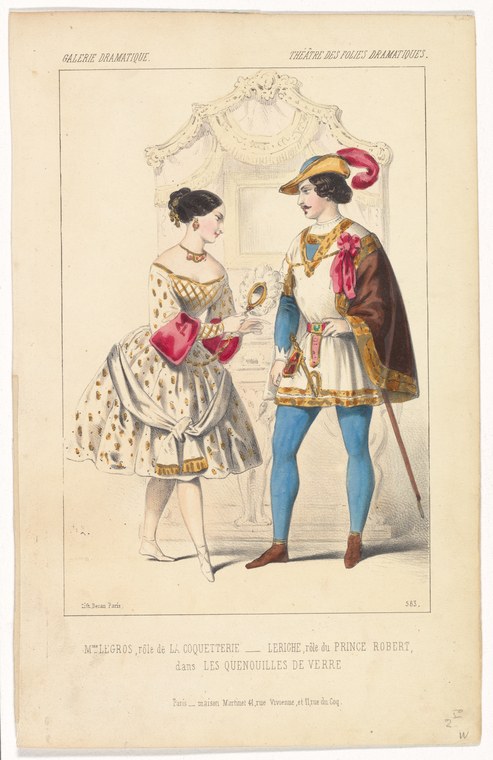
Two figures in theatrical costume stand in an ornate interior, engaged in what appears to be a formal theatrical moment. The figure on the left wears a pale dress with small-scale patterning (possibly floral or geometric), trimmed in deep rose or magenta silk, with a matching waistband and decorative collar; the hair is dark and arranged in a period style. The figure on the right wears a tunic in olive or golden-brown with blue stockings and red-brown shoes, a matching tunic-style overgament in rose, and a tall feathered headdress in rose and gold; the hair is also dark and styled to the period. The setting is a grand interior with a decorative arch or doorway frame above them, suggesting a palace or theatre. The composition is intimate—the figures stand close, turned toward one another, suggesting conversation or negotiation. The print is hand-colored with delicate tinting that emphasizes the richness of the fabrics.
The dancing
Both figures stand upright with weight evenly distributed, in a relaxed contrapposto stance typical of theatrical portraiture. The figure on the left faces slightly toward the right, with arms at rest; the figure on the right stands in profile or three-quarter view, one arm extended forward in a gesture of address or presentation, the other at the side. Neither figure is actively dancing—they are posed in conversation. The spatial relationship is formal but intimate, with bodies oriented toward one another in the manner of a dramatic scene or tableau.
The dance depicted
This is not a depiction of active dance but a theatrical portrait, likely representing characters from an opera, ballet, or dramatic production. The elaborate period costumes, feathered headdress, and noble styling suggest Romantic-era theatrical portraiture of the mid-19th century. The inscription indicates this represents characters from a specific work (partially legible as referencing Prince Robert and a location), which would have been a popular narrative opera or ballet of the period. The image documents theatrical character and costume rather than choreography or movement technique.
How it was made
This is a hand-colored engraving or lithograph, executed in a commercial theatrical illustration style common to the 1840s–1860s. The delicate hand-coloring of the fabrics, the careful linear definition of costume detail, and the softly-rendered interior setting are characteristic of theatre documentation prints intended for circulation among theatre-goers and collectors. The technique allowed rapid reproduction of popular theatrical moments and made them accessible to a broad audience; the quality of coloring suggests this was among the finer or more expensive copies produced.
About this work
This is a theatrical character portrait documenting a moment from a mid-19th-century dramatic production, likely an opera or ballet with European historical or legendary subject matter. It represents the visual culture of theatre during the Romantic era, when such prints served both as souvenirs and as records of celebrated performers and celebrated scenes. The work belongs in a dance collection because theatrical dance of the period was inseparable from dramatic narrative, costume, and stagecraft; this image reveals how character and dramatic situation were conveyed through dress, posture, and spatial relationship—elements as crucial to performance as choreography itself.
How to look at it
Attend to the quality and specificity of the costume detail: the drape of the fabric, the precise color and placement of silk trim, the headdress construction. These reveal what mattered to the theatre of the period—the visual spectacle of dress as an essential element of character and narrative. Notice also the restrained, dignified posture of both figures despite their theatrical costume; this was not the melodramatic exaggeration of popular imagination but a formal, controlled bearing suited to aristocratic or noble characters. The moment frozen here is one of stillness and attention—a pause in action, designed to be readable across a theatre auditorium.
The artist
The artist is not recorded. The style and printing technique are consistent with mid-19th-century French theatrical illustration, a genre dominated by commercial publishers who employed anonymous engravers and colorists to meet high demand for theatre souvenirs. Such prints were sold in theatre lobbies and through print sellers, making them ephemeral objects without signature attribution.
The period
The Romantic era (c. 1830–1870) witnessed explosive growth in theatrical dance, particularly ballet, as a vehicle for narrative spectacle and exotic fantasy. Performers such as Marie Taglioni, Fanny Elssler, and Lucile Grahn were international celebrities, and their images were mass-produced as engravings and lithographs. Simultaneously, opera was the dominant theatrical form across Europe, and many ballets were embedded within operatic works or shared the same aesthetic of historical drama, elaborate costume, and emotional gesture. This print belongs to that visual economy.
Where it lives
The work comes from the New York Public Library's collection of prints depicting dance. It is catalogued as a theatrical portrait but without attribution, date, or medium specified in the record. The inscription on the print itself provides the primary evidence of subject and context.
Questions about this work
Is this a depiction of an actual dance?
No—this is a theatrical character portrait in which the figures stand at rest, posed in conversation. It documents costume and character type rather than choreography or movement. However, it is essential to understanding how dance was presented theatrically in the mid-19th century, when ballet and opera were inseparable from narrative drama and elaborate visual spectacle.
What is the source of the inscription?
The text is printed on the plate itself and would have identified the work, the characters represented, and possibly the performers or theatre. Much of it is difficult to read in reproduction; the partial reference to 'Prince Robert' suggests a historical or legendary dramatic subject.
Why is the man's costume styled like that?
The tunic, stockings, and feathered headdress indicate a medieval or Renaissance-historical character type, consistent with Romantic-era taste for exoticized or historically distant settings. The headdress in particular was a marker of high rank and theatrical importance.
Could this be a print of a famous performance?
Possibly, but without a legible inscription or accession information, the specific production cannot be confirmed. Many such prints documented celebrated performers and acclaimed productions, making them collectable souvenirs. The quality of execution and hand-coloring suggests this may have been a more expensive or premium copy.
More dance artwork





