49 works in this view — arrow keys or swipe to move between them.
Dance in Art
Salvatore Viganò
Unknown artist
- Collection:
- Prints depicting dance
- Source:
- New York Public Library
- Rights:
- Public domain — free to use, share and adapt.
- Recorded as:
- Public Domain
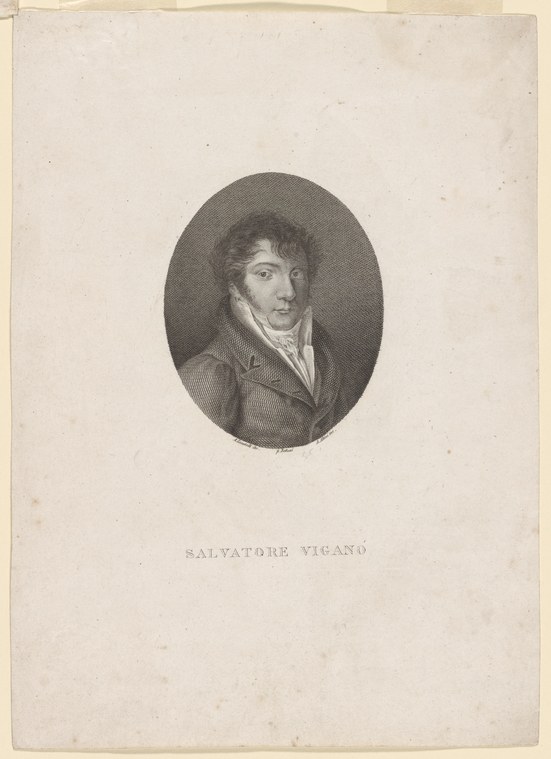
Viganò is a foundational figure in the history of theatrical dance, yet he is less widely known than his contemporaries. This portrait is one of the few surviving images of him and serves as a historical anchor for understanding the person behind the revolution in narrative ballet form. For historians and dancers studying the development of modern choreography, this print is documentary evidence of how cultural recognition of dance innovation was materially embodied and circulated in the early nineteenth century.
What you are looking at
This is an engraved portrait bust of a young man, rendered in the neoclassical style typical of early-nineteenth-century biographical prints. The subject is shown in three-quarter view within an oval frame, wearing the formal dress of the Napoleonic era: a dark coat with a high collar and a white shirt front visible beneath. His dark, curly hair is styled in the manner fashionable around 1800–1820. The engraving employs fine parallel lines (hatching) to model the face and create depth, with particular attention to the play of light across the subject's features. The background within the oval is rendered as a subtle gradient, darker toward the top to create atmospheric depth. Below the portrait, the name "SALVATORE VIGANÒ" is inscribed in capital letters. The print has aged to a warm cream tone, typical of early nineteenth-century paper stocks.
The dancing
The portrait shows only the head and shoulders of a single figure. There is no active gesture or bodily movement; the subject is positioned in a formal, frontal pose with his body angled slightly to the left. His gaze is directed outward and slightly upward, a convention of neoclassical portraiture that conveys dignity and intellectual presence. The clothing—the formal coat and high collar—frames the face and emphasizes the subject's status as a person of cultural importance.
The dance depicted
This is a commemorative portrait print of Salvatore Viganò (1769–1821), one of the most significant figures in European dance history and a pivotal innovator of pantomime ballet. Viganò was an Italian choreographer and dancer who revolutionized narrative ballet by developing *coreodramma*, a form that synthesized classical ballet technique with dramatic pantomime and created large-scale ensemble choreography. He worked primarily in Italy and Vienna during the Napoleonic era and was celebrated for works such as *Gli Strelizzi* and *Otello*. The portrait itself does not depict him dancing; rather, it is a biographical memorial—a form of cultural documentation that recognized his significance at a time when dance was emerging as a serious artistic subject worthy of permanent record.
How it was made
This is an engraving, a relief-printing technique in which an image is incised into a metal plate (typically copper) with a burin or needle, with ink held in the incised lines and transferred to paper under pressure. The fine, parallel hatching visible throughout the portrait—especially in the modeling of the face, the texture of the hair, and the fabric of the coat—is characteristic of engraved line work. The technique was well-suited to portraiture and biographical documentation, as it allowed for precise rendering of physiognomy and was reproducible in multiple impressions, making it an ideal medium for circulating images of notable figures to educated audiences. The inscription below indicates this was a print made for public or institutional distribution, not a unique work.
About this work
This engraved portrait commemorates Salvatore Viganò, the Venetian-born choreographer and dancer who became one of Europe's most influential dance artists in the early nineteenth century. Viganò's innovations in *coreodramma*—a synthesis of ballet technique, pantomime, and large-ensemble choreography—fundamentally altered how narrative could be expressed in dance. This print, likely produced sometime in the early nineteenth century (possibly after his death in 1821, as a memorial), documents not a moment of dance but the figure of the artist himself, reflecting the growing recognition of choreography and dance innovation as worthy of permanent commemoration. The work belongs in a dance gallery as evidence of how dancers and choreographers were being documented and honored during the period when ballet was establishing itself as a serious European art form.
How to look at it
This is not an action portrait; it is a memorial image, and the viewer should attend to what the formal conventions of neoclassical portraiture communicate about Viganò's historical status. The oval frame, the dignified three-quarter pose, the formal dress, and the carefully rendered physiognomy all signal that this was a figure of cultural importance deemed worthy of permanent, reproducible commemoration. The quality of the engraving—the fineness of the line work, the subtlety of the modeling—indicates that this was produced for educated, perhaps aristocratic or institutional audiences. The inscription is crucial: it grounds the portrait in Viganò's identity as a named individual and distinguishes it from generic or allegorical representations of "dance" or "the dancer."
The artist
The artist of this engraving is not recorded in the catalogue. However, the style and execution are consistent with high-quality biographical engraving practice of the period 1800–1830, when such portraits were commissioned to honor notable artists, intellectuals, and political figures across Europe. The work was likely produced by a professional engraver working from a drawn or painted original portrait, a common practice for creating reproducible commemorative prints.
The period
Salvatore Viganò lived and worked during the Napoleonic era and the early Restoration period in Europe, a time of significant innovation in ballet and theatrical dance. During this period, ballet was transitioning from the ornamental court entertainment of the eighteenth century toward a more dramatically coherent and emotionally expressive art form. Viganò's development of *coreodramma*—which gave prominence to dramatic narrative and used ensemble choreography as a primary means of expression—coincided with broader European movements in theatrical reform and Romantic aesthetics. The production of this biographical portrait engraving reflects the growing prestige of dance and choreography as worthy subjects of fine-art documentation, a shift that occurred gradually during the early nineteenth century as ballet gained recognition as a serious literary and artistic endeavor rather than mere divertissement.
Where it lives
This work is held in the New York Public Library's Prints depicting Dance collection, a collection explicitly organized around visual documentation of dance subjects. The engraving's presence in this collection reflects its recognition as a significant historical document of dance culture, even though it is a biographical portrait rather than a depiction of a dance or performance.
Questions about this work
Who was Salvatore Viganò?
Salvatore Viganò (1769–1821) was an Italian choreographer, dancer, and ballet master who revolutionized narrative ballet by developing *coreodramma*, a form that integrated ballet technique with dramatic pantomime and sophisticated ensemble choreography. He worked primarily in Milan and Vienna and created influential works such as *Gli Strelizzi* (1815) and *Otello* (1818). His innovations had lasting impact on how dance could convey complex narratives and emotional depth.
Is this print showing Viganò dancing?
No. This is a commemorative biographical portrait—a print made to honor and document Viganò as a historical figure, not to depict him in performance or in the act of choreographing. It belongs to a broader nineteenth-century practice of engraving portraits of notable artists, intellectuals, and cultural figures for circulation and preservation.
What is an engraving and why was it used for portraits like this?
An engraving is a relief-printing technique in which an image is incised into a metal plate, inked, and printed onto paper. It allowed for the creation of multiple identical copies from a single plate, making it an ideal medium for disseminating portraits of notable figures to educated audiences—museums, libraries, private collectors, and scholars. A printed engraving was more durable and shareable than a unique painting.
More dance artwork





