49 works in this view — arrow keys or swipe to move between them.
Dance in Art
Folk and ethnic costumes
Unknown artist
- Collection:
- Prints depicting dance
- Source:
- New York Public Library
- Rights:
- Public domain — free to use, share and adapt.
- Recorded as:
- Public Domain
This work exemplifies how Indigenous movement and ceremony were flattened into static ethnographic display in European print culture. Understanding these images is essential for historians of dance, because they shaped how European audiences imagined non-European peoples and because they often obscured or misrepresented the elaborate ceremonial and social dances that those communities actually performed.
What you are looking at
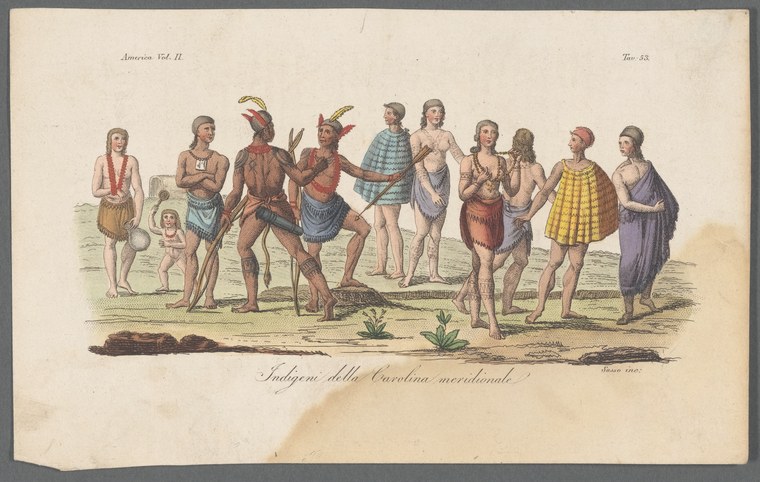
A colonial-era encounter scene showing a European man in rich red damask with feathered headdress meeting Indigenous people on a sandy shore. The composition is a formal line of figures: on the left, Indigenous women and a child in minimal dress; center, two Indigenous men in body paint and feathered ornaments gesture in greeting or negotiation; right, several European or creole figures in bright cloth—yellows, reds, purples—and draped garments. The ground is bare sand with low vegetation. The style is hand-colored engraving in the 18th-century ethnographic tradition, with careful attention to the contrast between European finery and Indigenous simplicity. The title states this depicts Indigenous people of the Carolinas, and the scene captures the moment of first contact or trade, frozen in formal arrangement rather than narrative action. Light is even and frontal, typical of print illustration.
The dancing
The figures stand in a loose line facing the viewer rather than engaged with each other—a compositional choice that prioritizes display of costume and body type over interaction. The two central Indigenous men have arms raised or extended, suggesting gesture or speech rather than dance movement. Their bodies are upright and still. The European figures stand with formal posture. There is no visible dance hold, weight transfer, or coordinated footwork. The arrangement is anthropological documentation rather than the capture of movement.
The dance depicted
This print does not depict dance in the modern sense. The raised arms and gestures of the Indigenous men may represent ceremonial greeting or oratory rather than choreographed movement. The scene belongs to the tradition of colonial encounter imagery, in which European artists documented (and often exoticized) Indigenous dress, body decoration, and social practice. Any movement shown is incidental to the primary purpose: ethnographic classification and the visual assertion of colonial hierarchy.
How it was made
Hand-colored engraving, a primary medium for ethnographic illustration in the 18th century. The technique allowed for precise line work and the detailed rendering of costume and ornament, which was its purpose. The print would have been distributed as a scientific document or travel narrative, reaching educated European audiences interested in colonial territories. The hand-coloring (visible in the bright yellows, reds, and purples) was applied after printing, making each copy somewhat unique and allowing the artist to emphasize costume distinctions.
About this work
This is an 18th-century ethnographic engraving of Indigenous Carolinians and European colonists in an encounter scene. It belongs in a gallery of dance in art not because it depicts dance, but because it represents a key visual convention of the colonial period: the documentation of unfamiliar bodies and practices through print. The image reflects how European artists and audiences understood Indigenous peoples—as objects of visual knowledge rather than as agents with their own performative and ceremonial traditions. It is a record of colonial perspective, not of dance itself.
How to look at it
Look at how the artist has arranged the figures in a line facing the viewer, rather than in a scene of action or interaction. Notice the stark contrast in dress and body decoration—the minimalism of Indigenous clothing against the elaborate fabrics and ornaments of the Europeans. Observe the raised arms and open postures of the central Indigenous figures: these suggest greeting or oratory, but they are held static, as if posed for inspection. The engraver's purpose was not to capture movement or emotion, but to display and categorize human types.
The period
The 18th century saw an explosion of travel narratives and ethnographic illustration in Europe, driven by colonial expansion and Enlightenment curiosity about 'other' peoples and places. These images were circulated in published volumes, natural history collections, and scientific societies. The engraving technique allowed for mass reproduction and wide distribution. Such prints shaped European understanding of non-European cultures, often reducing complex social and ceremonial practices to static visual types. By the time this print was made, Indigenous peoples of the Carolinas had been subject to sustained European contact, disease, displacement, and colonization for over a century.
Where it lives
Held in the New York Public Library's collection of prints depicting dance. The source attribution is NYPL. The work is catalogued as a folk and ethnic costume print, though the current catalogue record contains minimal detail.
Questions about this work
Is this actually a dance image?
Not in the sense of depicting choreographed or recognizable dance movement. The raised arms and gestures of the Indigenous figures may represent ceremonial greeting or communication, but the artist has frozen them in a static, posed arrangement for ethnographic display. The image is included in dance collections because it reveals how European print culture documented and misrepresented Indigenous movement and ceremony.
What do the feathers and body paint signify?
In this image, they are rendered as markers of 'otherness'—visual codes that distinguished Indigenous peoples from Europeans in the colonial imagination. However, feathers and body decoration had complex meanings in Indigenous ceremonial and social practice, meanings that this print does not convey or attempt to explore.
Why is this in a dance gallery if there's no dance?
Because understanding how Indigenous peoples were represented—or misrepresented—in European visual culture is essential to dance history. These prints shaped European assumptions about non-European bodies and practices for centuries. They are evidence of colonial perspective and visual erasure.
More dance artwork





