49 works in this view — arrow keys or swipe to move between them.
Dance in Art
Folk and ethnic costumes
Unknown artist
- Collection:
- Prints depicting dance
- Source:
- New York Public Library
- Rights:
- Public domain — free to use, share and adapt.
- Recorded as:
- Public Domain
This image illuminates how European institutions classified and displayed non-European cultures in the 19th century, and how costume material—even when static and non-performative—became associated with dance and folklore studies. It is a reminder that not all images in dance archives depict dance, and that understanding what an image *does not* show is as important as cataloging what it does.
What you are looking at
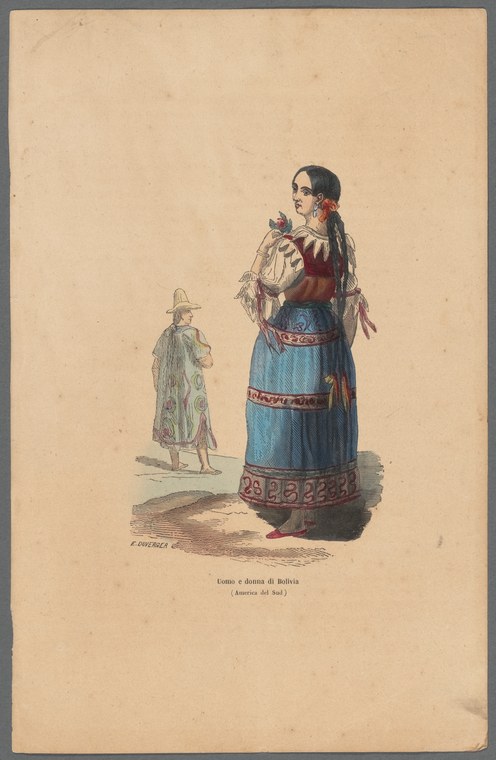
A hand-colored engraving presents two figures in folk costume against a plain background, rendered in the ethnographic style of 19th-century European travel documentation. The dominant figure is a woman standing in three-quarter view, wearing a red velvet bodice with ornamental trim, a blue linen skirt decorated with embroidered bands in red and gold, and a white linen chemise visible at the neck and sleeves. Her dark hair is bound with a red ribbon. She holds her hands before her in a gesture of animated conversation or demonstration. To her left stands a much smaller figure—a child or young person—dressed in a green-tinted coat or caftan and wearing a hat, rendered in a scale that emphasizes the woman as the primary subject. The artist has used watercolor or hand-coloring technique over an engraved or lithographed base, creating soft gradations in the fabric and delicate shadow work beneath the figures' feet. The caption reads "Donna e donna di Bolivia" (Woman and woman of Bolivia), though the costume elements—the velvet bodice, embroidered skirts, and styling—suggest Central European or Balkan folk dress rather than South American indigenous costume.
The dancing
The standing woman's posture is upright and frontal, with shoulders squared and arms positioned expressively at waist height, palms visible and separated. Her weight appears evenly distributed, and there is no indication of active movement or a dance step; the pose reads as presentational rather than kinetic. The smaller figure beside her maintains a static, observational stance. Neither figure displays the body frame, turnout, or coordinated partnering of theatrical dance, nor the weight transfer or grounded footwork of folk dancing.
The dance depicted
This image does not depict a dance or a dancing figure. The woman's pose is anthropological or ethnographic in intent—a display of costume, bearing, and cultural identity rather than a captured moment of movement. Her hand gesture may indicate speech, hospitality, or the presentation of costume elements. This type of image served documentary purposes in 19th-century European art and print collections, recording regional and colonial "types" for educated viewers far from the represented cultures.
How it was made
The work is a hand-colored engraving or lithograph, a commercial reproductive process that allowed multiple impressions to be distributed to a wide European audience. The engraving provides the line work and structure, while hand-coloring (applied afterward, likely in a workshop) renders the fabrics with subtle gradations and gives the figures depth. This technique was standard for ethnographic and costume documentation in the 19th century, combining the precision of engraving with the visual appeal of watercolor to make costume details legible and attractive to collectors and scholars.
About this work
This is a hand-colored ethnographic print documenting folk costume, likely from a larger series of regional or colonial "types" compiled for European consumption in the 19th century. The woman's pose is presentational—a standing display of bodice, skirt, and adornment—rather than an action or movement frozen in time. While it appears in a collection indexed as dance imagery, the work does not represent dance or dancers; it belongs instead to the visual archive of ethnography and colonial costume documentation that flourished during the Victorian era. Its presence in dance collections may reflect the historical entanglement of dance study with anthropology, or the later re-cataloging of costume and dress materials under broad dance-related categories.
How to look at it
Attend to the woman's stillness and frontal presentation: she is not caught mid-movement or in a social interaction with her companion, but posed formally for examination. Notice the meticulous rendering of textile detail—the embroidery, the velvet sheen, the linen folds—which is the true subject of the image. The small scale of the second figure relative to the woman suggests that the costume of the larger figure is the primary interest; the child may serve as a scale reference or as a secondary "type" for comparison. The caption's geographical attribution (Bolivia) combined with the evident Central European styling of the dress reveals the often-careless or propagandistic labeling typical of these commercial ethnographic prints.
The artist
The engraver's mark reads "E. Preceuti" or similar (script is ornate). The style and technique are consistent with mid-to-late 19th-century European ethnographic print production, likely German, Swiss, or Austro-Hungarian in origin. Such prints were typically produced in series by publishing houses aimed at educated middle-class collectors interested in geography, costume, and "primitive" cultures. Individual artists and engravers in this tradition rarely achieved lasting fame; their role was technical and documentary rather than expressive.
The period
The mid-to-late 19th century saw intense European interest in ethnography, spurred by colonial expansion and the rise of museums and scientific classification systems. Costume documentation and folk-dress imagery became fashionable commodities; publishers issued multivolume collections of regional and colonial "types," often marketed as educational material for children and scholars. This visual culture reinforced hierarchies of civilization and helped European audiences imagine distant peoples as static, picturesque subjects rather than dynamic societies. Dance and costume were often conflated in these archives—folk dress implied folk dances, even when no actual dance was depicted.
Where it lives
The work is held in the New York Public Library's collection of prints depicting dance, as cataloged in the source record. It is one of many such ethnographic hand-colored engravings circulated in 19th-century Europe, part of the visual infrastructure through which educated Europeans consumed and classified representations of non-European peoples.
Questions about this work
Is this a dance image?
No. While cataloged in a dance collection, the image does not depict dancing or even a dancer in motion. The woman is posed statically in a presentation stance, displaying her costume for documentary or ethnographic purposes. Her gesture—expressive hand placement—may suggest communication or conversation, not movement or choreography.
What is the geographic origin of this costume?
The caption claims Bolivia, but the visual evidence contradicts this. The velvet bodice, embroidered skirts, and styling are consistent with Central European or Balkan folk dress—regions including the Austro-Hungarian Empire, the Balkans, or Eastern Europe. The misattribution may reflect either careless cataloging by the publisher or deliberate exoticizing of European folk costume.
Why is this in a dance collection at all?
Ethnographic prints of folk costume were often shelved alongside dance materials in libraries and museums, reflecting the 19th-century belief that costume, folklore, and dance were inseparable aspects of a culture's character. Later re-cataloging may have simply retained these materials in dance sections. It is also possible the image once belonged to a larger series that did include dance documentation.
How was this image made?
It is a hand-colored engraving: an engraver first produced a metal plate with fine lines, which was then printed on paper. Trained colorists then applied watercolor or tinted washes by hand to each impression, making it a labor-intensive but widely distributable product suited to commercial and educational markets.
More dance artwork





