49 works in this view — arrow keys or swipe to move between them.
Dance in Art
Folk and ethnic costumes
Unknown artist
- Collection:
- Prints depicting dance
- Source:
- New York Public Library
- Rights:
- Public domain — free to use, share and adapt.
- Recorded as:
- Public Domain
This image is essential for understanding the visual culture surrounding Regency dance: the dress codes, the body language, and the gendered social rituals of the assembly room. For dance historians, it documents what dancers wore, how they carried themselves in social space, and the aesthetic values of the period. The reference to Brazil and Chile opens questions about how European fashion appropriated or imagined colonial and Latin American dress during the Napoleonic era.
What you are looking at
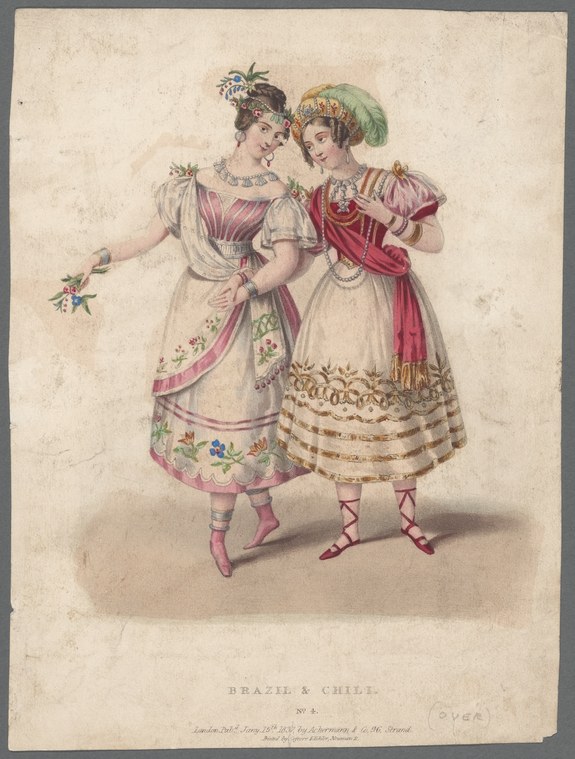
Two young women in Regency-era dress stand together in an intimate pose against a plain background, their bodies angled toward each other in conversation or conspiratorial closeness. The woman on the left wears a high-waisted white muslin dress with a deep rose or mauve trim along the bodice and hem, decorated with embroidered flowers; she wears a feathered headdress and holds a small decorative object (possibly a fan or ornament) in her lowered left hand. The woman on the right wears a crimson silk dress with gold braid trim and epaulettes on the shoulders, a style that suggests military or court dress; she wears a pale green bonnet or turban. Both have their hair styled in the fashionable Regency manner, and both wear colored stockings—the left figure in mauve or rose, the right in pink or white. The print is hand-colored, with delicate watercolor washes and gilt accents, particularly visible on the trim and decorative details of the dresses. The composition is vertical and intimate, presenting the two figures as equals in a moment of social connection.
The dancing
The two figures stand in close proximity, their bodies turned toward each other at a slight angle. The woman on the left has her weight settled, with her left arm extended downward holding a small ornament or fan, while her right arm is positioned across her body. The woman on the right leans slightly inward, her right arm raised and extended toward her companion in a gesture of affection or communication. Neither figure is in motion; both are poised in a static social stance typical of Regency portraiture. Their feet are planted firmly on the ground, their posture upright and dignified.
The dance depicted
This is not a depiction of active dance, but rather a fashion and social portrait in the Regency period (circa 1810–1820). The print documents contemporary dress and the social rituals of young women of the gentry class. The inscription identifies this as relating to Brazil and Chile—a curious addition that may indicate these are costume studies or fashion plates representing exotic or colonial dress, or it may reflect a contemporary fascination with Latin American dress and culture following independence movements. The Regency period was one of cotillion, quadrille, and country dancing among the gentry, but this image captures a moment of social interaction outside the dance itself, perhaps the prelude to or intermission from dancing.
How it was made
This is a hand-colored copper engraving or aquatint, a technique that allowed for mass production of fashion prints in the early 19th century. The image shows fine line work typical of engraving, with hand coloring applied in watercolor or gouache—visible in the careful application of rose, gold, green, and pink washes. The gilt accents on the trim suggest that some prints in this series may have received additional gilding for a luxury market. The technique was ideal for fashion publication and wide circulation among the middle and upper classes interested in contemporary dress and manners.
About this work
This is a hand-colored engraving from the Regency era (approximately 1810–1820) documenting fashionable dress and social interaction among young women. Although not depicting active dance, it is part of a visual culture deeply connected to dancing assemblies and the social world in which dances took place. The inscription references Brazil and Chile, suggesting these may represent exotic or colonial dress fashions that were circulating in European print culture following Latin American independence. The print belongs to a tradition of fashion plates and costume studies that served both as style guides and as records of the social codes and aesthetics of the Regency period. The handwork visible in the coloring and gilding indicates this was a luxury commodity, produced for an educated and affluent audience.
How to look at it
Attend to the precise details of dress: the high waistline, the Empire silhouette, the ankle-length skirts, and the decorative trims that signal Regency fashion. Notice the difference between the two dresses—one soft and floral, one martial and structured—and what that may suggest about rank or character. Look at the hand-coloring technique: the fineness of the line work beneath, the delicacy of the watercolor application, and the gilding that catches the light. Consider the pose: both figures are static and dignified, presented frontally to the viewer, in the manner of a fashion plate rather than a narrative scene. The small ornament in the left figure's hand and the positioning of the arms suggest an intimate moment of social connection, the kind that would have preceded or followed a dance.
The period
This print dates to the Regency era in Britain (1811–1820), a period of intense interest in fashion, social manners, and printed images for domestic consumption. The Regency saw the rise of the cotillion and quadrille as fashionable dances among the gentry, replacing some of the minuet traditions of the Georgian era. Hand-colored fashion plates and costume studies were a major print genre, serving as both style guides and social documents. The reference to Brazil and Chile reflects the post-independence political moment in Latin America and a contemporary European fascination with exotic and colonial dress. Print culture in this period was increasingly democratized, allowing middle-class households to access fashion and social information previously limited to the aristocracy.
Where it lives
This print is held by the New York Public Library as part of its collection of prints depicting dance. It is catalogued as part of a series on folk and ethnic costumes, though its actual subject is Regency fashion and social dress rather than folk or ethnic costume per se.
Questions about this work
Are these women dancing?
No. This is a fashion plate or social portrait showing two women in Regency dress in a moment of social interaction. They are posed statically, not in motion. The print documents the dress, posture, and social rituals of the Regency period, but does not depict active dance.
What does the inscription about Brazil and Chile mean?
The inscription suggests these may be costume studies representing exotic or colonial dress, or fashions influenced by or named for Brazil and Chile. Alternatively, they may simply indicate the print's commercial categorization. The reference likely reflects early 19th-century European fascination with Latin America following independence movements.
How was this print made?
This is a hand-colored copper engraving or aquatint. The image was engraved in fine lines on a metal plate, which was then printed on paper. Each print was then individually colored by hand using watercolor or gouache, and in some cases gilded with gold leaf. This technique was labor-intensive but allowed for multiple copies, making it affordable for affluent middle-class households.
What does the dress tell us about the period?
The high waistline, Empire silhouette, and ankle-length skirts are hallmarks of Regency fashion (1810–1820). The decorative trims, feathered headdresses, and colored stockings signal wealth and fashionable taste. One figure wears what appears to be military-inspired dress with epaulettes, a style that was fashionable among women of rank during the Napoleonic era.
More dance artwork





