49 works in this view — arrow keys or swipe to move between them.
Dance in Art
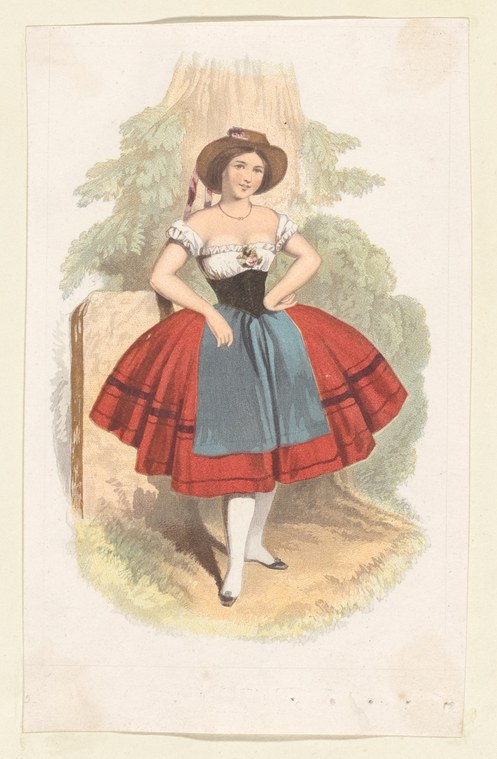
A ballerina in a folk costume
Unknown artist
- Collection:
- Prints depicting dance
- Source:
- New York Public Library
- Rights:
- Public domain — free to use, share and adapt.
- Recorded as:
- Public Domain
This work shows how nineteenth-century European dance culture engaged with folk traditions by absorbing them into theatrical and balletic practice, and how costume became a vehicle for both authenticity claims and fantasy. The precision of the costume rendering tells us what a professional dancer of this period wore when performing national dances—information that choreographic texts and reviews alone cannot convey.
What you are looking at
A young woman stands against a tree trunk in a wooded setting, posed in a moment of pause or preparation. She wears a white off-shoulder peasant blouse with short puffed sleeves and a dark corset or bodice at the waist. Her skirt is the striking focal point: a full, tiered construction in shades of red and blue, with the red outer layers gathered into broad horizontal flounces or ruffles that extend well below the knee. She wears a small straw hat and holds one hand near her waist in a relaxed, confident posture. The background is rendered in soft greens and earth tones, with the tree behind her providing vertical anchor and compositional balance. The figure is centered and three-quarter length, rendered in a hand-colored print technique with delicate shading that suggests mid-nineteenth-century production.
The dancing
The dancer stands in a frontal pose with weight distributed evenly, one hand placed near the waist in a gesture of readiness or ease. Her posture is upright and composed rather than actively dancing—the moment captured is preparation rather than movement. The skirt's construction is key: the multiple layers and prominent ruffles suggest a garment designed for rotational movement, with the fullness engineered to create visual drama in a turn. Her frame is relaxed and her gaze directed outward, suggesting a portrait-like presentation of the figure in costume rather than a snapshot of active performance.
The dance depicted
This image most likely documents European folk or regional dance costume of the mid-nineteenth century, most probable from Central or Eastern European traditions given the tiered skirt construction and the combination of peasant blouse with structured bodice. The style of the skirt—with its multiple layers in contrasting colors and deep ruffles—is consistent with Hungarian, Transylvanian, or Alpine folk costume, where such voluminous constructions were used to create visual spectacle during spinning or turning movements. The hand-colored print format and the posed, static nature of the figure suggest this is costume documentation rather than a scene of active dance. The title 'A ballerina in a folk costume' indicates this is a theatrical or professional dancer depicted in ethnographic dress, possibly for a staged performance or concert featuring national dances.
How it was made
This is a hand-colored lithograph or engraving, likely from the 1840s–1860s based on the printing technique and coloring method. The delicate hand coloring—visible in the subtle gradations of the skin tones, the careful rendering of the fabric textures, and the soft background—indicates this was produced for a European print market where hand-coloring was a standard finishing step for dance and costume prints. The technique allowed for wide circulation of such images as inexpensive souvenirs, prints for theatrical publicity, or illustrations in dance and costume reference books. The clarity of detail and the compositional centering suggest this may have been one of a series documenting dance costumes of different regions or nationalities.
About this work
This hand-colored print depicts a professional dancer posed in Central European folk costume, most likely a Hungarian or Alpine dress, during the period when theatrical interest in national dances and 'exotic' regional traditions was at its height. The image documents both the virtuosity of the performer and the designed spectacle of the costume itself, particularly the engineered fullness of the tiered skirt meant to create visual drama in rotational movements. It belongs to the nineteenth-century tradition of dance prints—both documentation of actual performance practices and tools for the circulation of dance imagery to a growing middle-class audience.
How to look at it
Notice the construction of the skirt: the multiple layers and flounces are not incidental decoration but engineered costume elements designed to create maximum visual effect during spinning or turning. The print captures the dancer in stillness, a pose for documentation, but the costume itself tells the story of movement. The hand-coloring technique, with its careful attention to fabric texture and the delicate shading of the figure, reflects the commercial and cultural value of such images—they were not cheap prints but finished artworks for collectors interested in dance and costume.
The period
The mid-nineteenth century saw a surge in European ballet and theatrical dance companies' interest in incorporating folk material and 'national dances' into their repertoires. The Romantic era's fascination with the exotic, the authentic, and the peripheral fueled demand for images of dancers in regional costume. Hand-colored lithographs and engravings of dancers and dance costumes were mass-produced for a growing middle-class audience—sold as theatrical souvenirs, costume references, and entertainment. This print likely dates to roughly 1850–1870, the period of peak demand for such imagery in European publishing.
Where it lives
This work is part of the New York Public Library's collection of prints depicting dance. The collection includes primarily nineteenth-century dance imagery from European sources, documenting both professional theater and folk traditions.
Dance in this work
Questions about this work
What dance is this person performing?
The costume suggests a Central or Eastern European folk dance, possibly Hungarian or Alpine, but the print does not identify it specifically. The tiered, ruffled skirt construction is characteristic of dances that featured spinning and rotational movements. The figure is posed statically, so we cannot see the actual dance technique.
When was this printed, and how do we know?
Based on the hand-coloring technique, printing method, and costume style, this likely dates to the 1840s–1860s. We establish this from the image itself because the catalogue record does not provide a date. The style of the bodice, skirt construction, and print technology all point to this period.
Why is a professional dancer wearing folk costume?
In the nineteenth century, European ballet companies and theatrical producers were fascinated by folk traditions and 'national dances.' Professional dancers performed these pieces both to showcase their virtuosity and to satisfy middle-class curiosity about other cultures. The costume represents both an attempt at authenticity and a theatrical interpretation of folk dress.
Was this actually danced, or is it just a costume design?
The image is most likely a document of actual performance—a dancer posed in the costume she would have worn. The careful detail and the professional presentation suggest this was created as a theatrical souvenir or for a dance costume reference, not as a design proposal. The posed, frontal stance is typical of dance prints from this era, which were meant to showcase both performer and costume.
More dance artwork





