49 works in this view — arrow keys or swipe to move between them.
Dance in Art
Harlequin
Unknown artist
- Collection:
- Prints depicting dance
- Source:
- New York Public Library
- Rights:
- Public domain — free to use, share and adapt.
- Recorded as:
- Public Domain
Commedia dell'arte was foundational to European theatrical dance, influencing ballet, pantomime, and social dance from the Renaissance forward. This print preserves the visual identity of a character type that shaped centuries of performance, offering evidence of how such figures were visually codified and transmitted across Europe. For dance historians, it documents the visual vocabulary of a performance tradition predating formal ballet notation.
What you are looking at
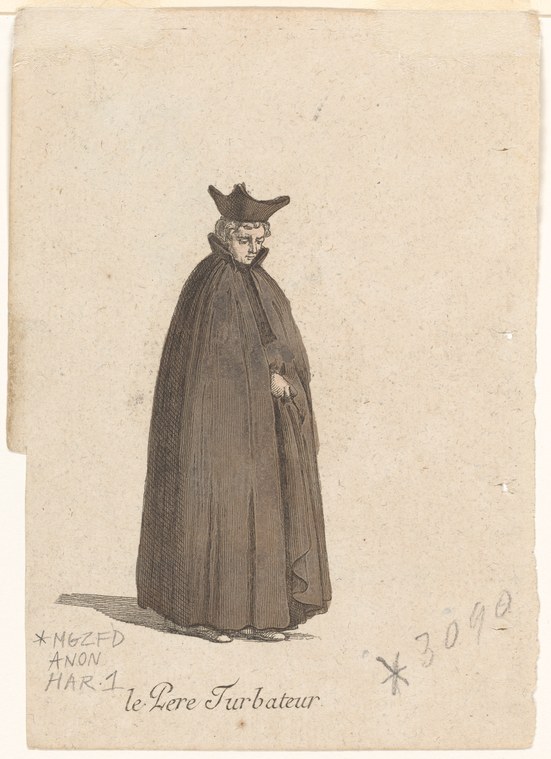
A single figure stands against a plain cream background, viewed in three-quarter profile facing left. The person wears a dark, voluminous cloak or cape that falls to the ankle, with deep vertical folds creating a columnar silhouette. The garment appears to be heavy fabric, possibly wool, with a standing collar at the neck. The face is rendered with sharp, defined features and a somewhat austere expression. The head is crowned with a distinctive three-pointed hat (tricorn), typical of 18th-century fashion. The figure's right hand emerges from the cloak, holding what appears to be a small object. The pose is static and formal, with weight evenly distributed. Handwritten annotations appear in the lower left corner, and what appears to be a catalogue number is visible in the lower right.
The dancing
The single figure is motionless and upright, with a formal, nearly frontal stance despite the three-quarter view. The cloak obscures the body entirely, making it impossible to discern actual limb position, weight distribution, or any posture that would indicate active movement or dance position. The raised hand gesture is minimal and does not suggest any dance frame or hold. There is no indication of the flex, articulation, or dynamic tension that characterizes a dancer in motion.
The dance depicted
The figure is identified in the inscription as 'le Père Furbatteur' (Father Furbatteur), a character from commedia dell'arte tradition. This figure is most likely Pantalone, Gratiano, or Il Dottore from the stock characters of this theatrical tradition, who appear in comedic theatrical pieces rather than formal dance. While commedia dell'arte involved physical performance and stylized movement, this image shows a figure in costume rather than in the act of dancing. The static pose and heavy cloak suggest a character portrait or costume study rather than documentation of choreographed movement.
How it was made
This is an engraving or etching executed in black ink on cream paper, evidenced by the fine parallel hatching lines that model form and shadow, particularly visible in the cloak's folds and the face. The technique is consistent with 18th-century reproductive printmaking, allowing for wide distribution among collectors, scholars, and theater practitioners. The relatively small scale and monochrome execution suggest this was a page from a printed series or compendium of character types, likely intended for theatrical reference or historical documentation rather than as a fine art print for display.
About this work
This is a character study of a commedia dell'arte figure, presented as a formal standing portrait rather than as an action shot. 'Le Père Furbatteur' belongs to the tradition of Italian improvised comedy that heavily influenced European theatrical practice from the 16th century onward. Though commedia dell'arte was fundamentally performative and physical, this image documents costume and character type rather than the dance or movement vocabulary of the tradition. It represents how such theatrical characters were recorded, circulated, and understood—as stock personas defined by costume, deportment, and social role rather than as dancers executing particular steps.
How to look at it
Examine the costume detail: the heavy cloak is the primary visual statement, with its vertical folds creating a columnar mass typical of theatrical costume design for comedic effect. The three-pointed hat and formal bearing suggest social pretension—this character is likely a learned man (Gratiano or Il Dottore) being mocked through costume. Notice the small handheld object (possibly a scroll or document, appropriate for a pedantic character). The static pose is deliberately formal and unnatural, emphasizing the character type over any individual personality or moment of action. This is how such characters were visually communicated before photographic documentation existed.
The artist
The artist is not recorded. The hand annotations ('GLAZED ANON' and 'HAR') suggest this work was catalogued by a collector or archivist, but the original printmaker and date remain unknown. The style is consistent with 18th-century theatrical character prints, a well-established genre that circulated widely.
The period
Commedia dell'arte reached the peak of its European influence in the 17th and 18th centuries, with troupes performing across Italy, France, England, and the German states. The tradition involved improvised dialogue and physical comedy built around stock characters, each with fixed costume, mask, and behavioral traits. Theatrical character prints became a major category of popular prints in this period, circulated to theater companies, collectors, and as educational references. The heavy formal cloak seen here reflects the grand, exaggerated silhouettes fashionable in this era and used for comic effect in commedia performance.
Where it lives
The work is held in the New York Public Library's collection of prints depicting dance. The handwritten annotations and catalogue marks indicate it was accessioned into an organized collection, likely in the 19th or 20th century. It is part of a series or compendium of theatrical character studies.
Questions about this work
Is this actually a dance image?
Not in the modern sense. The figure is static and posed rather than captured in movement. However, commedia dell'arte was deeply physical and involved choreographed movement, comic business, and stylized gestural vocabulary. This print documents a character type from that tradition, preserving the visual identity of a performer category, even if it does not show the character in action.
Who was 'le Père Furbatteur'?
The inscription identifies the character, but the specific attribution is uncertain from this image alone. The formal bearing, cloak, and what may be a document suggest one of the learned male characters of commedia—most likely Gratiano, Il Dottore, or a variation thereof. 'Père' (father) may indicate an older or paternal version of the type. These characters were performed with exaggerated pedantry and comic pomposity.
Why was commedia dell'arte important to dance history?
Commedia dell'arte provided much of the physical vocabulary, character types, and choreographic logic that shaped European theater dance for two centuries. Its stock characters, scenarios, and movement patterns influenced pantomime, early modern ballet, and social dance. The tradition demonstrated that improvised, character-driven performance could be as structured and teachable as any formal art.
More dance artwork





