49 works in this view — arrow keys or swipe to move between them.
Dance in Art
Funeral of Francesco de' Medici
Unknown artist
- Collection:
- Prints depicting dance
- Source:
- New York Public Library
- Rights:
- Public domain — free to use, share and adapt.
- Recorded as:
- Public Domain
For dance history, this image matters primarily as a negative: it shows the scale and formality of Renaissance court space, and the way grand occasions could involve elaborate staged movement without being dance. It is also an artifact of how the Medici court commissioned and circulated images of its own ceremonies, part of the visual culture within which court dance developed as a distinct, more intimate and rhythmic practice. Understanding what this is not helps clarify what Renaissance dance was.
What you are looking at
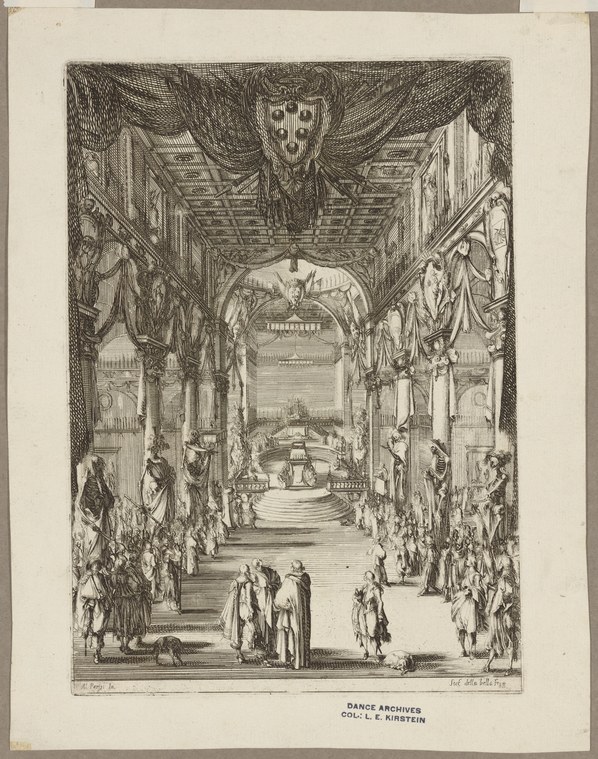
This engraving depicts an elaborate funeral procession or ceremonial gathering within a vast Renaissance palace or cathedral. The composition uses strict linear perspective to draw the viewer's eye along a colonnade of classical columns receding toward a distant portal, where a catafalque or ceremonial structure is visible. The setting is crowded with figures in Renaissance dress—robes, doublets, and formal attire—arranged in a loose crowd that fills both sides of the colonnade and the central aisle. The architecture features a coffered ceiling above the columns, and the walls are articulated with classical pilasters. A heraldic or symbolic device appears at the apex of the composition, dominating the upper register like a funerary emblem. The lighting is created through cross-hatching, giving the space a solemn, shadowed atmosphere despite the daylight suggested by the distant opening.
The dancing
The figures are not arranged in any organized dance formation. They stand, process, or gesticulate in small groups and clusters—some facing forward, others toward the catafalque, many in discussion or observation. The body language reads as respectful and formal: upright posture, minimal dynamic movement, the bearing of mourners at a state funeral. No paired holds, rhythmic alignment, or synchronized motion is evident. The crowd density and dispersion suggest ceremonial movement—a procession—rather than choreographed dance.
The dance depicted
This image does not depict dance in any recognizable form. It records a grand state funeral ceremony, likely aristocratic or royal, with processional and ceremonial elements but no evidence of dancing bodies, synchronized movement, musical accompaniment for dance, or the spatial or temporal organization that characterizes dance performance. The title names Francesco de' Medici, the Medici Grand Duke, whose death in 1587 would have occasioned exactly such an elaborate funeral spectacle. Ceremonial processions and funeral rites are distinct from dance, though both may be staged and rule-bound.
How it was made
This is an engraving, identifiable from the fine parallel line work (hatching and cross-hatching) that model form, shadow, and spatial recession. The technique allowed precise architectural rendering and the distribution of large crowds across a coherent perspectival field—essential for documenting a complex ceremonial space. Engravings of this kind were produced for circulation as prints, recording state occasions and dynastic events for educated audiences across Europe. The level of architectural detail and the composition's ambition suggest a print made after a drawing or painting documenting the actual ceremony.
About this work
This is a Renaissance state funeral engraving documenting the ceremonial procession or lying-in-state of Francesco de' Medici, the Medici Grand Duke, within a monumental palace interior. The work is neither a dance image nor a depiction of public dancing; it belongs in a gallery of dance history only insofar as it records the architectural and social context in which Renaissance court dancing occurred, and the distinction between ceremonial processional movement and choreographed dance performance. The engraving is an artifact of dynastic and artistic culture—it documents power, mourning, and the Renaissance mastery of perspective and architectural representation.
How to look at it
The viewer should attend to the architectural ambition of the composition: this is as much an engraving about perspective, Renaissance order, and spatial command as it is about the funeral itself. Note the hierarchy of the composition—the catafalque as a distant focal point, the crowd arranged in implied tiers rather than a processional line, and the way the colonnade structures and contains the mourners. The artist has chosen not to animate the scene: there is no moment of high ritual or theatrical intensity frozen in the image, but rather a stable architectural documentation of where the ceremony takes place. This static, spatially precise approach reflects the engraving medium's capacity for architectural detail and perspective, and the court's desire to record the occasion as a permanent, legible document rather than as a dynamic performance.
The artist
The artist is not recorded in the catalogue. The level of execution and the subject matter suggest a professional engraver working for a Florentine or Italian patron in the late 16th century, when the Medici court was commissioning prints to document its power and piety. The style is consistent with Renaissance-era state funeral engravings, which were produced across Italian and Northern European courts as commemorative publications.
The period
The late 16th century witnessed both the flourishing of Renaissance court dance as a refined art form and the continued importance of ceremonial procession and funeral spectacle as expressions of dynastic power. Francesco de' Medici's death in 1587 occurred during a period when the Medici court was actively patronizing both dance and the visual arts. The funeral print tradition was a major vehicle for circulating images of power and piety across Europe. At the same time, court dances were becoming increasingly sophisticated and were beginning to be documented through dance notation and choreographic writing, marking a shift toward dance as a recorded and reproducible art form separate from courtly ceremony.
Where it lives
The work is held in the New York Public Library's collection of prints depicting dance, which classified it under that category. The specific holding and accession details are not provided in the catalogue record.
Questions about this work
Is this actually a dance image?
Not in the strict sense. The engraving documents a state funeral procession and ceremonial gathering, which involves organized, formal movement but not choreographed or rhythmic dance. The distinction matters for dance history: Renaissance court culture included both elaborate dances and elaborate ceremonies, and they were understood as different practices. This image shows the architectural and social context of one, not the performance of the other.
Who was Francesco de' Medici?
Francesco I de' Medici (1541–1587) was the second Grand Duke of Tuscany and a major patron of the arts, including music, theater, and court entertainment. His death would have been marked by one of the most elaborate state funerals of the Renaissance, involving the entire Florence court and extensive commissioned documentation like this engraving.
How do we know this is an engraving and not a painting or drawing?
The technique is visible in the image: the form, shadow, and spatial recession are created entirely through parallel lines (hatching) and their intersection (cross-hatching), which is the defining characteristic of engraving. This process was used to create multiple prints from a single copper plate, making engravings the primary medium for circulating images of court events across Renaissance Europe.
What does this tell us about Renaissance dance?
Indirectly, it tells us about the scale and formality of Renaissance court space, the architecture that housed dance, and the visual culture in which dance was valued. More importantly, it shows that state occasions involved both ceremonial procession (documented here) and social dance (not shown here), which were recognized as distinct practices. The grandeur of the setting reminds us that court dance happened in spaces of extraordinary architectural and social significance.
More dance artwork





