49 works in this view — arrow keys or swipe to move between them.
Dance in Art
Pas styrian, as danced by Mr. & Miss Wells
Unknown artist
- Collection:
- Prints depicting dance
- Source:
- New York Public Library
- Rights:
- Public domain — free to use, share and adapt.
- Recorded as:
- Public Domain
This image is direct evidence of how a specific dance was performed and costumed by named dancers in a specific era, recorded by a commercial printmaker at the moment when the dance was fashionable. Few Regency-era country dances and imported Alpine forms survive in any visual record, making this a rare document of English ballroom practice outside the formal cotillion and quadrille.
What you are looking at
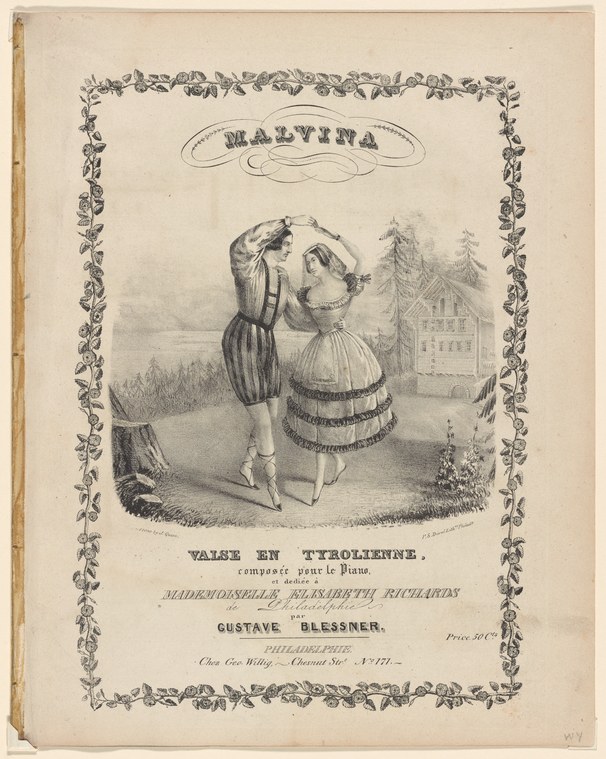
A man and woman pose in an elegant exterior setting, dressed in early 19th-century attire. The woman wears a high-waisted muslin gown with horizontal striped bands at the hem and bodice, her hair adorned with a feathered headdress; the man wears a dark tailcoat with striped breeches and white stockings. Between them stands a large country house with multiple chimneys, set among evergreen trees rendered in soft atmospheric perspective. The couple are positioned as if mid-dance or about to dance, the woman's body turned toward the man with her arms raised in a graceful gesture, while he inclines toward her in an attitude of courtship or invitation. The setting and their poses suggest the kind of outdoor dance or promenade common to Regency-era social life.
The dancing
The two dancers are in an open position, neither in a closed ballroom hold. The woman's arms are raised and extended, one hand gesturing upward in an expressive, inviting manner while her body angles toward her partner. The man leans forward slightly, his body inclined toward hers in a posture of attention and deference. Both figures stand with the upright carriage and refined posture characteristic of Regency drawing-room dance. The arrangement suggests a dance that involves some separation and arm work rather than the tight couples' frame of later ballroom forms.
The dance depicted
The print is titled *Pas styrienne* (Styrian Dance or Austrian Dance) and claims to have been danced by Mr. and Miss Wells, popular performers of the Regency era. The Styrian dance (Ländler-type) was a turning couple dance of Alpine origin that enjoyed fashionable currency in English ballrooms in the early 19th century. The open position, raised arms, and outdoor garden setting all accord with contemporary images of Regency country dances and rural-inflected social dances. The posture and dress date the image firmly to the 1810s–1820s, the heyday of such dances in British society.
How it was made
This is a lithograph or finely executed engraving, rendered in black ink on laid paper. The decorative border of stylized leaves and the refined line work suggest a commercial dance print, likely issued as a souvenir or instructional image tied to the performances of the Wells dancers. The technique allowed for rapid, economical reproduction and distribution to a broad audience of dance enthusiasts and theater-goers. The soft modeling of the background landscape and the careful attention to costume detail indicate skilled reproductive printmaking of the Regency period.
About this work
This is a commercial dance print commemorating a performance by two prominent Regency-era dancers, likely issued in the 1810s or 1820s. It documents the *Pas styrienne*, an early 19th-century ballroom import that enjoyed vogue in England and represented a fashion for Alpine and rural dance forms among the urban gentry. The print is both a performance souvenir and a record of how this specific couple executed the dance—important evidence for the costume, posture, and spatial arrangement of a dance form that left few other graphic records.
The work belongs to a rich tradition of dance prints that served both as commercial commodities and as implicit instruction for social dancers who wished to imitate fashionable performers. The image circulated among the same audiences who attended the Wells dancers' performances and who danced in assembly rooms and private homes across England.
How to look at it
Attend to the open frame and the raised, expressive arms—this is not a closed ballroom hold but a dance with arm work and spatial play. The couple's orientation toward each other and the slight forward lean of the man's torso suggest the moment just before engagement or at the height of a turning phrase. The garden setting is not incidental: rural or naturalistic backgrounds were conventional in Regency dance prints and signaled the dance's supposed Alpine or pastoral origin. The careful rendering of costume—the striped hem, the feathered headdress, the tailcoat—is evidence that the print aimed to document not just the dance but the fashionable dress associated with it.
The artist
The print credits Gustave Blessner as composer or arranger and notes publication by Chez Cce. Dieng in Philadelphia. The engraver is not recorded. Blessner was likely a music publisher or composer active in early 19th-century transatlantic circles. The Philadelphia imprint suggests that the dance and its performers had currency on both sides of the Atlantic and that the print was distributed to American as well as English audiences.
The period
The 1810s–1820s were the height of the English Regency and a moment of intense interest in country dances, folk-inflected ballroom forms, and imported European dances—particularly from France, Austria, and the Alpine regions. The Ländler and related turning couple dances represented an exotic, rural-cosmopolitan fusion that appealed to urban ballroom society. This was also the era of the concert dancer and the celebrity performance, when named dancers like the Wells pair could command audiences and see their performances commodified as prints and souvenir objects. Lithography and fine engraving were mature commercial technologies, making such prints affordable and widely circulated.
Where it lives
The print is held in the New York Public Library's collection of prints depicting dance. It is a commercial lithograph or engraving, published in Philadelphia by Chez Cce. Dieng, likely in the 1810s or early 1820s based on dress and typography.
Dance in this work
Questions about this work
What is a Styrian dance?
The *Pas styrienne* or Styrian dance was an early 19th-century ballroom dance of Alpine (Styrian/Austrian) origin. It was a turning couple dance similar to the Ländler, featuring rotation and arm work, and enjoyed fashionable currency in English and American drawing rooms during the Regency era. It represented the period's appetite for imported folk-inflected social dances.
Who were the Wells dancers?
Mr. and Miss Wells were concert and ballroom dancers active in the early 19th century, popular enough to have their performances commemorated in commercial prints. No detailed biographical record is attached to this image, but their names suggest they were a performing pair or family act marketed to Regency audiences on both sides of the Atlantic.
How do you know this is a dance and not just a social scene?
The open frame, the raised and expressive arm gestures, the titled reference to a specific dance form (*Pas styrienne*), the leaning posture, and the contemporary costume all mark this as a record of a recognized ballroom dance rather than a casual social moment. The print's commercial purpose was to document and celebrate this specific dance.
What does the outdoor garden setting mean?
Rural or pastoral backgrounds were a conventional device in Regency dance prints, signaling that the dance had folk or Alpine origins and was therefore exotic and fashionable. In practice, dances like the *Pas styrienne* were performed indoors in assembly rooms; the garden is a romantic convention of the print.
More dance artwork





