49 works in this view — arrow keys or swipe to move between them.
Dance in Art
Commedia dell'arte figures
Unknown artist
- Collection:
- Prints depicting dance
- Source:
- New York Public Library
- Rights:
- Public domain — free to use, share and adapt.
- Recorded as:
- Public Domain
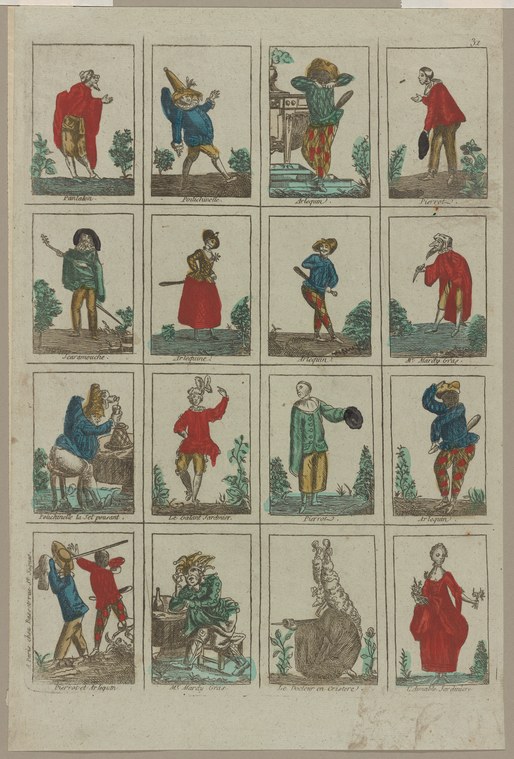
Commedia dell'arte was a primary source for later European theater dance, influencing the physical vocabulary, character types, and pantomimic conventions that appeared in ballet and musical theater for centuries. This print shows how the tradition's performers and poses were understood and remembered by audiences, and offers a rare glimpse of the physical grammar of pre-classical theater before the codification of ballet vocabulary. Understanding these figures helps explain the theatrical ancestry of modern dance and the persistent connection between comedy, physical exaggeration, and organized movement.
What you are looking at
A hand-colored engraving arranged in a 4×4 grid of sixteen small scenes, each depicting a character in theatrical costume and pose against a plain background with minimal landscape elements. The figures wear the bright silks and exaggerated proportions typical of commedia dell'arte: reds, blues, greens, and yellows with considerable gilding. Each panel shows a single figure in isolation, striking an attitude or attitude of action — some with hands raised, others gesturing toward absent partners, one holding what appears to be a staff or sword. The costumes include elements of servant dress (striped breeches, simple coats), master's finery (long robes, feathered hats), and fantastical combinations suggesting stock characters. The prints themselves are small, perhaps 3 by 2 inches each, suggesting this was a popular reference sheet or souvenir rather than a monumental work.
The dancing
Each figure stands alone, weight planted on one or both feet, arms frequently lifted or extended away from the body in emphatic gesture. The poses are formulaic and exaggerated — one figure leans backward with both arms splayed; another crouches with knee bent and arm raised; a third stands upright with arms akimbo. The stances suggest frozen moments from physical comedy rather than formal dance vocabulary: these are poses designed to be read and remembered at distance, emphasizing character and intention over technique. The bodies are compact and the movements broadly outlined, with little attention to the articulation of the spine or the nuances of weight transfer that would appear in later dance representation.
The dance depicted
These are not dancers in the modern sense, but rather theatrical comedians in the tradition of commedia dell'arte, whose performance involved physical comedy, acrobatic tricks, and semi-improvised action as much as or more than structured dance. The poses suggest the kinds of physical gag and character business that would have appeared in street performances and popular theater, particularly in Italy and across Europe in the sixteenth and seventeenth centuries. The grid format — presenting stock characters in canonical poses — suggests this was either a reference sheet for actors learning the tradition or a souvenir for audiences, allowing the memory of specific comedians or character types to circulate in print. While commedia dell'arte involved considerable physical movement and was admired for the agility and timing of its performers, it is not 'dance' in any formal sense and does not match the vocabulary of any recognized dance style in our taxonomy.
How it was made
This is a hand-colored engraving or etching, established from the fine parallel lines visible in the reproduction and the characteristic linearity of the composition. The hand coloring — applied after printing and varying slightly from panel to panel — indicates commercial production for a popular market: these were printed in some quantity and then colored by assistants, a standard practice for affordable prints in the sixteenth and seventeenth centuries. The technique allowed rapid circulation of images of celebrated performers and stock characters, making this a form of popular theater merchandise. The small scale and grid format suggest these were bound into books or sold as single sheets for a few pennies, reaching audiences who could not afford paintings or sculptures.
About this work
This is a grid of sixteen hand-colored engravings depicting stock characters from commedia dell'arte, the semi-improvised popular theater tradition that flourished in Europe from the sixteenth century onward. Each figure is shown in an exaggerated, legible pose, suitable for recognition at distance and for easy memory and circulation in print. While commedia dell'arte was famous for its physical virtuosity and influenced later dance and theatrical traditions, these particular figures are not engaged in recognized dance forms; instead they show the kinds of physical comedy, acrobatic attitudes, and character business that defined the genre. The work is valuable not as a record of dance itself but as evidence of how movement, comedy, and theatrical character were conceived and communicated in the period, and as a document of the popular theater that would eventually feed into opera, ballet, and other theatrical dance forms.
How to look at it
Each figure is presented as a kind of emblem or coat of arms of a character type, frozen in a pose that communicates instantly who the character is and what kind of action he performs. The viewer should notice how much information is conveyed by costume, stance, and gesture alone, with no context or narrative — this was how theatrical characters were recognized and remembered in a largely pre-literate audience. The exaggeration of pose and the isolation of each figure from any scene or interaction is characteristic of sixteenth-century theatrical imagery; later prints would show characters in relation to each other and to a stage space. Looking at these sixteen panels together, one can see the repertoire of recognized character types and physical attitudes that made up the tradition — a kind of visual dictionary of commedia dell'arte performance.
The artist
The artist is not recorded. The print is characteristic of sixteenth- or seventeenth-century popular theatrical merchandise, likely produced in Italy or one of the major printing centers of northern Europe (Venice, Rome, Augsburg, Antwerp). Such sheets were made by printmakers who specialized in theatrical subjects, often working from live performance or from earlier engravings, and were sold to audiences as souvenirs and reference materials. The anonymity of the maker is typical; most such popular prints did not carry signatures, and the work was understood as a commercial product rather than an autonomous artistic statement.
The period
Commedia dell'arte emerged in Italy in the mid-sixteenth century and spread rapidly across Europe, becoming one of the dominant forms of popular entertainment by 1600. The tradition relied on physical skill, acrobatic ability, and semi-improvised performance within conventional scenarios and character types. At the same time, Renaissance and early Baroque court cultures were beginning to codify dance as an art form — the treatises on dance technique and courtly choreography that would define ballet were being written in Italy and France in this very period. The coexistence of these two traditions — the acrobatic, comedic popular theater and the regulated, increasingly formalized court dance — produced a crucial tension in European performance culture. Print culture allowed both traditions to circulate and influence each other; theater prints brought commedia dell'arte characters into homes and studies where they could be studied and imitated.
Where it lives
This work is held in the NYPL Prints collection under the heading 'Prints depicting dance.' The catalogue record provides only a title and collecting context, with no artist, date, or publication information recorded. The work appears to be a typical early modern popular print — produced commercially, hand-colored, and circulated as a souvenir or reference sheet rather than as a unique or precious object.
Questions about this work
Is this actually dance?
Not in the modern sense. Commedia dell'arte was theatrical comedy with strong physical and acrobatic elements, and it influenced later dance forms, but the tradition itself was not organized around codified dance vocabulary or technique. These figures show stock theatrical attitudes and comic business rather than steps or choreography. They matter to dance history because they show what movement, character, and physical comedy looked like before ballet technique became the dominant language of theatrical movement.
What are these characters?
These are the stock character types of commedia dell'arte: servants (zanni), masters (magnificos), lovers, and comic old men and women. The inscriptions below each figure would have identified the specific character (Pantalone, Arlecchino, Il Dottore, etc.), though they are not clearly legible in this reproduction. Each character had a recognized costume, mask or face paint, and repertoire of physical gags and business that audiences would have immediately recognized.
When and where was this made?
The catalogue record does not provide a date or publication information. Based on the style of the engraving, the costumes, and the printing technique, this appears to be from the sixteenth or seventeenth century, likely produced in Italy or a major European printing center such as Venice or Augsburg. Prints of commedia dell'arte characters were produced in considerable quantity during this period and circulated widely.
Who performed commedia dell'arte?
Commedia dell'arte was performed by semi-professional and professional companies of actors who traveled across Italy and Europe, performing in streets, courts, and theaters. The tradition depended on physical skill, timing, improvisation, and the ability to work within and around a conventional scenario. Famous performers became celebrities, and their names and characters were celebrated in prints, poems, and memoirs. The tradition eventually influenced court ballet and professional theater across Europe.
More dance artwork





