49 works in this view — arrow keys or swipe to move between them.
Dance in Art
La Polka
Unknown artist
- Collection:
- Prints depicting dance
- Source:
- New York Public Library
- Rights:
- Public domain — free to use, share and adapt.
- Recorded as:
- Public Domain
The polka was one of the most consequential social dances of the 19th century, and this image documents how it was performed and understood in French popular culture. The careful rendering of folk costume details and the dynamic capture of the dance's characteristic movement provide visual evidence of performance practice and aesthetic standards during the polka's height of fashion. For historians of social dance and the theater, this print offers a window into how Central European folk traditions were interpreted, refined, and commercialized within urban entertainment venues.
What you are looking at
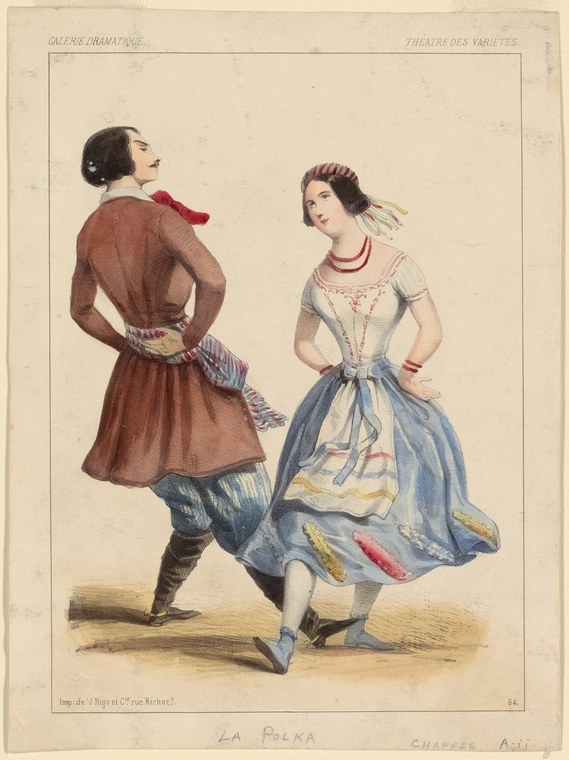
Two figures in folk dress are shown in a moment of social dance, set against a plain beige background. On the left stands a man in a rust-brown jacket and dark leggings, turned away from the viewer, his posture animated and his head tilted back. To his right stands a woman in a pale blue skirt with colored panels (yellow, pink, and red visible along the hem), a white short-sleeved bodice with decorative red trim at the neckline, and an embroidered or patterned vest-like overlay. Her dark hair is styled and she looks toward the man with an engaged expression. Both figures are positioned as if caught mid-motion, their feet active on the ground. The woman's voluminous skirt is the dominant visual element, its construction and the artist's rendering of its movement suggesting a vigorous, turning motion. The handwritten annotation "LA POLKA" and what appears to be a signature or attribution mark are visible at the bottom of the sheet.
The dancing
The man's posture is open and energetic, with his weight forward and his body rotated; the woman mirrors this engagement, her frame upright and her gaze fixed on her partner. Both appear to be in the characteristic bouncing or springing motion associated with polka. The woman's arms are held in a relatively modest position, neither fully extended nor constrained—typical of folk dance of the period. Their proximity and orientation suggest a couple dance, likely a closed or semi-closed partnering, though the exact hold is obscured by the viewing angle and the woman's elaborate skirt.
The dance depicted
This is a depiction of the polka, a couple dance of Central European origin that swept through popular and ballroom culture in the mid-19th century. The polka is characterized by a quick, springing movement in 2/4 time, typically performed by couples in closed position with a distinctive hop-step pattern. The artist has captured the buoyant, lively energy the dance was known for. The dress of both figures—particularly the woman's folk costume with its embroidered details and structured skirt—places this in the context of either folk performance or the domestication of folk dance into parlor and public ballroom settings. The image suggests the formal or display version of the polka rather than strict folk practice.
How it was made
This is a hand-colored lithograph or engraving; the technique appears to be lithographic or engraved print with selective hand coloring applied to the figures' garments and a light background wash. The inscription at the top—"GALERIE DRAMATIQUE" and "THEATRE DES VARIETÉS"—indicates this was part of a series of theatrical or performance imagery, likely produced in France in the mid-19th century. The New York Public Library holding confirms this is a print from their collection of dance-related imagery. The hand-coloring technique allowed for economical production of multiple copies while preserving fine detail in the figures' features and the intricate patterning of folk dress.
About this work
This is a mid-19th-century French hand-colored print documenting the polka, one of the defining social dances of the era. The work belongs to a series of theatrical and variety-hall imagery and captures a moment of energetic partnership between a man and woman in folk-inspired dress. It serves as evidence of how the polka was visualized and performed in public contexts—particularly in French popular theater and dance venues—and how folk dress was appropriated and stylized for entertainment and social dancing among urban audiences. The image sits at the intersection of folk dance tradition, ballroom fashion, and theatrical representation.
How to look at it
Notice the spring and lift in both figures' bodies—the bent knees, forward lean, and tilted head position that convey the characteristic bouncing rhythm of the polka. The woman's skirt is rendered with attention to how fabric moves in rapid turning motion, with colored panels visible along the hem suggesting both the construction of folk dress and the centripetal force of the dance. The man's turned-away posture and the woman's engaged gaze create a sense of captured momentum and partnership. This is not a formal, stilled pose but a moment of action, which was itself a significant development in how dance was being represented in visual culture during this period.
The artist
The print is attributed to sources or artists working within the "Galerie Dramatique" and "Théâtre des Variétés" context, suggesting it was produced by a commercial print house specializing in theatrical imagery for a broad public market. The hand-coloring and compositional style are consistent with mid-19th-century French popular prints. Without a signed attribution, the individual artist remains unidentified, though the work's quality and detail suggest a professional or trained hand.
The period
The polka emerged in Bohemia in the 1830s and became a dominant social dance across Europe and North America by the 1840s–1860s. Its popularity coincided with a broader cultural fascination with folk and national identity in European Romanticism, and with the rise of the modern ballroom and public dance hall. In France, the polka was embraced by both aristocratic salons and the middle-class and working-class public spaces depicted here. The mid-19th century also saw an explosion of theatrical and entertainment venues, particularly in Paris, where variety halls and specialty theaters promoted new dances, music, and spectacle. The "Théâtre des Variétés" was a real and popular venue, making this print a document of actual performance contexts.
Where it lives
This print is part of the New York Public Library's "Prints depicting dance" collection, a holding focused on visual documentation of dance across genres and periods. The inscription and series attribution place it within the "Galerie Dramatique" and "Théâtre des Variétés" series, a mid-19th-century French print series documenting performers, costumes, and dances associated with theatrical entertainment and popular variety halls.
Dance in this work
Questions about this work
What is a polka and why was it so popular?
The polka is a lively couple dance in quick 2/4 time, originating in Bohemia in the 1830s. It became wildly fashionable across Europe and America by the mid-19th century because it was energetic, sociable, relatively easy to learn, and perfectly suited to the emerging culture of public dance halls and ballrooms. It represented a break from more rigid, formal dances like the minuet.
What do the folk costumes in this image tell us?
The woman's embroidered bodice, decorative trim, and paneled skirt, along with the man's rustic jacket, are styled folk dress rather than authentic peasant clothing. They reflect the 19th-century Romantic fascination with folk traditions and national identity, and how theatrical and ballroom contexts appropriated and refined folk aesthetics for urban audiences. This was common practice in variety halls and dance performances of the period.
Where would this dance have been performed?
The inscription references the Théâtre des Variétés, a real Parisian venue specializing in entertainment, musical performance, and variety acts. Polkas were performed in such theaters as part of regular programming, in ballrooms and public dance halls, and in upper-class salons. This print documents the theatrical and commercial performance context rather than folk or social dancing in private homes.
How was this print made and who would have seen it?
This is a hand-colored lithographic or engraved print, a technology that allowed relatively inexpensive mass production. It would have been sold to a broad public—theater-goers, dance enthusiasts, people interested in fashion and entertainment. Such prints were collected, displayed, and circulated as affordable mementos of popular performers, dances, and theatrical moments.
More dance artwork





