49 works in this view — arrow keys or swipe to move between them.
Dance in Art
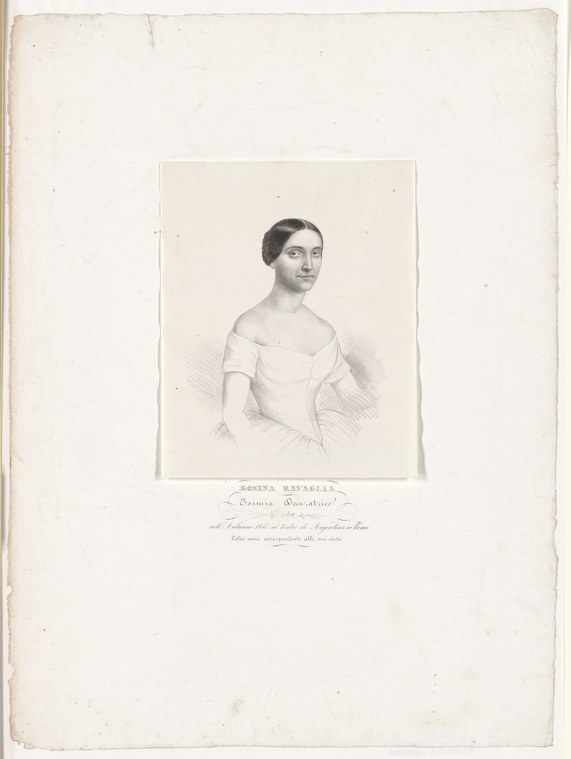
Rosina Ravaglia, esimia danzatrice che nell'autunno 1847 al Teatro di Argentina in Roma colse onori corrispondenti alle sue virtù
Unknown artist
- Collection:
- Prints depicting dance
- Source:
- New York Public Library
- Rights:
- Public domain — free to use, share and adapt.
- Recorded as:
- Public Domain
Ravaglia's prominence in Rome during a significant moment in European theatrical history—the height of Romantic ballet—makes this portrait a document of that cultural world. The image records the face of a performer now forgotten, preserving her name and her achievement (however briefly) in the public record. For historians of 19th-century dance and theatre, such portraits reveal how performers were marketed, celebrated, and remembered: not primarily through descriptions of their technique, but through the circulation of their images.
What you are looking at
A three-quarter-length portrait of a young woman, rendered as a delicate lithographic study in black ink on cream paper. She is turned slightly to the right, her head inclined with a composed, introspective gaze. Her dark hair is parted in the center and swept back in the fashion of the 1840s. She wears a simple white or pale-colored off-shoulder dress with short puffed sleeves that expose her upper arms and shoulders—a costume typical of Romantic-era theatrical dress and also common in formal portrait conventions of the period. The figure is modeled with soft shading to suggest the roundness of her face and the delicate musculature of her neck and shoulders. The background is left entirely blank except for light hatching in the upper corners that creates a subtle sense of atmospheric space. The composition is carefully centered, with the figure occupying the upper two-thirds of the sheet, leaving ample margin below. Below the portrait sits a printed caption identifying the subject.
The dancing
The dancer is shown standing at rest rather than in motion, her weight evenly distributed and her posture upright but relaxed. Her arms hang naturally at her sides, with no indication of the lifted frame, turned-out legs, or extended epaulement that would characterize formal ballet training. The shoulders are dropped and soft; the neck is long and graceful but not rigidly held. There is no visible footwork—the image shows only the upper body and face. This is a portraiture convention, not a dance pose, and it tells us nothing about how Ravaglia actually moved on stage.
The dance depicted
Rosina Ravaglia was an Italian dancer who achieved prominence in Rome in autumn 1847, according to the inscription, but the print itself does not depict her dancing. Rather, it is a formal portrait of her as a person—a type of theatrical promotion common in the 19th century. The subject line promises that she won "honors corresponding to her virtues" at the Teatro di Argentina (the Argentina Theatre), Rome's principal opera house, but the image gives us only her face and upper body in rest. We cannot determine from this portrait alone what style of dance she performed, though the off-shoulder dress and the theatrical context suggest either Romantic ballet or a related theatrical genre of the 1840s. The portrait was likely circulated as a promotional object or souvenir.
How it was made
This is a lithograph, identifiable by its characteristic soft line work, gentle tonal gradation, and the warm cream tone of the paper stock typical of 19th-century commercial printing. Lithography allowed rapid, affordable reproduction from stone, making it ideal for distributing images of popular performers to theatre audiences and collectors. The artist's signature does not appear on the visible portion of the sheet, and the catalogue record does not attribute it. The fine line work and delicate modeling of the face suggest a skilled theatrical lithographer, possibly working from a painting or drawing. The printing would have been relatively inexpensive to produce in multiple editions, ensuring circulation in Rome's theatre world.
About this work
This is a formal theatrical portrait of an Italian dancer from Rome in the mid-19th century. Rosina Ravaglia performed at the Teatro di Argentina in autumn 1847, and this lithograph served as a promotional image—a souvenir for theatergoers or a calling card for the performer. It preserves her likeness in the soft, careful style of theatrical portraiture contemporary with the early Romantic ballet era, when star dancers were celebrated as much for their beauty and grace off stage as for their virtuosity on it. The work belongs in a gallery of dance imagery because it documents the performance culture and celebrity apparatus of mid-19th-century Italian theatre, even though it shows us not a dancer in motion but a woman presented to an admiring public.
How to look at it
Attend to the softness of the rendering: the artist has used lithography's capacity for subtle tonal gradation to model the face and neck with great delicacy, creating an impression of living presence. Notice the fashion details—the off-shoulder dress and the hairstyle—which place the work precisely in the 1840s and suggest a theatrical context rather than a formal society portrait. The blank background and centered composition follow the conventions of promotional theatrical portraiture, emphasizing the subject's face and presence rather than narrative or movement. The slight turn of the head and the downward gaze create a sense of introspection or modest composure, a quality valued in the Romantic aesthetic.
The period
This portrait dates to 1847 or shortly after, placing it firmly in the Romantic ballet era (1830s–1850s). Italian theatre in this period was dominated by opera and ballet performed in major houses like the Argentina Theatre in Rome. Dancers like Maria Taglioni and Fanny Essler had made Romantic ballet an international sensation, and stars in provincial cities like Rome were celebrated for their beauty and stage presence as well as their technique. The fashion of Ravaglia's dress—the off-shoulder cut, the simple white fabric—reflects the Romantic ideal of ethereal femininity and aligns with the costumes seen in Romantic ballet. However, Italy maintained strong traditions of pantomime, dramatic ballet, and academic training distinct from the French school. The promotion of individual performers through lithographic portraits was standard practice in theatre culture across Europe during this decade.
Where it lives
The work is held in the New York Public Library's collection of prints depicting dance. It is catalogued as a lithograph from an unknown artist, with the subject identified by the printed caption on the sheet itself. The print likely circulated in Rome in or shortly after 1847 as a theatrical souvenir or promotional object.
Questions about this work
Who was Rosina Ravaglia?
Rosina Ravaglia was an Italian dancer who performed at the Teatro di Argentina in Rome in autumn 1847. The inscription on this print states that she achieved honor befitting her abilities ("virtù") during that season, but little else is recorded about her. She was one of many 19th-century performers who were celebrated in their time but left minimal trace in later historical record.
Why does this portrait not show her dancing?
Formal theatrical portraiture of the 19th century typically presented performers at rest, emphasizing their appearance and beauty rather than their skill. Dancers were promoted through their likenesses and celebrity as much as through descriptions of their technique. This portrait served as a souvenir or promotional image for audiences, not as a record of her movement or style.
What kind of dance did Ravaglia perform?
The inscription does not specify her dance genre, and the portrait gives no technical clues. The off-shoulder dress and the date (1847) suggest either Romantic ballet or a related Italian theatrical tradition, but we cannot be certain from the image alone. The Teatro di Argentina hosted both opera and ballet, so she may have performed in either genre or both.
How was this print made and shared?
This is a lithograph, a printing technology that allowed artists to draw directly onto stone and produce multiple copies quickly and affordably. Lithographic portraits of popular performers were widely distributed as theatrical souvenirs—purchased by theatergoers as collectibles or given away as promotional materials. They were inexpensive and portable, making them ideal for building a performer's celebrity.
More dance artwork





