49 works in this view — arrow keys or swipe to move between them.
Dance in Art
Amadis
Unknown artist
- Collection:
- Prints depicting dance
- Source:
- New York Public Library
- Rights:
- Public domain — free to use, share and adapt.
- Recorded as:
- Public Domain
This work demonstrates how Renaissance and early modern book illustration drew on the visual language of classical rhetoric, pageantry, and courtly performance to present narrative and allegory. Understanding the conventions of such formal illustration—the use of classical dress, architectural framing, and hierarchical gesture—illuminates the aesthetic world in which court dances were choreographed and understood. The work is evidence of a shared visual and performative culture in which the human body, properly dressed and positioned, was the vehicle for meaning-making.
What you are looking at
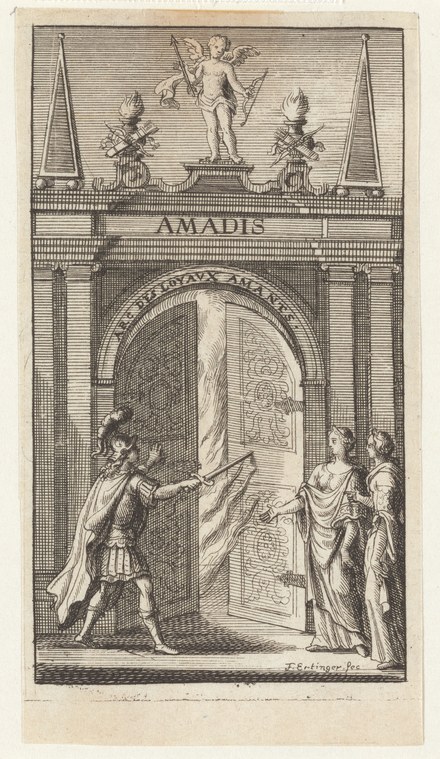
This is an engraved title page or frontispiece depicting a scene from the romance *Amadis of Gaul*, a popular chivalric narrative of the Renaissance and beyond. The composition is formally architectural: a grand classical portico with fluted columns frames a central doorway. Above the entablature sits the word "AMADIS" in capital letters, flanked by ornamental urns and crowned with a putti (winged cherub) bearing a staff or lance. The scene within the portico shows three figures in classical drapery. On the left stands an armed knight in Roman-style armor and short tunic, gesturing toward the open doorway with his right arm raised in a declarative or commanding pose. Two women in flowing classical robes stand to the right, one nearer the door, both turning toward the knight. The lighting is even and the entire composition is rendered in fine parallel lines typical of engraving, creating a sense of formal, static dignity rather than action. This is a work of allegorical or narrative illustration designed to introduce a text rather than to depict an actual performance or social dance.
The dancing
The three figures occupy distinct positions within the architectural frame. The knight's body is turned leftward, his weight forward, his right arm raised in an oratorical or commanding gesture—not a dance posture. The women are in contrapposto stances, their bodies relaxed and draped, turning to engage with the knight rather than with each other. The spatial relationship is hierarchical and illustrative rather than participatory: they do not touch, maintain formal distance, and are organized to create a narrative tableau. There is no evident hold, no frame between partners, and no footwork suggested by the composition.
The dance depicted
This image does not depict dance, or does so only in an emblematic or allegorical sense. The scene is a narrative or allegorical illustration from a chivalric romance, arranged to suggest dramatic encounter or declaration rather than social or theatrical dance. The postures and compositions are those of classical rhetoric and pageantry—the conventions of Renaissance and early modern heroic narrative art—not of any recognizable dance practice. If movement is implied at all, it is the movement of story or argument, not of trained choreographic form.
How it was made
This is a finely executed engraving, likely 16th or 17th century, recognizable by the dense parallel hatching and the precision of line work used to model form, light, and texture. Engraving allowed for fine detail and wide distribution through printing; this is a work designed for multiplication and circulation as a printed page, not a unique artwork. The technique's capacity for fine tonal gradation through line density allowed the engraver to suggest sculptural volume in the classical architecture and the soft folds of the figures' garments. The inscription at the bottom suggests this is a published book illustration or title page.
About this work
This is a Renaissance or early modern engraved title page or frontispiece illustrating a scene from the chivalric romance *Amadis of Gaul*. It is a work of narrative and allegorical art, not a document of actual dance, and belongs in the Gallery of Dance in Art only because it uses the human body in formal, theatrical arrangement within a classical architectural frame—a mode of visual rhetoric that shares aesthetic conventions with court performance and pageantry of the period. The work exemplifies how early modern printed illustrations used the language of classical drama and heroic narrative to present stories and ideas to a reading and viewing public.
The image sits at the intersection of literature, visual art, and the conventions of courtly performance. While it does not depict dance itself, it is evidence of how the educated classes of the Renaissance understood and visualized human beauty, gesture, and formal encounter—values that informed both court dance and the visual arts of the period.
How to look at it
Attend to the formal architecture and the careful positioning of the figures within it. The engraver has organized the scene according to principles of classical rhetoric and order—the knight's raised arm echoes the gesture of an orator or a figure of authority from classical history or allegory. The women's turning poses and the open doorway create a sense of narrative unfolding or revelation. The entire composition is static and illustrative rather than dynamic; movement, if any, is implied through narrative and allegory rather than through the kinetic language of actual bodily motion. Notice how the engraver uses the fineness of line and the density of hatching to suggest the texture of drapery and the solidity of architectural elements—a technique that gives the classical world depicted here a sense of tangible presence and authority.
The artist
The engraver is not recorded in the catalogue. The style and inscription suggest a 16th- or 17th-century printmaker working in the tradition of Renaissance book illustration, possibly German or Low Netherlandish, producing work for a published edition of the *Amadis* romance or a related courtly narrative. The precision and classical erudition of the composition suggest a trained and educated artisan familiar with architectural theory and classical iconography.
The period
The *Amadis of Gaul* was one of the most widely read and translated romances of the Renaissance, first published in Spanish in 1508 and rapidly disseminated throughout Europe in printed editions and translations. It was a key text in the formation of courtly culture and the ideals of chivalry, love, and heroic action that governed the conduct and imagination of the European nobility. The romance's celebration of refined courtesy, martial prowess, and romantic devotion was directly reflected in the pastimes and performances of Renaissance courts—in the dances, masques, tournaments, and elaborate pageants that were staged to enact and celebrate these same ideals. The classical architectural and rhetorical language of this engraving reflects the humanist education and classical revival that characterized Renaissance court culture.
Where it lives
The work is held in the New York Public Library's Prints collection and is catalogued as a work depicting dance, though the catalogue record itself is minimal. It is likely a page from a printed book—a title page or frontispiece—rather than an independent print.
Questions about this work
Is this actually a dance scene?
Not in the sense of a performed dance. This is a narrative or allegorical illustration from a Renaissance romance, using formal classical gestures and poses to depict a moment of encounter or declaration. However, the visual language it employs—classical drapery, formal gesture, hierarchical arrangement—is closely related to the conventions of Renaissance court spectacle and dance.
What is the *Amadis of Gaul*?
A chivalric romance, first published in Spanish in 1508, that became one of the most influential literary works of the Renaissance. It tells the story of the knight Amadis and his adventures in love and war, and its ideals of courtly behavior, refined conduct, and romantic devotion were deeply embedded in the culture of Renaissance courts.
Why is this in a dance collection?
Because it uses the human body in formal, stylized arrangement to convey meaning—a practice that is central to both visual art and dance. The conventions of classical gesture and drapery that this engraver deploys are the same conventions that governed the choreography and performance of Renaissance court dances and pageants.
More dance artwork





