49 works in this view — arrow keys or swipe to move between them.
Dance in Art
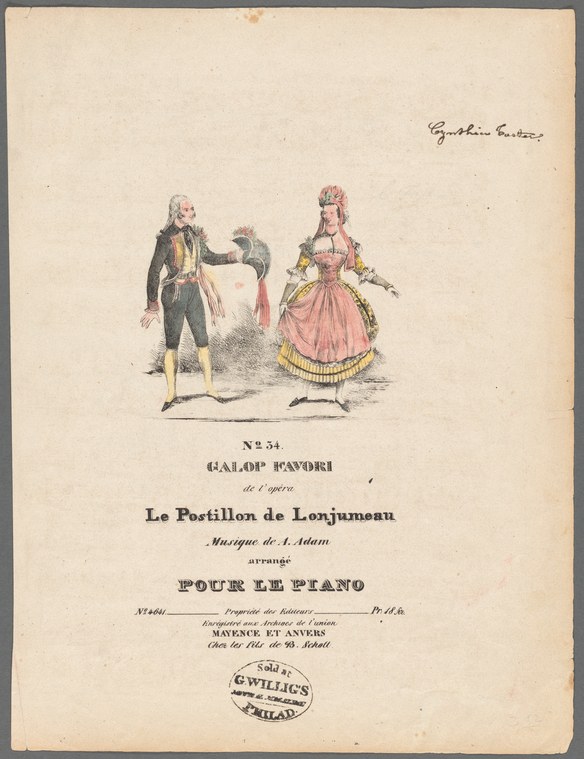
No. 34, Galop favori de l'opéra Le postillon de Lonjumeau, musique de A[dolphe] Adam, arrangé pour le piano
Unknown artist
- Collection:
- Prints depicting dance
- Source:
- New York Public Library
- Rights:
- Public domain — free to use, share and adapt.
- Recorded as:
- Public Domain
For dance historians, this engraving documents the galop's role in 1830s opera and its status as a fashionable social dance; for music historians, it exemplifies how theatrical dances were adapted for domestic consumption through printed scores and promotional imagery. The image shows how dance and fashion were inseparable commodities in the Romantic era, marketed together to a growing middle-class audience.
What you are looking at
A hand-colored engraving shows two figures in fashionable early 19th-century dress. On the left, a man in dark tailcoat, breeches, and shoes stands in profile, gesturing toward his companion with his right hand extended. On the right, a woman in a voluminous pink dress with a deep yellow underskirt faces forward, her posture upright and engaged. The woman wears an elaborate headdress with feathers or plumes and jewelry. Both figures are rendered against a plain background with minimal setting, placing all emphasis on their costumes and the interaction between them. The composition is centered and frontal, typical of theatrical or operatic illustration of the period. Below the figures, ornamental framing lines and text identify the work as a dance arrangement.
The dancing
The man stands with his weight forward, his right arm extended in an inviting or explanatory gesture toward the woman, whose bearing is formal and composed. The woman's skirt occupies most of the pictorial space, its volume suggesting the characteristic silhouette of Romantic-era dress but also the expanded scale needed for ballroom and stage movement. Neither figure is in active motion; instead, they are posed in the manner of theatrical portraiture, presenting themselves for display rather than captured mid-step. The spatial relationship between them suggests a greeting, courtship moment, or dramatic exchange rather than a close dancing contact.
The dance depicted
This is a vocal score arrangement for piano of a dance number from Adolphe Adam's 1836 opéra comique *Le Postillon de Longjumeau*. The galop—a quick, energetic couple dance in 2/4 time—was a fashionable stage and ballroom dance of the 1830s–1840s. The theatrical context and the title "Galop favori de l'opéra" establish that this music accompanied a specific dance scene in the work. The engraving illustrates the principal characters in costume rather than attempting to show galop choreography; the formal presentation suits the function of such prints as advertisements for sheet music and theatrical events.
How it was made
This is a hand-colored engraving, recognizable from the fine parallel line work visible in the background and drapery, the crisp contours of the figures, and the secondary hand-application of watercolor or gouache to define the colors of dress and complexion. The technique allowed for mass production of theatrical publicity and sheet-music covers, reaching a broad middle-class audience interested in opera, dance, and fashionable music. The precision of engraving and the expense of hand-coloring indicate this was a premium product, likely sold to piano owners and opera-goers who could afford both sheet music and colored prints. The publisher, Mayence et Anvers (Mainz and Antwerp), and the retailer Willms of Emilau, establish distribution across Europe.
About this work
This is a promotional engraving for a piano arrangement of a dance number from a canonical French opéra comique of the 1830s. The galop, a light couple dance in rapid duple time, was enormously popular in both theatrical and ballroom contexts during the Romantic period; operatic versions such as this one introduced the dance to audiences and provided sheet music for domestic performance. The print served simultaneously as stage publicity and as a cover or advertisement for the musical arrangement, making it a document of how dance circulated from opera stage to parlor piano. The figure of the woman in her elaborate dress and the formal presentation of both dancers reflect how Romantic-era dance imagery marketed both the aesthetic appeal of fashionable movement and the theatrical and commercial machinery that made it accessible.
How to look at it
The engraving presents the figures in a formal, static pose rather than mid-movement—a convention of dance publicity that prioritized the legibility of costume and the recognition of celebrated performers over the representation of actual choreography. The woman's swollen skirt, the man's elegant tailcoat, and the formal bearing of both figures embody the visual language of Romantic gentility. Notice how the engraver has invested as much detail in the textures of fabric and the fineness of the woman's headdress as in the structure of the bodies beneath them—a priority that reflects the era's fascination with fashion and display as central to theatrical dance. The inscription below provides the work's pedigree: its source in an opera by a named composer, its arrangement for a specific domestic instrument, and the publishers and retailers through which it circulated.
The period
The 1830s–1840s were the height of the galop's popularity across Europe. The dance originated in Germany in the early 1830s and spread rapidly through ballrooms and theaters. Adolphe Adam (1803–1856) was one of the most prolific and successful composers of opéra comique, a French genre that blended comedy, song, and spectacle; his works reached both opera houses and domestic music-makers through published arrangements. The opéra comique itself was a vehicle for introducing stage dances to broad audiences; brief, showy numbers like a galop could be performed by principal singers and dancers and then reproduced in sheet-music form for amateurs. This print belongs to the culture of theatrical merchandise that grew alongside the rise of opera as public entertainment.
Where it lives
This print is held by the New York Public Library as part of its collection of prints depicting dance. Such prints typically originated as theatrical merchandise and publicity, sold at playhouses and through music retailers; the NYPL's acquisition reflects early 20th-century collecting practices that recognized the historical and visual interest of theatrical ephemera.
Dance in this work
Questions about this work
What is a galop?
The galop is a quick, lively couple dance in 2/4 time, originating in Germany in the early 1830s and rapidly adopted in ballrooms and theaters across Europe. It was typically performed as a finale or entertainment number because of its energetic, showy character. Operatic galops like this one brought the dance before theatrical audiences and provided music for domestic dancing.
Who was Adolphe Adam?
Adam (1803–1856) was a prolific French composer of opéra comique—a popular theatrical genre combining comedy, song, and spectacle. *Le Postillon de Longjumeau* (1836) was one of his most successful works. His music was widely published in arrangements for piano and other instruments, reaching amateur musicians and families who could not attend opera houses.
Why does the engraving not show people actually dancing?
This is a promotional print and sheet-music cover, not a record of choreography. The figures are posed formally to showcase their costumes and make them recognizable to theater-goers, following the convention of theatrical portraiture. The actual dance movements were conveyed by the music itself, which dancers and amateurs would learn through performance and practice.
What does the clothing tell us about the dance?
The woman's full, weighted skirt indicates a dance that required space for expansive movement and employed the skirt itself as a visual element. The man's tailcoat and breeches represent formal ballroom attire. Together, they mark this as a fashionable social dance of the Romantic period, performed in theatrical and ballroom contexts by people of means.
More dance artwork





