49 works in this view — arrow keys or swipe to move between them.
Dance in Art
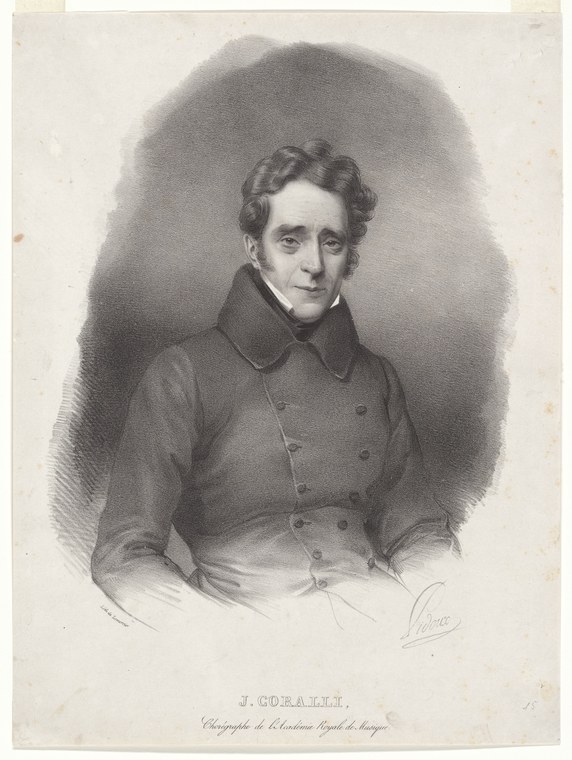
J. Coralli
Unknown artist
- Collection:
- Prints depicting dance
- Source:
- New York Public Library
- Rights:
- Public domain — free to use, share and adapt.
- Recorded as:
- Public Domain
Coralli was the architect of *Giselle*, the most frequently performed Romantic ballet and one of the foundational works of the classical repertoire. This portrait is contemporary evidence of his standing as a major figure during the height of Romantic ballet in Paris, and it records the visual culture of theatrical celebrity in the 1830s.
What you are looking at
A half-length portrait of a young man in early 19th-century dress, rendered in fine stippled engraving. He wears a dark double-breasted coat with a broad collar and buttons visible down the front, set against a soft vignetted background that darkens toward the edges. His dark hair is arranged in the fashionable style of the 1820s–1830s, swept back from his forehead in loose waves. The face is rendered with delicate cross-hatching and stippling to model the cheekbones and jawline, giving an alert, intelligent expression. The signature and inscription at the base identify the subject as J. Coralli.
The dancing
A single seated or three-quarter-length figure occupies the frame, shoulders squared to the viewer, head turned slightly to the left. The posture is calm and formal, with no hint of movement or gesture—this is a portrait of repose, not action. The hands are not visible, and there is no indication of dance position, hold, or footwork.
The dance depicted
This is a portrait of a historical figure, not a depiction of dance in progress. The subject is Jean Coralli (1779–1854), the French ballet master and choreographer best known for creating *Giselle* (1841) and *La Péri* (1843) alongside Adolphe Adam and other collaborators. He was a dominant figure in Romantic ballet and trained dancers at the Paris Opéra. The engraving documents his appearance, not his work as a dancer or pedagogue.
How it was made
This is a finely executed steel or copper engraving, likely a stipple or mixed-technique engraving combining cross-hatching with stippling to achieve tonal gradation and soft modeling of the face. The vignette background—where the image fades into white rather than being enclosed by a border—was typical of high-quality engraved portraits in the early 19th century. The refined technique and careful rendering suggest this was a formal publication portrait, intended for circulation among the theater world or collected as a commemorative print.
About this work
This engraving documents Jean Coralli, one of the most influential ballet choreographers of the 19th century. Though the print itself shows only his face and shoulders—not dance—it belongs in a dance gallery because it is a portrait of a figure who shaped Romantic ballet and because it appears in a collection specifically devoted to prints depicting dance and dancers. The print is a historical record of a creator whose work defined the genre, even though this particular image captures him at rest. It serves as a reference point for understanding the aesthetic and institutional context of Romantic ballet, showing how dancers and choreographers were commemorated through formal engraved portraiture.
How to look at it
Read this as a historical document rather than a dance image. Note the formality of the pose, the fashionable styling of hair and coat, and the intelligence conveyed by the face—these are what mattered in early 19th-century theatrical celebrity portraiture. The soft vignetting and delicate engraving technique create an impression of dignity and refinement, befitting a senior artist of the Paris Opéra. The absence of any costume or prop hints at dance; instead, Coralli is presented as a gentleman of letters and taste.
The artist
The engraver is not identified in the record. The inscription "Gravé par" (engraved by) would appear on the print itself but is not fully legible in the catalogue. The style and execution suggest a competent professional engraver working in Paris during the 1830s–1840s, producing formal theatrical portraits for collectors and archives.
The period
This portrait dates to the height of Romantic ballet in France, a period when the Paris Opéra was at the center of European dance innovation and when choreographers and dancers had achieved the status of celebrated public figures. The 1830s saw the premieres of *La Sylphide* (1832) and the rise of the ballerina as the dominant figure on stage. Coralli's work at this moment—before *Giselle*—was already substantial and respected, and his portrait would have circulated among theater patrons, dancers, and collectors. The refined stipple-engraving technique reflects the high production values of portraits aimed at educated audiences.
Where it lives
This engraving is held in the New York Public Library's collection of prints depicting dance. It is a standard theatrical portrait from the 1830s–1840s, produced and distributed as a commemorative print for theatergoers and collectors.
Questions about this work
Why is a portrait of a man in a coat in a dance collection?
Jean Coralli was a leading ballet choreographer and master of the Paris Opéra. Though this engraving shows him as a formal portrait rather than at work, it documents a major figure in dance history. Early 19th-century theater collections often included portraits of celebrated dancers, choreographers, and composers as a record of the personalities who shaped the art form.
Is this Coralli dancing or choreographing?
Neither. This is a formal portrait of repose, a standard commemorative print of the kind circulated to celebrate a notable figure. It does not show Coralli in action or teaching, but rather preserves his appearance for posterity.
Who was Jean Coralli?
Coralli (1779–1854) was a French ballet master, choreographer, and dancer who directed the Paris Opéra ballet and created or co-created many important works including *Giselle* (1841), one of the four pillars of the classical ballet repertoire. He was influential in establishing the Romantic ballet aesthetic.
More dance artwork





