49 works in this view — arrow keys or swipe to move between them.
Dance in Art
Peasants dancing
Unknown artist
- Collection:
- Prints depicting dance
- Source:
- New York Public Library
- Rights:
- Public domain — free to use, share and adapt.
- Recorded as:
- Public Domain
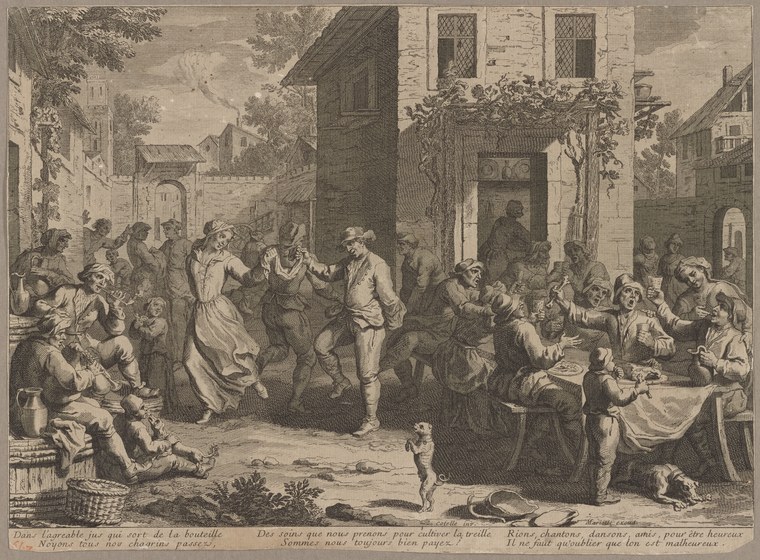
This image is a rare direct record of how peasants actually danced together in the early modern period, before such dances were codified, reformed, or forgotten. Most dance documentation from this era concerns elite and court dancing; prints like this one preserve the texture and informality of folk practice as it existed in living communities. For historians of social dance, vernacular culture, and gender relations, it offers concrete visual evidence of public festivity and the integration of movement, food, and collective leisure.
What you are looking at
A crowded village or town square fills with peasants dancing, eating, and socializing in what appears to be a festival or celebration. The scene is densely populated, with figures distributed across a foreground of packed earth where food baskets sit overturned, and receding into a background of substantial stone buildings with arched doorways and shuttered windows. The architecture suggests a European setting, possibly Mediterranean or Alpine. The composition is divided into clusters of activity: at left, figures dance in loose formation; at center and right, seated groups consume food and drink, their bodies relaxed and angled toward each other. The light is even and bright, typical of prints, with the engraver's hatching creating depth and shadow in the buildings and between figures. The mood is convivial and boisterous—this is a moment of collective leisure and festivity, captured with attention to the specificity of peasant dress, gesture, and interaction.
The dancing
Dancers at the left show bodies in motion with raised arms and turned frames, suggesting a round or line dance where participants pivot and sway together. The nearest dancers have their arms elevated and bodies leaning inward, characteristic of folk-dance formations that emphasize rhythm and group cohesion rather than technical precision. Weight shifts visibly from foot to foot, and the composition suggests movement in progress rather than a static pose. Seated figures throughout the scene show varied postures—some bent forward over food, others twisting to speak or watch the dancers, creating a contrast between the vertical energy of the dancing group and the horizontal informality of those at rest.
The dance depicted
This depicts a peasant or folk celebration, almost certainly a village festival or fair dance. The loose, buoyant movement and the mixed-gender grouping suggest social dancing rather than performed spectacle or court ritual. The setting and dress place this firmly in the early modern period (likely 16th–17th century based on visual evidence), when such celebrations were documented by Northern European artists as scenes of rural life and social custom. The dancers show no formal training or stylization; their participation appears spontaneous and joyful, driven by music (likely a pipe or fiddle, though no musician is prominently visible). This is a document of how ordinary people danced in communal settings, not how elite or professional dancers moved.
How it was made
This is an engraving, a technique evident in the fine parallel hatching that models form and shadow, the crisp black lines, and the tonal range achieved through the density of linear marks rather than wash or color. Engravings were relatively expensive to produce but capable of wide circulation in multiple impressions, making them a key medium for distributing images of everyday life and ethnographic subjects to educated audiences across Europe. The artist has used the medium's precision to differentiate textures—the woven pattern of baskets, the folds of linen sleeves, the roughness of stone walls—allowing viewers to read fine detail even in reproduction. This suggests the work was intended for a book or series documenting rural customs, not as a precious unique object.
About this work
This is a Northern European engraving documenting peasant life and dance in what appears to be the 16th or 17th century. The work captures a moment of collective festivity in a village square, with careful attention to the specificity of costume, architecture, and social interaction. It belongs to a tradition of prints depicting the customs and amusements of rural life, created for educated urban audiences interested in ethnographic and social documentation. The dance itself is unspecialized and communal—a village celebration rather than a performance or courtly ritual—and the print preserves evidence of how ordinary people moved together in moments of collective pleasure.
How to look at it
Observe the contrast between the energetic, upright bodies of the dancers at left and the sprawled, informal postures of the eaters and drinkers at right and center. Notice how the artist has positioned the dancers in profile or three-quarter view to show the torsion and lean of their bodies as they move in a coordinated group, while seated figures are viewed from more varied angles, their stillness emphasized by their horizontal or bent frames. The density of the crowd and the overlapping of figures create a sense of press and momentum. Look at the hands and arms of the dancers: they are raised, active, and animated, driving the visual rhythm of the composition upward in contrast to the downward focus of those eating and drinking.
The period
In the 16th and 17th centuries, Northern European artists—particularly in the Low Countries, Germany, and Switzerland—developed a sustained interest in depicting peasant life as a subject of moral, ethnographic, and entertaining value. Such scenes were printed and circulated among educated townspeople as evidence of rural custom and social hierarchy. Dancing was a central feature of village festivals and fairs, occasions when ordinary work rhythms were suspended and communal celebration took precedence. These events were also sites of courtship, food sharing, and social bonding that reinforced village identity. Artists recorded them with an eye to both the lively energy of the celebrations and the moral resonance of collective festivity—sometimes celebratory, sometimes critical.
Where it lives
This work is held in the New York Public Library's collection of prints depicting dance. It is part of a broader documentation effort to gather visual records of dance across media and periods.
Dance in this work
Questions about this work
What kind of dance is this?
This is a peasant or folk social dance, most likely a round or line dance at a village festival or fair. The dancers move together without formal training or rigid structure, responding to rhythm and communal energy rather than choreography. Such dances were common forms of public entertainment and courtship in rural Europe.
How do I know this is from the 16th or 17th century?
The costume, architecture, and engraving technique all point to this period. The style of dress—the cut of the men's hose, the women's linen headdresses and skirts—the design of the buildings with their shuttered windows, and the visual language of the engraving itself (fine hatching, crisp line work) are all consistent with Northern European prints from this era.
Is this a real event or an idealized scene?
It is almost certainly based on real village celebrations, though the artist has composed and arranged the figures for clarity and effect. The level of specific detail in dress, food, and architecture suggests observation of actual practice, but the overall arrangement and the density of the crowd are shaped by the demands of printmaking and the artist's desire to tell a story about festivity and social life.
More dance artwork





