49 works in this view — arrow keys or swipe to move between them.
Dance in Art
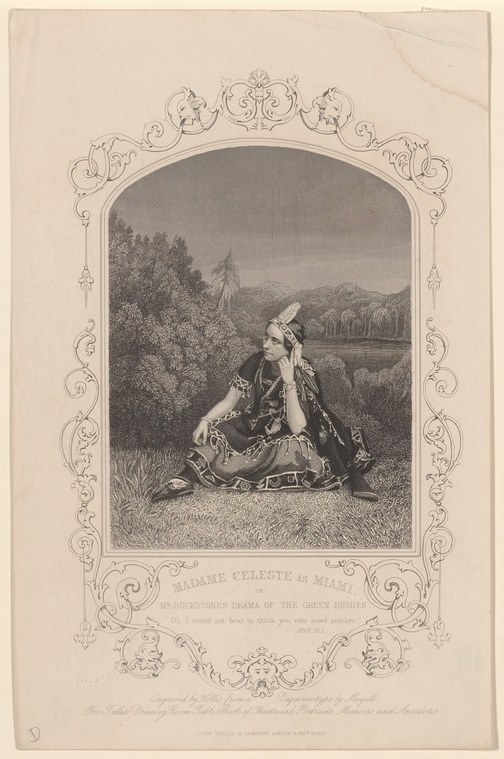
Madame Celeste as Miami in Mr. Buckstone's drama of The green bushes
Unknown artist
- Collection:
- Prints depicting dance
- Source:
- New York Public Library
- Rights:
- Public domain — free to use, share and adapt.
- Recorded as:
- Public Domain
Madame Celeste (1815–1882) was one of the most celebrated stage performers of the 19th century, known for pantomime, song, and physical performance across multiple continents. This print documents her in a specific named role, anchoring her body to a text and a theatrical moment in a way that connects performance history, actress biography, and the visual culture of theatre. The engraving itself shows how women performers' images were captured, framed, and sold to the public as theatrical souvenirs.
What you are looking at
A woman in elaborate theatrical costume sits alone in a landscape setting, posed as if mid-performance. She wears a richly decorated dress or wrapper in dark fabric with lighter patterning, a wide-brimmed hat or bonnet, and holds what appears to be a fan or hand prop. The setting is a countryside or garden scene with trees on the left, water (a river or lake) visible in the distance, and mountains or hills on the horizon. The composition is arranged within an ornamental rococo-style frame with scrollwork and decorative motifs in the margins. The engraving technique renders fine gradations of tone, creating depth and atmosphere; the sky is darker, drawing focus to the figure. The work has the character of a theatrical portrait print, documenting a specific role or character from stage performance.
The dancing
The dancer sits in a composed, frontal pose with one leg extended or draped, suggesting the frozen moment of a theatrical gesture rather than active movement. Her posture is upright and dignified, with arms arranged to show off costume and prop. The pose reads as a formal portrait attitude rather than a captured moment of energetic dance, typical of early 19th-century theatrical documentation in which performers are shown in character but in a presentational rather than action mode.
The dance depicted
The catalogue identifies this as Madame Celeste in the character of Miami from John Baldwin Buckstone's 1835 melodrama *The Green Bushes*. Buckstone's play was a popular work of early Victorian theatre featuring comic and romantic scenes. The pose and costume suggest this is not a depiction of structured dance but rather theatrical performance—likely a song, a character moment, or entrance pose. Early 19th-century theatrical prints regularly documented actresses and performers in signature roles but do not always depict dance proper. Whether Miami's role included dancing is unclear from the image alone.
How it was made
This is a steel or copper engraving, likely hand-colored or printed in tone, from the mid-19th century. The ornamental border and formal composition indicate a commercial theatrical print intended for collectors and theatre-goers—the kind distributed as souvenirs or collected in albums. The fine line work and tonal rendering required skilled engraving; the rococo frame suggests a mid-market product, neither the cheapest popular prints nor the most luxurious. This technique allowed wide circulation of theatrical portraiture, making performers' likenesses available to the public between performances.
About this work
This is a theatrical portrait engraving documenting Madame Celeste in a named role from an early Victorian melodrama. It sits at the intersection of dance documentation, theatre history, and commercial printmaking. While it records a performer known for her physical expressiveness and dancing ability, the image itself shows her in a posed, presentational moment rather than in the act of dance. The work matters as evidence of how theatrical bodies were circulated and commodified in the 19th century—how a performer became an image, and how that image was framed and marketed to audiences.
How to look at it
Notice how the figure is presented: seated, composed, and clearly conscious of being viewed. This is not a candid moment of performance but a formal portrait in costume—the theatrical equivalent of a fashion plate. The landscape setting is idealized and generic, not a realistic stage set; it frames and romanticizes the figure rather than anchoring her to a specific dramatic action. The ornamental border declares this a work of commercial art meant for display and collection, not a documentary image. The pose and gaze ask you to admire the performer and remember her in this role.
The artist
The artist is not recorded. The print was published as part of a commercial theatrical print series; such works were often produced by established printmakers and publishers who specialized in theatre portraiture. The style and execution are professional and competent, consistent with mid-19th-century commercial engraving practices. Without a signature or other identifying information visible in the image, authorship cannot be determined from the work itself.
The period
This print dates to the 1830s–1840s, during the early Victorian theatre boom when melodrama and musical comedy were dominant commercial forms. Theatrical portraiture was a major publishing genre; prints of famous actors and actresses in named roles were produced in quantity and sold at theatres, print shops, and through subscription. Madame Celeste's international fame and the popularity of *The Green Bushes* made her a marketable subject. The rococo-style ornamental border reflects aesthetic taste of the period while signaling theatrical or artistic subject matter to viewers.
Where it lives
This work is held in the New York Public Library's collection of prints depicting dance. It was acquired as theatrical portraiture and documentation of performance, reflecting the library's interest in both visual culture and performance history. The NYPL collection includes similar theatrical prints from the 19th century, many documenting named performers in specific roles.
Questions about this work
Who was Madame Celeste?
Madame Celeste (1815–1882) was a French-born actress, dancer, and performer who became one of the most celebrated stage artists of the 19th century. She performed across Europe and America and was known for her physical expressiveness, pantomime, dancing, and singing. She was particularly famous in melodrama and musical comedy, and was a major star of London and American theatres.
What is 'The Green Bushes'?
The Green Bushes is an 1835 melodrama by John Baldwin Buckstone, an English playwright. It was a popular theatrical work of the early Victorian period, featuring romantic and comic elements. The character of Miami was one of several roles in the play, and Madame Celeste's performance in the role was apparently significant enough to warrant a theatrical portrait print.
Is this a dance image?
The image documents a theatrical performer in character, but the pose itself is presentational rather than a depiction of active dance. Madame Celeste was known as a dancer and physical performer, but this particular print shows her in a composed, seated portrait attitude rather than in the act of dancing. It is theatrical portraiture first and foremost.
How were theatrical prints made and used?
Theatrical prints were produced as commercial products to be sold at theatres, print shops, and through subscription. They served as souvenirs, publicity, and mementos of performances and favorite actors. The engraving technique allowed prints to be produced in quantity and distributed widely, making performers' likenesses and named roles accessible to the public.
More dance artwork





