49 works in this view — arrow keys or swipe to move between them.
Dance in Art
The Bavarian girl's song: buy a broom!
Unknown artist
- Collection:
- Prints depicting dance
- Source:
- New York Public Library
- Rights:
- Public domain — free to use, share and adapt.
- Recorded as:
- Public Domain
Madame Vesteris was one of the most celebrated performers of her era, and this print preserves her image in a role that made her famous. The work documents the intersection of music-hall comedy, theatrical character work, and the body—a genre often overshadowed by ballet history but central to how most people experienced performance in the early 19th century.
What you are looking at
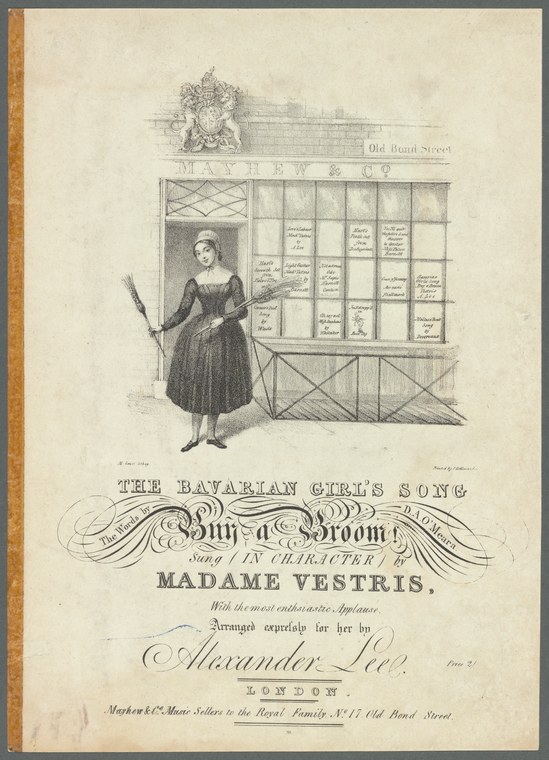
A woman in early 19th-century dress stands before a shopfront window, holding a broom aloft in her right hand. She wears a dark, long-sleeved dress with a high waistline typical of the Regency period, along with a bonnet or cap. The window behind her is divided into a regular grid of small panes, each inscribed with handwritten text (likely song lyrics or dialogue). Above the window, a coat of arms and the text "Old Bond Street" indicate this is a London commercial setting. The composition is a theatrical print—an engraving or lithograph—rendered in black ink with delicate cross-hatching to suggest shadow and volume. The woman's pose is direct and engaging, as though she addresses the viewer or an audience, her upright posture and the prominent broom suggesting both commercial advertisement and theatrical character.
The dancing
A single standing female figure in an upright, frontal pose. Her weight is evenly distributed, her left arm hangs naturally at her side while her right arm is raised to shoulder height, gripping the broom handle vertically. Her gaze is forward and engaging. There is no indication of active movement or dance steps; the pose is stationary and presentational, suited to theatrical character portrayal or commercial promotion rather than kinetic performance.
The dance depicted
This appears to be a theatrical character print rather than a depiction of dance proper. The title references a song—"The Bavarian Girl's Song: Buy a Broom!"—performed by Madame Vesteris, a celebrated performer of the Regency era. The image shows her in character as a street vendor, a comic or sentimental theatrical role rather than a dancer executing a specific dance form. Vesteris was known for song, comedy, and dramatic acting; this print documents her in a popular comic character piece, not a ballet or formal dance.
How it was made
This is an engraving or aquatint, likely hand-coloured or left in monochrome, printed from a copperplate or steel plate. The fine linear hatching, the architectural precision of the window grid, and the delicate modeling of the figure's face and dress are characteristic of early 19th-century theatrical prints. Such prints were commercial products distributed by music sellers and print shops (the imprint indicates a London publisher on Old Bond Street), aimed at a middle-class audience hungry for images of popular performers and their celebrated roles.
About this work
This is a theatrical character print from the early 19th century documenting a performance by Madame Vesteris, a leading London actress and singer of the Regency era. It shows her in the role of a Bavarian street vendor, a comic song character that became one of her signature pieces. The print was created for commercial circulation, intended to satisfy public curiosity about a famous performer and her popular roles. While not a record of dance, it belongs in a gallery of dance imagery as a window into the theatrical world that fed and surrounded dance in the Regency period—the same stages, the same performers, the same audiences, and the overlapping boundaries between song, comedy, and movement that characterized early 19th-century popular theatre.
How to look at it
Look at the pose: it is stationary and frontal, designed to present the performer to the viewer as a character type rather than to capture movement. The broom is a prop, marking her theatrical role as a street vendor. The handwritten text in the window panes suggests that the performance was built around song and spoken dialogue, not choreography. This is a document of theatrical celebrity and popular song, not of dance—but it shows the ecosystem in which dance existed.
The artist
The artist is not recorded. The print was arranged expressly for Madame Vesteris and published by Lacy's Music Sellers, suggesting it was a commercial product created quickly to capitalize on the popularity of her song and performance. The printer's name, "Henry Ackermann", appears at the bottom left, indicating a professional theatrical print workshop.
The period
This print dates to the Regency era (c. 1811–1820), when London theatre was flourishing and theatrical imagery had become a major commercial and visual commodity. Madame Vesteris rose to prominence in this period, known for comic roles, songs, and a naturalistic acting style that contrasted with the more rhetorical conventions of earlier Georgian theatre. The print reflects the era's appetite for celebrity imagery and the blurred boundaries between high and popular theatre—stages that housed both ballet and farce, tragedy and comic songs.
Where it lives
This is part of the "Prints depicting dance" collection held at the New York Public Library. It is a published theatrical print, one of thousands created in early 19th-century London to commemorate popular performers and their roles.
Questions about this work
Who was Madame Vesteris?
Lucia Elizabeth Vestris (1797–1856) was one of the most celebrated performers of the Regency and early Victorian theatre, known for comedy, singing, and acting. She appeared in pantomimes, comic operas, and musical farces, and later became a pioneering theatre manager. This print documents her in one of her comic character roles.
Is this a record of a dance?
No. This shows a theatrical character—a street vendor singing and selling brooms—rather than a formal dance. However, it documents the same stages and audiences that attended ballet and other dance performances in this era, and shows how theatrical performance encompassed music, comedy, and movement.
What do the words in the window panes say?
They are not clearly legible at this resolution, but they likely contain lyrics or dialogue from the song or scene. The theatrical print convention was often to inscribe text in windows or on playbills to hint at the performance's narrative or hook.
More dance artwork





