49 works in this view — arrow keys or swipe to move between them.
Dance in Art
Les Muses
Unknown artist
- Collection:
- Prints depicting dance
- Source:
- New York Public Library
- Rights:
- Public domain — free to use, share and adapt.
- Recorded as:
- Public Domain
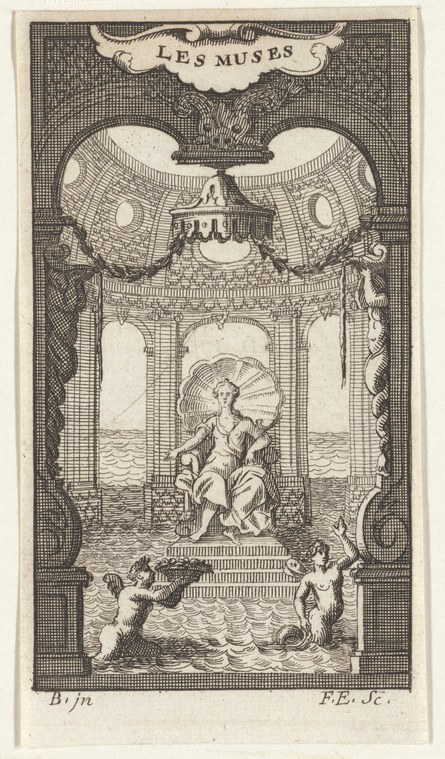
For historians of dance iconography, this print reveals how early modern artists understood the relationship between the Muse (the abstract inspirer) and the dancer or musician (the executor). The immobility and elevation of the Muse, surrounded by playful attendant putti, reflects a hierarchical vision in which divine inspiration was conceived as separate from bodily action. The work documents the visual language through which dance was positioned within classical learning and allegory during the period.
What you are looking at
This engraving depicts a classical allegorical scene set within a grand architectural interior. A single female figure, identifiable as a Muse by her classical drapery and the title, occupies the center of a vaulted space with columned archways. She sits elevated on a plinth or stepped platform, framed by an elaborate classical niche with rusticated stonework and pediments. The architectural setting suggests an Apollonian temple or palace interior, with views of water and landscape visible through the archway openings. Two putti (cherubs) flank the base of the platform, one on each side, emerging from or reclining in the foreground waters. The composition is highly formal and symmetrical, with the Muse as the immobile focal point rather than an active dancer. The engraving's fine hatching and cross-hatching throughout creates depth and shadow, particularly in the architectural elements, which dominate the composition.
The dancing
The central female figure is posed in a seated or semi-recumbent attitude of repose rather than active dance. Her body is relaxed, draped in classical garments, and she holds what appears to be an attribute or object in her lap—possibly a lyre or scroll, symbols of her identity as a Muse of music or poetry. Her posture is contemplative and stationary, the inverse of the energetic, moving bodies typical of dance imagery. The two putti are rendered in active, playful poses in the water below, but they are attendant figures rather than dancers themselves. There is no hold, frame, or footwork evident; the entire composition emphasizes stillness and allegorical presence over movement.
The dance depicted
This work does not depict dance in the conventional sense. The figure titled 'Les Muses' is presented as a personification—a classical allegory of the Muse, likely of music, poetry, or one of the nine Muses from Greek mythology. The seated, stationary pose and the architectural framing locate this in the tradition of classical allegory and emblem art rather than the documentation or celebration of actual dance practice. The Muse is an attribute of dance and artistic inspiration rather than a dancer, and no choreographic content is visible or intended.
How it was made
This is an engraving, created using the incised-line technique characteristic of northern European printmaking. The fine parallel hatching (the 'B. Jm' and 'P.E.Sc' marks at the bottom suggest the engraver's initials) and the precise, controlled linework throughout create tonal gradation and atmospheric depth, particularly in the architectural recession. Engravings of this caliber were labour-intensive to produce and circulated among educated audiences—collectors, scholars, and those versed in classical iconography. The formal architectural frame and allegorical content suggest this was part of a learned emblem book or series of classical themes intended for an elite readership.
About this work
This is a classical allegorical engraving depicting a Muse in a state of repose within an idealized architectural setting. It belongs to a tradition of Renaissance and Baroque emblem art and allegorical prints that used mythological figures to represent abstract concepts—in this case, the Muse as the embodiment of artistic inspiration, including musical and poetic creation. While the Muse was central to the mythology and imagery surrounding dance in the early modern period, this work itself presents contemplation and allegory rather than kinetic movement or dance practice. It is valuable to a gallery of dance in art because it documents how the Muse—the supernatural inspirer of dancers and musicians—was visualized and venerated in the early modern imagination, even when the Muse herself is shown at rest.
How to look at it
Attend to the architectural framing and the deliberate immobility of the central figure. The artist has chosen not to show the Muse in active motion but in a state of inspired repose, emphasizing her role as a source or vessel of inspiration rather than as an executor of movement. Notice how the composition creates a hierarchy: the Muse elevated on her plinth, the putti in the water below. The engraving's refined technique and learned iconography—the classical attributes, the perfect architecture—mark this as a work for an educated, literate audience versed in classical mythology.
The artist
The engraver's identity is indicated only by initials at the lower corners ('B. Jm' and 'P.E.Sc'), following common practice in early modern printmaking where engravers might be less celebrated than the designers of compositions. The work's technical refinement and sophisticated allegorical program suggest a trained hand working within a cosmopolitan humanist tradition, likely in northern Europe (possibly the Netherlands or Germany) during the 16th or early 17th century. Without further documentation, the artist cannot be identified with certainty.
The period
This engraving was created in an era when allegorical emblem books and classical iconography were dominant forms of visual and intellectual culture among the educated classes. The Renaissance recovery of classical texts had revived intense interest in the nine Muses and their attributes. In the same period, courtly dance was flourishing in Renaissance courts, and the Muse appeared frequently in dance librettos, pageants, and court spectacle as a personified inspirer of the dancers who performed below. This print exemplifies the elevation of classical learning over bodily practice—a tension that characterized educated attitudes toward dance in the early modern period.
Where it lives
The work is held in the New York Public Library's collection of prints depicting dance (or dance-related subjects). It is catalogued without artist attribution or precise date, suggesting it may be part of a larger collection of early modern prints assembled thematically rather than by maker or provenance.
Questions about this work
Is this a picture of someone dancing?
No. The central figure is a Muse—a personification of artistic inspiration in classical mythology—shown in a state of repose. She is an allegorical representation rather than a depiction of actual dance. However, the Muse was intimately connected to dance in early modern culture, and she often appeared in dance spectacles and court entertainments as a symbolic inspirer of the dancers below.
What is the architectural setting?
The Muse is positioned within a grand, classically inspired interior space with rusticated columns, pediments, and a vaulted ceiling. This architectural framing elevates and honors the figure, locating her within a realm of idealized classical learning and refinement rather than a secular or everyday space. The water visible beyond the archway suggests a liminal space between the earthly and the divine.
Who made this print and when?
The engraver is identified only by initials ('B. Jm' and 'P.E.Sc') at the bottom, which was common practice in early modern printmaking. The work is undated in the catalogue record, but the style, technique, and allegorical program suggest it was made in the 16th or early 17th century in northern Europe, likely in the Netherlands or Germany. The identity of the original designer is also unknown.
More dance artwork





