49 works in this view — arrow keys or swipe to move between them.
Dance in Art
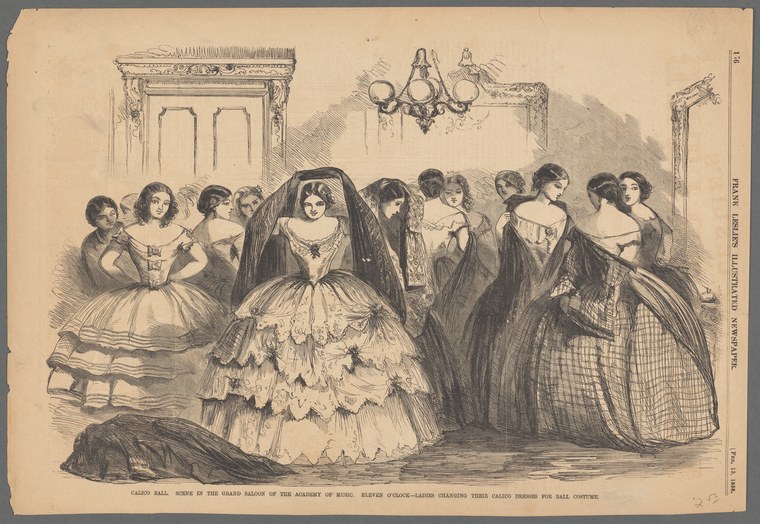
Calico ball, scene in the grand saloon of the Academy of Music, eleven o'clock, ladies changing their calico dresses for ball costume
Unknown artist
- Collection:
- Prints depicting dance
- Source:
- New York Public Library
- Rights:
- Public domain — free to use, share and adapt.
- Recorded as:
- Public Domain
This image reveals that ballroom dancing was framed by elaborate rituals of dress and transformation, not simply by the dances themselves. For historians of dance, costume, and gender, it shows how the ball was constructed as a total social performance in which appearance was inseparable from participation. The calico ball, a more democratic or commercial form of ballroom, was a significant development in 19th-century dance culture and rarely appears in visual art.
What you are looking at
A crowded scene in an elegant ballroom, the Academy of Music's grand saloon, captures the moment of transition from daywear to formal costume before an evening ball. At the center stands a woman in an elaborate wedding or ball gown, with a full skirt of white fabric layered with lace flounces and a black veil or shawl draped over her shoulders and head—a dramatic focal point. She is surrounded by at least a dozen female figures, some still dressed in simple calico day dresses (rendered in lighter line-work), others already changed into evening wear with full skirts, bare shoulders, and dark shawls or wraps. The composition is crowded and animated: figures gesture, turn toward one another, and cluster in conversation. A crystal chandelier hangs above, and the architectural frame—a doorway with ornate classical molding visible on the left, and what appears to be a fireplace mantel or wall feature on the right—establishes the interior setting. The engraving's fine cross-hatching creates depth and shadow, drawing the eye to the elaborately dressed central figure while suggesting the bustle and social negotiation of the pre-ball dressing ritual.
The dancing
The women are rendered in varied attitudes of standing, turning, and conversing—none are in a dance hold or active dance movement. The central figure's posture is formal and upright, her gown occupying significant visual space. The surrounding women gesture with raised arms, turn their bodies to face one another, and lean in as if in conversation. Some reach toward fasteners or garments, suggesting the active work of dressing. The artist differentiates dress states clearly: the simpler line-work of calico shifts contrasts visually with the densely cross-hatched shadows of silk evening wear. There is no balletic frame or partner relationship; this is a social scene of preparation, not performance.
The dance depicted
This is not a depiction of dancing but of the social preparation for a ball. The title explicitly identifies the moment as "eleven o'clock, ladies changing their calico dresses for ball costume"—a backstage or dressing-room scene rather than the ball itself. It documents the transformation from day to evening dress, a ritual of considerable social and cultural significance in 19th-century elite society. The image is a window into the labor and spectacle of appearance-making that preceded the actual dances to come. The calico ball itself (a democratized or commercial ball where the dress code permitted simpler fabrics) makes this a scene of middle- to upper-class social aspiration and the shedding of daywear for the formal dress required of ballroom culture.
How it was made
This is an engraving (or wood engraving), established by the fine parallel line-work, cross-hatching, and the overall technique of rendering tone through density of line rather than wash. The technique allowed for mass reproduction in newspapers and magazines, suggesting this was a scene of public interest—probably published as a fashion or society illustration in a mid-to-late 19th-century periodical. The precision of the engraved line made such scenes accessible to a wide readership, and the legible narrative (the title inscribed below) indicates it was meant to be read as a contemporary news or fashion image rather than a fine-art print.
About this work
This is a mid-19th-century engraved illustration of women dressing for a formal ball, capturing a moment of social theater before the dancing began. The work belongs in a gallery of dance in art not because it depicts dancing but because it documents the performance of identity and the social rituals inseparable from ballroom culture. The calico ball was a significant social form—a less exclusive, more commercialized version of the subscription ball—and this image records the collective preparation, the fashion, and the anticipation that framed the evening's dances. It is a document of how dance was experienced as spectacle, aspiration, and social ritual.
How to look at it
The viewer should attend first to the contrast between the two states of dress—calico versus silk, simple versus elaborate—which the artist has made visually legible through varying densities of line. Notice the central figure's veil and elaborate gown, which dominate the composition and read as the focal point of social attention. Observe the gestures and body language of the surrounding women: the raised arms, the turning toward one another, the apparent social negotiation. The title inscribed below is essential; it names the specific moment and the specific event (calico ball, eleven o'clock) that the image documents. This was not high art but news and fashion reporting, meant to be read quickly and understood by a contemporary audience familiar with the codes of fashionable society.
The period
The 19th century saw the rise of the commercial or subscription ball in urban centers, a democratization of the exclusive subscription balls of the 18th and early 19th centuries. The calico ball represents an intermediate social form, accessible to the aspiring middle classes but still governed by strict dress codes and ritual. In the same period, the illustrated press—newspapers and magazines—flourished as a medium for documenting and disseminating images of fashionable society. Fashion illustration and society reporting were linked, and images like this one were produced to satisfy public appetite for insight into the dress, manners, and social life of the ballroom. Simultaneously, the Romantic ballet was transforming the nature of theatrical dance, but the social ballroom remained the primary context in which most people experienced dancing, making scenes of ball culture and preparation valuable documents of lived experience.
Where it lives
This work is held as part of the NYPL's collection of prints depicting dance. It is an engraved illustration, a form of mass-produced reproductive print typical of 19th-century periodical publication, suggesting it circulated in newspapers or magazines rather than as a fine-art print.
Questions about this work
Was the calico ball a real event, or is this fictional?
The calico ball was a genuine social form in 19th-century urban society, a more democratized or commercial version of the exclusive subscription ball. This image documents an actual social practice and the spaces in which it occurred. The specificity of the title—naming the event, the location (Academy of Music), and the time (eleven o'clock)—suggests this represents a particular, documented moment rather than a generic scene.
Why would women change clothes at the ball?
Strict dress codes governed ballroom participation. Daywear (including calico, a printed cotton) was not acceptable for evening dancing; women were required to change into formal evening dress, usually of silk or similar fine fabrics, with bare shoulders and full skirts. The ball's name (calico ball) may indicate that the dress code was slightly relaxed compared to the most formal occasions, but formal evening wear was still required. This image captures the logistics and labor of that transformation.
What can this image tell us about 19th-century ballroom dancing?
This image shows that ballroom dancing was embedded in elaborate social rituals of preparation, dress, and collective assembling. It suggests that the ball was experienced as a total social performance, not simply a series of dances. It also documents the labor and anticipation—the dressing, the conversation, the transformation—that preceded the actual dancing, revealing how costume and appearance were central to the experience.
More dance artwork





