49 works in this view — arrow keys or swipe to move between them.
Dance in Art
Folk and ethnic costumes
Unknown artist
- Collection:
- Prints depicting dance
- Source:
- New York Public Library
- Rights:
- Public domain — free to use, share and adapt.
- Recorded as:
- Public Domain
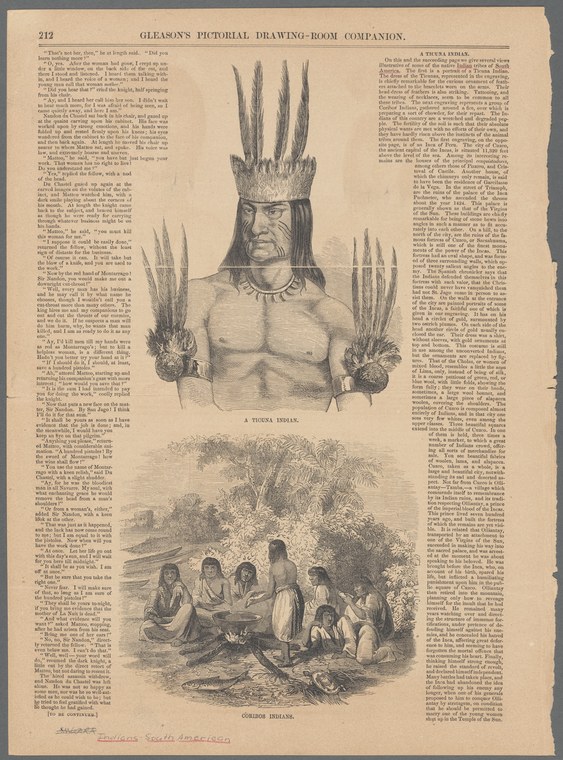
This work documents how Native American material culture and ceremonial practice were visualized and circulated to 19th-century American mass audiences through the illustrated press. The formal pose and isolated presentation of the upper figure—detached from context or movement—exemplifies the extractive ethnographic mode of the period, treating indigenous people and their regalia as exotic curiosities for visual consumption rather than as practitioners of living cultural forms.
What you are looking at
A two-part engraving from Gleason's Pictorial Drawing-Room Companion. The upper section depicts a Native American man, identified as a Yosemite Indian, viewed from the waist up. He wears a tall headdress of bundled reeds or grass arranged in a distinctive crown formation, a decorated band across his chest, and holds bundles of similar reeds in both hands at shoulder height. His muscular, bare torso and stern expression suggest a figure of authority or ceremonial importance. The lower section shows a scene of Native American women and children gathered outdoors around what appears to be a cooking or gathering activity, seated on the ground in a natural landscape with trees. Both scenes are rendered in the characteristic wood-engraving style of 19th-century American illustrated periodicals.
The dancing
The central figure in the upper vignette stands in an upright, frontal stance with arms raised symmetrically to shoulder height, hands grasping bundles of reed material. The posture suggests either a ritual pose held for display or the freeze-frame of an active gesture. The lower scene shows multiple figures in seated or crouched positions, clustered informally around a central activity; the body language is static and domestic rather than dynamic or choreographed. There is no formal dance hold or frame evident in either section.
The dance depicted
While the title specifies folk and ethnic costumes and the upper figure holds ritual regalia, the image does not depict active dancing. The upper figure's raised-arm stance with bundled reeds could represent a ritual gesture or a moment from ceremonial practice, but without supporting text or context it cannot be confidently identified as dance rather than a posed portrait of ceremonial dress and implement. The lower scene appears entirely non-choreographic. The work functions as ethnographic documentation of appearance and material culture rather than as a record of movement or dance practice.
How it was made
This is a wood engraving, a relief printing technique widely used for newspaper and periodical illustration in the 19th century. The fine parallel hatching and cross-hatching visible throughout create tone and modelform without wash or color. Wood engraving permitted rapid reproduction and high-volume circulation; this work appears in Gleason's Pictorial Drawing-Room Companion, a mass-market American illustrated weekly popular from 1851 to 1859. The technique constrains the artist to bold contrasts and linear detail, favoring clear silhouettes and legible narrative over atmospheric subtlety.
About this work
This engraved illustration from a mid-19th-century American periodical presents ethnographic imagery of Native American people, specifically identified as Yosemite Indians. The upper vignette shows a male figure in ceremonial or ritual dress holding bundles of grass or reed, standing in a frontal, posed manner; the lower vignette depicts women and children in a domestic gathering. The work is catalogued as folk and ethnic costumes and reflects the visual conventions of period ethnographic documentation. While the upper figure's raised-arm posture and ritual regalia suggest ceremonial or sacred practice, the image does not clearly document active dance movement or choreography. It belongs in the dance collection as a record of indigenous material culture and bodily practice, even if dance as such is not the primary subject.
How to look at it
Observe the carefully articulated headdress construction and the deliberate symmetry of the pose—raised arms and bundled reeds create a figure of visual authority and ceremonial significance. The bare torso and decorative band emphasize bodily display. The lower scene, by contrast, shows informal gathering without formal arrangement, suggesting that the upper figure is presented as exceptional or exceptional in status. Note also the engraver's use of parallel hatching to create volume and musculature, a technique that subordinates individual likeness to idealized anatomical form—characteristic of period ethnographic imagery.
The artist
The work is uncredited. It appears in Gleason's Pictorial Drawing-Room Companion, which employed in-house illustrators and engravers to produce topical and ethnographic imagery for a broad readership. The periodical was known for its sensational and often romanticized illustrations of American frontier life, indigenous peoples, and distant lands.
The period
This engraving dates to the mid-19th century, a period of intense American colonial expansion westward and concurrent documentation (or appropriation) of indigenous cultures through illustrated periodicals, daguerreotype, and ethnographic prints. The visual language of such works—the formal frontal pose, the decontextualized figure, the emphasis on exotic costume and regalia—became standard in popular ethnography. Native American sacred and ceremonial practices were frequently rendered as static spectacle rather than as dynamic, embodied knowledge.
Where it lives
This engraving is held by the New York Public Library as part of its collection of prints depicting dance. It derives from Gleason's Pictorial Drawing-Room Companion, an American illustrated weekly periodical that circulated widely to middle-class households in the 1850s.
Questions about this work
Is this a dance?
It is not clear. The upper figure's raised arms and ceremonial regalia suggest ritual or sacred practice, but the image presents a static, posed moment rather than active movement. The work documents indigenous material culture and formal dress more than choreography or dance as such.
What is the figure holding?
The man holds bundles of what appear to be dried grass, reeds, or similar plant material, configured into the headdress and grasped in both hands. These materials likely held ceremonial or practical significance in Yosemite Indian regalia and practice.
Why is this in a dance collection?
The collection holds works that document indigenous movement, ritual, ceremonial dress, and cultural practice broadly construed—not only staged or recognizable choreography. This engraving records material culture and formal bodily display relevant to understanding indigenous expressive forms.
How was this image made?
It is a wood engraving, a relief printing technique. An artist designed the image, which was then transferred to an end-grain wooden block and incised by a skilled engraver. The block was inked and printed, allowing thousands of copies to be circulated through the periodical.
More dance artwork





