49 works in this view — arrow keys or swipe to move between them.
Dance in Art
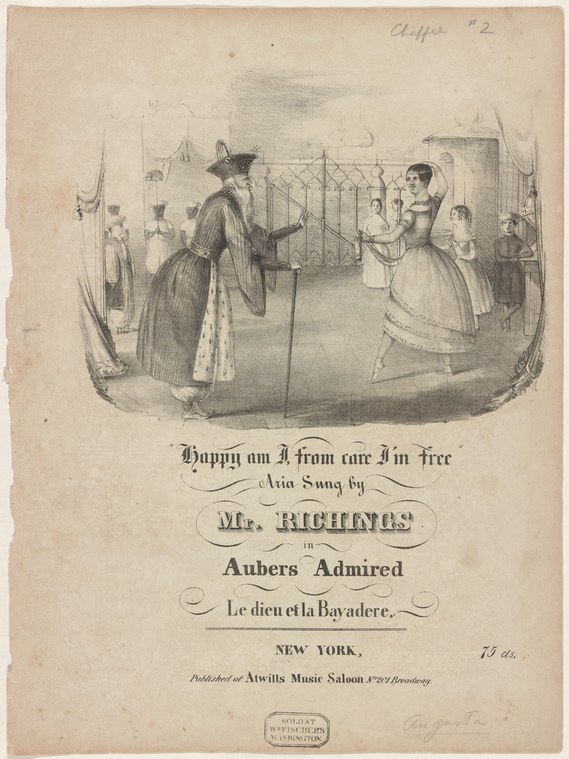
Le dieu et la bayadère: Aria sung by Mr. Richings in Auber's admired Le dieu et la bayadère
Unknown artist
- Collection:
- Prints depicting dance
- Source:
- New York Public Library
- Rights:
- Public domain — free to use, share and adapt.
- Recorded as:
- Public Domain
Though it does not show dance in motion, this print documents the cultural appetite for spectacle centered on dancers and exotic femininity in early 19th-century musical theater, and reveals the machinery by which opera and its performers were marketed to the American public. It is evidence that the figure of the bayadère—the Eastern dancing woman—was a star attraction in European and American theaters well before Orientalism became a dominant aesthetic.
What you are looking at
This is a lithographic illustration for a vocal score, depicting a theatrical scene from Auber's opera *Le dieu et la bayadère*. The composition shows an interior space with a decorative fence or grille in the center background. At left stands a tall figure in a long dark coat and wide-brimmed hat, leaning forward on a cane in a posture of dramatic address or supplication. At right, a woman in a pale, high-waisted Empire-silhouette dress with puffed sleeves stands among a group of attendant figures in similar pale dress. The lighting is soft and atmospheric, created by the lithographic process, with darker tones defining the left side and a lighter, more diffuse illumination around the female figures. The composition suggests a moment of encounter or revelation, typical of operatic melodrama.
The dancing
The male figure dominates through his stance and gesture—leaning forward with arm extended toward the woman at right, creating a diagonal line of dramatic engagement across the composition. His posture suggests pleading, supplication, or commanding address. The female figure at center-right is upright and frontal, her body framed by attendants who stand passively beside and behind her. There is no depiction of active dance movement; all figures are static or in conversational poses. The spatial relationship is hierarchical and theatrical rather than balletic—the dramatic confrontation between the two principal figures is the action.
The dance depicted
This image does not depict dance movement in progress. It is a promotional engraving for a vocal aria sung by Mr. Richings in Auber's 1830 opéra comique *Le dieu et la bayadère*, which tells the story of a Hindu deity disguised as a mortal who falls in love with a dancing girl (bayadère). The work was known for its exotic setting and spectacular choreography, but this illustration captures a dramatic spoken or sung moment rather than a dance number—likely a scene from Act II in which the god reveals himself to the bayadère. The bayadère would be trained in theatrical dance of the period, but no such training is visible in this static, operatic tableau.
How it was made
This is a lithograph, a planographic printing process that was the dominant medium for theatrical publicity and sheet-music illustration in the early 19th century. Lithography allowed rapid, cost-effective reproduction and distributed the image widely to music lovers and opera patrons. The delicate tonal modeling and soft atmospheric effects visible here—particularly in the background and the play of light across the figures—are characteristic of refined artistic lithography of the 1830s. The technique made this illustration affordable and reproducible, ensuring it reached a broad middle-class audience purchasing vocal scores for home performance.
About this work
This is a lithographic frontispiece for a vocal score published in New York around 1830, illustrating a dramatic moment from Daniel-François-Esprit Auber's popular opéra comique *Le dieu et la bayadère*. It documents not a dance scene but a scene of operatic encounter: the moment of recognition or declaration between two characters, one of whom (the bayadère) was known as a dancer. The work belongs to the history of theatrical dance representation indirectly—it shows how dance and dancers were marketed, imagined, and presented to music-buying audiences of the early 19th century, even when the specific image chosen does not show dance itself.
The aria sung by tenor John Richings would have been a show-stopping moment, and the illustration was designed to capture its emotional and dramatic intensity rather than any movement quality. It is a window into the operatic culture in which theatrical dance was embedded, and into the visual conventions used to sell theatrical entertainment to American audiences.
How to look at it
Attend to the asymmetrical composition and the gesture language: the male figure's lunging posture and extended arm create the emotional center of gravity, pulling the viewer's eye leftward and downward, while the female figure's calm frontality and enclosure within a group of attendants create a contrasting center of stillness. The fence or grille between them is not merely a background element but a barrier that the male figure's gesture transgresses—it marks the spatial and social transgression that is the drama. The soft lithographic handling of tone creates an atmosphere of intimacy and melodrama rather than spectacle or movement.
The artist
The artist is not recorded. The print was published by Atwills Music Saloon in New York and is consistent with the style of commercial theatrical lithography of the 1830s-40s. Such work was typically produced by music publishers' in-house workshops or contracted to local lithographic firms; attribution of unsigned theatrical prints of this period is often impossible.
The period
Auber's *Le dieu et la bayadère* premiered in Paris in 1830 and was an immediate success, exported rapidly to London, New York, and other major cities. The opéra comique form, despite its name, was a fully sung dramatic work that combined comedy, sentiment, and spectacle. The 1830s and 40s saw a flowering of Orientalist subjects in European opera and ballet, fueled by colonial expansion, travel literature, and the Romantic movement's fascination with the exotic and distant. The bayadère (or bayadere) appeared frequently as a character type—the sensual, skilled dancer of Eastern origin who embodied both erotic appeal and artistic accomplishment. This was also the era in which ballet was establishing itself as the principal vehicle for theatrical dance in Europe, even as opera remained the dominant theatrical form.
Where it lives
This print is held in the New York Public Library's collection of prints depicting dance. It is a vocal score cover or sheet-music illustration, one of thousands produced by music publishers in the 19th century to drive sales of individual songs extracted from popular operas.
Questions about this work
Is this image of an actual bayadère dancer or a character in an opera?
This is a character in an opera—the bayadère in Auber's *Le dieu et la bayadère*. She would have been played by a soprano trained in singing and acting, and would have danced in the spectacle numbers, but this particular illustration does not show her dancing. It captures a dramatic dialogue or declaration scene.
What was a bayadère in the 19th-century imagination?
Bayadère (or bayadere) was the European term for an Indian court dancer or temple dancer. In 19th-century opera and ballet, the figure was typically imagined as sensual, exotic, skilled in both dance and music, and often caught between worlds—between East and West, or between romantic love and duty. The historical accuracy of these representations was minimal; the bayadère was primarily a fantasy figure that allowed European audiences to explore desire and otherness.
Who was John Richings?
John Richings (c. 1800–1876) was an English-born tenor who had a successful career in American opera and musical theater in the 1830s-50s. He was known for roles in opéra comique and for his vocal brilliance. This print documents one of his star vehicles—an aria that would have been a highlight of the evening and a draw for audiences.
Why does this print show a dramatic scene rather than a dance?
Vocal score covers were typically designed to capture the emotional or dramatic heart of a famous aria, not to illustrate dance. The aria sung by Richings was a moment of high drama—declaration, supplication, or revelation—which the lithographer represented through theatrical gesture and composition. Dance numbers were usually published separately or illustrated in different formats.
More dance artwork





