49 works in this view — arrow keys or swipe to move between them.
Dance in Art
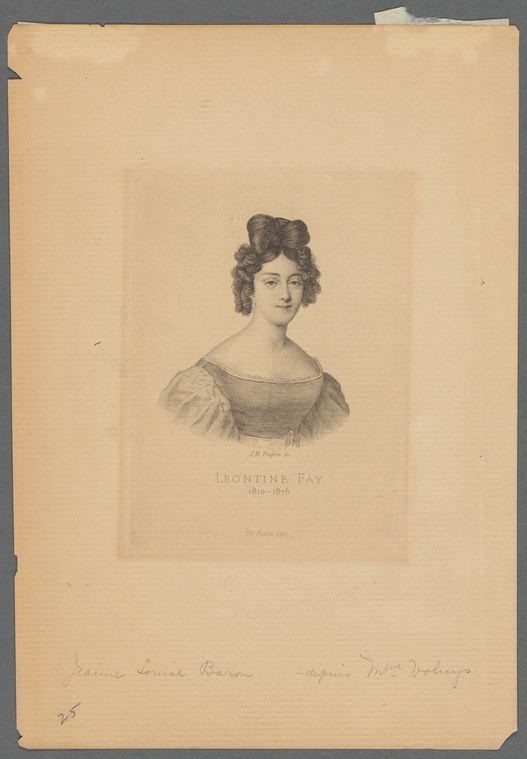
Leontine Fay, 1810-1876
Unknown artist
- Collection:
- Prints depicting dance
- Source:
- New York Public Library
- Rights:
- Public domain — free to use, share and adapt.
- Recorded as:
- Public Domain
Leontine Fay is otherwise obscure in the historical record, and this print may be among the only surviving images of her. For historians of early Regency dance and theatre, such prints are primary evidence of who performed, how they were marketed, and how bodies and dress were represented on the stage of the period. The work demonstrates that dance history is not only choreography or technique, but also the circulation of performers' images and the economics of fame.
What you are looking at
A bust-length portrait of a young woman facing three-quarter right, rendered in engraved or lithographed line work on aged cream paper. She wears a high-waisted Empire-silhouette dress with short puffed sleeves, the neckline cut low and wide across the shoulders in the Regency fashion. Her dark hair is dressed in loose waves pinned atop her head, with ringlets framing her face. The figure is set against a plain background with subtle tonal shading that suggests depth without defining a specific setting. The work appears to be a formal commemorative or theatrical portrait—the kind of engraved dance print that circulated as souvenirs or publicity in the early nineteenth century.
The dancing
The sitter is shown in repose, not in active dance. Her posture is upright and frontal, with shoulders relaxed and arms at rest or lightly crossed. There is no gesture or body position that indicates movement or a specific dance technique. The portrait is a likeness rather than a representation of performance.
The dance depicted
This is not a dance scene but a portrait of a named dancer—Leontine Fay, a performer of the early nineteenth century. The inscription below confirms her identity and dates (1810–1876). The absence of motion, costume, or choreographic context means the work tells us little about the style or technique she practiced. The dress, however, is consistent with the stage wear of Regency-era theatrical dancers, particularly those working in pantomime, ballet, or music theatre. Without additional documentation, we cannot determine her speciality or the dances for which she was known.
How it was made
This is an engraving or lithograph on paper, likely produced for circulation as a theatrical souvenir or portrait print. The technique is linear, relying on fine hatching and cross-hatching to build tone and model the face and bodice. The aged, cream-colored paper and the presence of conservation tape suggest this is an archival print that has been stored and handled over time. Such prints were affordable, reproducible, and widely distributed to audiences and collectors, making them important documents of early nineteenth-century stage performers.
About this work
Leontine Fay (1810–1876) was a professional dancer of the Regency era, documented here in a formal engraved portrait that belongs to a large category of theatrical ephemera and commemorative prints. The work is not a record of her dancing but of her public identity: she is presented in fashionable dress of the period, meeting the eye of the viewer with the composed authority expected of a celebrated performer. This portrait survives as part of a collection of dance-related prints held by the New York Public Library, a testimony both to Fay's professional standing and to the early nineteenth-century practice of circulating performers' likenesses as objects of collection and remembrance.
How to look at it
Observe the confidence and directness of the sitter's gaze and posture, which would have conveyed professional status and star quality to contemporary viewers. Note the carefully rendered detail of the Empire-waist dress, the cascading ringlets, and the subtle play of light across the face and shoulder—techniques that give the engraving its flattering, portrait-like quality. This is a work designed to be looked at, remembered, and kept; it asks the viewer to see and remember a particular woman's public face.
The artist
The artist is not recorded in the catalogue. The print bears no visible signature. It is the work of a commercial engraver working in the early nineteenth century, likely London, producing theatrical portraits for theatrical print publishers. Such prints were often unsigned or credited only to the publisher.
The period
The Regency era (roughly 1811–1820, though the aesthetic extended beyond these dates) saw an explosion of theatrical dance in London: ballet, pantomime, melodrama, and music theatre all drew large audiences and created demand for performers' portraits. Engraved and lithographed prints were a standard form of promotion and memorabilia, affordable enough for a wide audience but prestigious enough to frame and collect. The fashion evident in this portrait—the Empire silhouette, the Grecian dressing of the hair—aligns with both Regency street fashion and the neoclassical aesthetic that influenced stage costume and movement aesthetics of the time.
Where it lives
The work is held in the Prints collection of the New York Public Library, part of a broader collection documenting dance and theatrical imagery. It is a single-sheet engraved or lithographed print, likely produced and distributed in the early nineteenth century by a London theatrical print publisher.
Questions about this work
Who was Leontine Fay?
Leontine Fay (1810–1876) was a professional dancer active in the early nineteenth century, most likely in London. Beyond her dates and this portrait, little is recorded of her career, roles, or speciality. She may have danced in ballet, pantomime, or music theatre—all popular forms of the Regency era—but no surviving documents specify. This print is one of the few traces of her professional existence.
Why is there no artist's name on this print?
Theatrical portrait prints of this period were often unsigned, or signed only by the publisher. The engraver's name—if it ever appeared—may be lost. The work is the product of a commercial workshop, and individual authorship mattered less than the print's ability to circulate and sell.
What does her dress tell us?
The Empire-waist, short-puffed-sleeve gown was fashionable for both street wear and the stage in the Regency era. On stage, such dresses suggested elegance, modernity, and a certain fashionable femininity. The hair—loose waves and ringlets—was the height of Regency style and appears in both portrait and theatrical imagery of the time.
Is this a costume portrait or an ordinary portrait?
It is ambiguous. The dress and hair are so much in fashion—both theatrical and civilian—that it is impossible to say whether Fay is shown in a stage costume or in fashionable street dress. Regency theatrical portraits often blurred this distinction deliberately, presenting performers as both bodies on stage and fashionable figures in the world.
More dance artwork





