49 works in this view — arrow keys or swipe to move between them.
Dance in Art
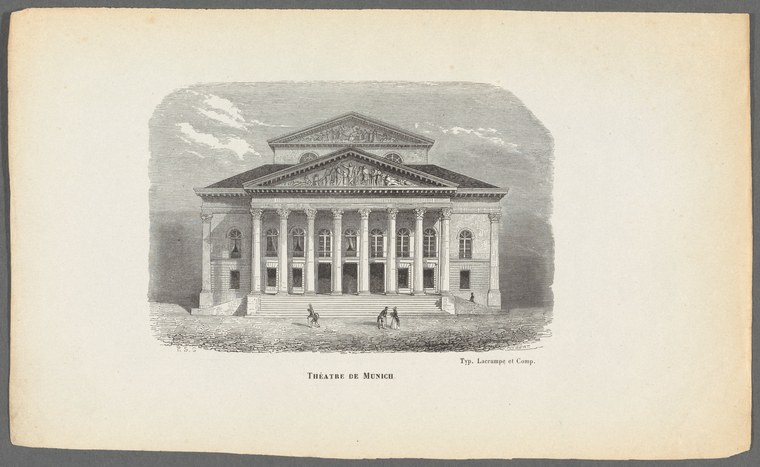
Théatre de Munich
Unknown artist
- Collection:
- Prints depicting dance
- Source:
- New York Public Library
- Rights:
- Public domain — free to use, share and adapt.
- Recorded as:
- Public Domain
This engraving is historically significant as documentation of a major 19th-century German theater building, the likely venue for ballet and opera in Munich. For dance historians, architectural images of theaters contextualize the stages on which historical performances occurred and reveal how theater design shaped performance possibility and audience experience.
What you are looking at
A neoclassical theatre building is depicted in this engraving, shown frontally with a columned portico and triangular pediment. The structure displays eight fluted columns across its façade, with a dark shadowed interior visible between them. Small human figures stand on the ground before the entrance, their scale emphasizing the monumental architecture. The sky above shows clouds rendered in light tones, creating atmospheric depth. The building is presented as an architectural portrait—a statement of civic importance rather than a scene of performance or movement. The engraving style and the formal, emblematic composition suggest this is a record of a significant venue, not a moment of dance in action.
The dancing
The figures visible before the portico are tiny and largely undifferentiated—several standing shapes in dark ink that do not read as dancers in any recognizable pose. They function as scale indicators rather than subjects. No body position, hold, frame, or choreographic intent is visible; they are architectural accessories.
The dance depicted
This is not a depiction of dance. The work is an architectural rendering of a theater building identified as the Théâtre de Munich (Theatre of Munich). While theaters were the primary venues for theatrical dance in the 19th century, this image records the building itself, not any performance, dancer, or choreographic activity. The title and formal presentation make clear this is a record of an important public structure.
How it was made
This is an engraving or possibly a steel engraving, as indicated by the fine linear detail, the subtle tonal gradations achieved through line density, and the rounded corners characteristic of wood or steel-engraved architectural prints of the 19th century. The technique allowed for precise architectural rendering and wide circulation through printing. The style and execution suggest commercial publication, likely as part of a series documenting notable European buildings.
About this work
This is an architectural engraving of the Theatre of Munich, a neoclassical public building of the 19th century. It documents a major European performance venue through formal architectural representation rather than through the depiction of performance or dancers. The work belongs in a dance archive as a record of the physical infrastructure within which theatrical dance took place, and as evidence of the monumental importance 19th-century European cities placed on purpose-built theater buildings.
How to look at it
Approach this as architectural documentation rather than a dance image. Attend to the proportions and ordering of the classical elements—the columned portico, the pediment, the symmetry—which express late 18th- or early 19th-century ideals of public taste and civic ambition. The tiny figures at ground level are included to convey scale and human use; they do not represent dancers or choreography.
The artist
The artist is not recorded. The engraving style and execution are consistent with commercial architectural print production of the mid-to-late 19th century. Such prints were typically created for popular illustrated publications, architectural journals, or travel books documenting European cities and their monuments.
The period
The 19th century saw a major expansion of purpose-built theater architecture across Europe as part of urban modernization and civic pride. Munich's theater would have been a venue for the Romantic ballet that dominated European stages from the 1830s onward. Neoclassical architectural style in public buildings reflected Enlightenment values and aspirations to order and rational design, even as the art performed within them—ballet and opera—emphasized emotion, spectacle, and the supernatural.
Where it lives
The work is held in the New York Public Library's collection of prints depicting dance. Its presence in this collection likely reflects the library's comprehensive documentation of theatrical venues and infrastructure rather than any depiction of choreography within the image itself.
Questions about this work
Why is an architectural engraving in a dance collection?
This is a record of a major 19th-century theater building, the type of venue where ballet and opera were performed. Architectural documentation of theaters belongs in dance archives as evidence of the physical conditions and possibilities that shaped historical performance.
Is there any dance visible in this image?
No. The work is a formal architectural rendering of the theater building itself. The small human figures at ground level are compositional elements indicating scale, not dancers or performers.
What is the Theatre of Munich?
This appears to be a 19th-century public theater building in Munich, Germany, designed in neoclassical style. Without additional documentation or a date, its precise history and theatrical significance cannot be established from the image alone.
More dance artwork





