49 works in this view — arrow keys or swipe to move between them.
Dance in Art
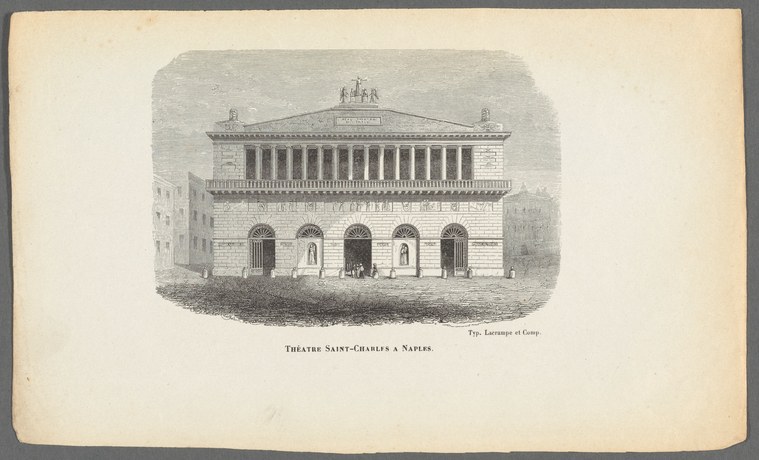
Théatre Saint-Charles a Naples
Unknown artist
- Collection:
- Prints depicting dance
- Source:
- New York Public Library
- Rights:
- Public domain — free to use, share and adapt.
- Recorded as:
- Public Domain
While not a dance image itself, this print documents the physical infrastructure of professional theatrical dance in 19th-century Naples. For scholars studying the economics, geography, and institutional contexts of dance, such architectural records are valuable evidence of where and in what kind of space dance was performed.
What you are looking at
This is an architectural engraving depicting the facade of the Théâtre Saint-Charles in Naples, a neoclassical building of considerable grandeur. The structure dominates the composition, presented frontally and symmetrically. The ground floor features five large arched openings—likely entrance doors—separated by rusticated stonework. Above this runs a continuous entablature, and the upper story displays a colonnade of engaged columns supporting an entablature and balustrade. The building is crowned by a pediment with sculptural ornament and decorative urns at the roofline. The street level is suggested by minimal ground detail, and the sky above is rendered in fine engraved lines creating atmospheric depth. The print is rendered in the documentary style typical of 19th-century architectural illustration, with careful attention to proportion and Classical detail.
The dancing
No figures or dancers appear in this image. The work is an architectural study without human subjects or choreographic content.
The dance depicted
This engraving contains no dance content. It is a record of a theatre building, not a depiction of performance or movement.
How it was made
This is an engraving, recognizable from the fine parallel hatching used to create tone and shadow, the precise linear quality of the architectural lines, and the overall aesthetic consistent with 19th-century steel or copper engraving. The technique allowed for detailed architectural documentation and was the standard medium for distributing images of significant public buildings to a broad audience. The careful rendering suggests this was made for publication in an architectural journal or a commemorative print series.
About this work
This is an architectural engraving documenting the façade of the Théâtre Saint-Charles in Naples, a neoclassical public building. It belongs in a dance archive only by extension: as a historical record of one of the venues where dance performances occurred during the 19th century. The image preserves the external appearance of a significant theatrical institution, providing visual evidence of the architecture within which dance was presented to paying audiences in one of Europe's major cities.
How to look at it
View this as a historical document rather than an artistic composition. Attend to the classical proportions, the fenestration pattern, and the hierarchy of the facade—these elements reveal the scale and ambition of 19th-century civic investment in theatrical buildings. The symmetry and formality tell us something about how theater was institutionalized and valued in urban society.
The artist
The artist is not recorded. The engraving style and aesthetic are consistent with 19th-century architectural documentation practice, likely produced by a professional engraver working for publication rather than as an independent artist.
The period
The Théâtre Saint-Charles was built in the early 19th century and became one of Naples' principal venues for opera and theatrical performance. This engraving likely dates to the mid-19th century, when such architectural prints were commonly circulated to document major public buildings. Naples was a major European center for both opera and theatrical dance during this period, and such venues were sites where ballet and theatrical dance were regularly performed as part of mixed entertainment programs.
Where it lives
The print is held in the New York Public Library's collection of prints depicting dance. Its presence in that collection suggests it was acquired as documentary evidence of venues associated with dance performance, rather than as a depiction of dance itself.
Questions about this work
Is there any dance happening in this print?
No. This is an architectural record of a theatre building, not a depiction of dance or performance. It documents the exterior of the Théâtre Saint-Charles where dance may have been performed, but shows no dancers or choreographic action.
Why is an architectural print in a dance image collection?
Theatre buildings are part of dance history. This engraving documents one of the major venues where professional dance was presented in 19th-century Naples, making it valuable for understanding the institutional and physical contexts in which dance existed.
When was the Théâtre Saint-Charles built?
The record does not provide the construction date. The building is a major Neapolitan landmark, but the dating of this particular engraving is unknown.
More dance artwork





