49 works in this view — arrow keys or swipe to move between them.
Dance in Art
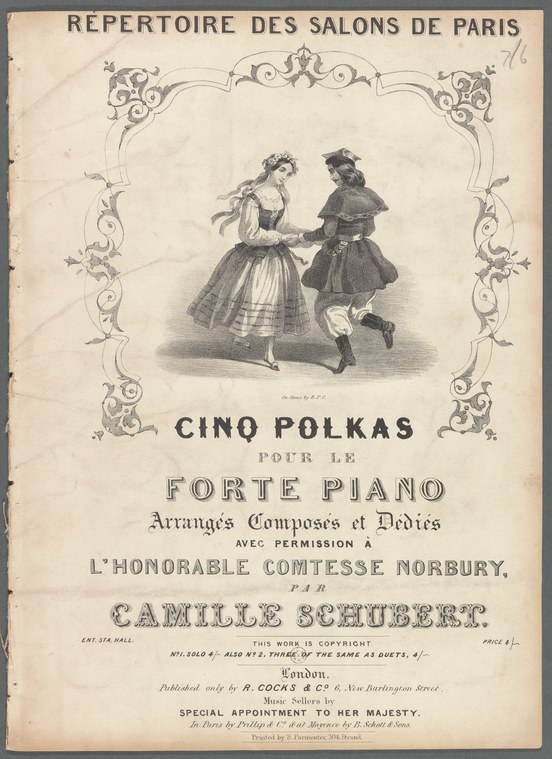
Cinq polkas pour le forte piano
Unknown artist
- Collection:
- Prints depicting dance
- Source:
- New York Public Library
- Rights:
- Public domain — free to use, share and adapt.
- Recorded as:
- Public Domain
This work documents the intersection of dance, music publishing, and ballroom fashion at a moment when the polka was transforming European social dance. For dancers and historians, it is evidence of how the polka was taught, distributed, and consumed in the nineteenth-century drawing room—not as a spectacle but as a participatory social practice. The engraving preserves the exact silhouette and posture of the polka as it was performed in elite spaces, information that costume and movement historians cannot recover from text alone.
What you are looking at
This is a title page and cover for a published collection of five polkas arranged for solo piano forte. The central vignette shows two figures in mid-dance within an ornate scrollwork cartouche: a woman in a full skirt with horizontal striping at the hem, her upper body turned toward her male partner, and a man in dark clothing with a distinctive tall hat, captured mid-step. The woman's skirt is lifted and spread, suggesting rapid movement; her posture is open and animated. The man leans into the dance with his weight forward. The composition frames them against a plain background, with the ornate Baroque-revival border drawing all attention to the pair. The typography below identifies this as part of the "Répertoire des Salons de Paris," suggesting a collection aimed at drawing-room performers. The credit to Camille Schubert and dedication to the Comtesse Norbury establishes this as a commercial music publication of the mid-nineteenth century.
The dancing
Two dancers are shown in a waltz-like or polka frame, with the woman's right hand likely in the man's left hand (the convention of the period), her left arm raised and extended, his right arm supporting her at the waist or shoulder. Both bodies show weight shift and forward momentum—the man's posture is more vertical and controlling, while the woman's body angles backward slightly, creating the typical partnership dynamic of couple dances of this era. The woman's full skirt, with its visible striped flounces, is the dominant visual element and suggests the rapid spinning characteristic of the polka or waltz. The man's top hat and dark coat mark him as the leader and indicate this is a formal ballroom context, not a folk or staged version.
The dance depicted
The title explicitly names this as five polkas (Cinq Polkas) for forte piano, and the image of the couple confirms the ballroom polka of the 1840s–1860s. The polka was a Bohemian couple dance that became one of the most popular ballroom dances in Europe and North America during the nineteenth century; it was faster than the waltz, with a distinctive hop-step rhythm. The engraving shows the dress and posture typical of the polka as danced in Parisian salons—the man in formal black coat and top hat, the woman in the crinoline-supported skirt with decorative striping that was standard for ballroom wear. The fact that this is a piano reduction for home use suggests that polka was a dance expected to be danced at private balls and perhaps taught from these arrangements.
How it was made
This is a wood engraving or steel engraving, identifiable by the fine parallel lines (hatching) that model form and shadow, the crisp contrast between black and white, and the precision of the decorative border. The technique allowed for fine detail and was ideal for music publication; the plate could be printed thousands of times and was durable enough for multiple print runs. The ornate Rococo-revival border is hand-engraved and characteristic of mid-nineteenth-century commercial music covers, which used visual display to appeal to amateur musicians of taste. The presence of a printed publisher's mark (R. Cocks & Co, New Burlington Street, London) confirms this as a commercial product with significant distribution capacity, likely sold through music dealers across Europe.
About this work
This is a commercial music publication cover from the mid-nineteenth century, presenting five polkas arranged for domestic piano performance. It is a document of ballroom dance fashion and practice at a precise historical moment—the peak of the polka's popularity in fashionable European salons. The engraved vignette is not a record of a specific performance or event but a type-image: a generic representation of how a polka should look when danced well—the formal dress, the controlled partnership, the energetic but restrained movement. As a printed object, it tells us that the polka was not merely a folk dance but a commercial cultural commodity, packaged and sold to middle-class amateur musicians who wanted to dance and play the latest fashions from Paris and Prague.
How to look at it
Attend to the moment of the movement: the artist has frozen the polka at a point of active rotation or travel, not a static pose. The woman's lifted and spread skirt is the key visual indicator of the dance's tempo and character—the polka was much faster and more energetic than the waltz, and the artist conveys this through the billowing fabric. Notice how the man's posture and the woman's lean create a sense of forward momentum despite the stillness of the image. The formal dress—particularly the woman's bare shoulders, the man's top hat, and the elegant restraint of the pose—indicates this is a ballroom version of the polka, not a folk or theatrical version. The ornamental border frames this as a precious object, a luxury item for consumption by the leisured and well-to-do.
The artist
The work is credited to Camille Schubert as the arranger of the music, not as the visual artist. The engraver is not credited on the visible portion of the page. The collection is dedicated to "l'Honorable Comtesse Norbury," a common gesture in nineteenth-century music publishing to secure patronage and enhance the prestige of a publication. Schubert's practice of arranging popular dances for piano suggests he was a commercial composer working in the music trade, producing arrangements that could reach the amateur market. The involvement of a London publisher (R. Cocks & Co) indicates that the work was distributed internationally, not confined to Paris despite the "Répertoire des Salons de Paris" heading.
The period
The polka emerged in Bohemia in the 1830s and reached Vienna and Paris by the early 1840s; by the 1850s it was the dominant ballroom dance across Europe and America, rivaling the waltz in popularity. In this period, ballroom dance was a primary social technology—dancing well was essential to courtship, social advancement, and the performance of gentility. Music publishers capitalised on dance fashions by producing enormous quantities of piano reductions, teaching manuals, and illustrated guides for home consumption. The mid-nineteenth century saw the rise of the middle-class drawing room as a site of cultural performance; a household with a piano and a collection of dance arrangements could host balls. Visually, the ornate Rococo-revival border of this cover is typical of 1850s commercial design, suggesting a date in that decade. The crinoline skirt of the woman in the engraving also dates the representation to the 1850s–1860s.
Where it lives
This is a printed cover from a music publication held in the New York Public Library's collection of prints depicting dance. It is catalogued as part of the "Répertoire des Salons de Paris" series, suggesting it is one of many similar publications in that collection. The NYPL holds substantial collections of nineteenth-century music covers and dance-related prints, which document both the history of dance and the history of commercial graphic design.
Dance in this work
Questions about this work
What is a polka and why was it popular?
The polka is a Bohemian couple dance that became one of the most fashionable ballroom dances of the nineteenth century. It is faster and more energetic than the waltz, with a distinctive hop-step rhythm. Its popularity exploded after 1840 and remained high until the early twentieth century. It was danced at balls in every major European city and was taught to respectable young people as part of their education in social manners.
How do I know this is a polka and not another dance?
The title page explicitly states 'Cinq Polkas pour le Forte Piano.' The engraving also shows the dress and posture typical of the polka: the woman's full crinoline skirt is lifted and spread, indicating the rapid spinning and forward momentum of the dance, and the couple are in a closed ballroom hold with the man leading. The formal dress and setting confirm this is a ballroom polka, not a folk version.
Who was Camille Schubert?
Schubert is credited as the arranger of this collection, but biographical details are not available from the document itself. His practice of arranging fashionable dances for solo piano suggests he was a professional composer working in the commercial music trade. Many such arrangers are now obscure, though their work was widely distributed in the nineteenth century.
Why was this published in London if it is called 'Répertoire des Salons de Paris'?
The 'Répertoire des Salons de Paris' was a popular series of music publications that documented fashionable Paris dances and music. Publishers in London and other cities licensed and reprinted these works for the English market. The polka and other ballroom dances were international fashions, and music was distributed across Europe; a London publisher could capitalize on the prestige of Paris by claiming association with its salons.
More dance artwork





